 Add to Chrome
 Add to Firefox
 Add to Edge
A Multi-Objective Learning Approach for Adaptive Waveform Selection in Integrated Sensing and Communications Systems
Mar 14, 2026
Integrated Sensing and Communications (ISAC) has emerged as a key enabler for sixth generation (6G) wireless systems by jointly supporting data transmission and environmental awareness within a unified framework. However, communication and sensing functionalities impose inherently conflicting performance requirements, particularly in heterogeneous networks where users may demand sensing only, communication only, or joint services. Selecting a waveform that satisfies diverse service demands therefore becomes a challenging multi objective decision problem. In this paper, a multi objective learning approach for adaptive waveform selection in ISAC systems is proposed. A simulation driven evaluation framework is developed to assess multiple waveform candidates across communication, sensing, and joint performance metrics. Instead of enforcing scalar utility aggregation, waveform performance is represented in a multi dimensional objective space where Pareto optimal candidates are identified for each scenario. A dataset is generated by varying user demand distributions and channel conditions, and multi-label targets are constructed based on Pareto dominance. Machine learning models are trained to learn the mapping between network conditions and Pareto optimal waveform sets, enabling fast waveform selection under dynamic network states. Simulation results demonstrate that the proposed framework effectively adapts waveform selection to heterogeneous service requirements while preserving sensing communication trade offs, providing a forward-looking perspective for 6G and beyond ISAC deployments.

On the Performance of Handover Mechanisms for Non-Terrestrial Networks
Jan 13, 2022
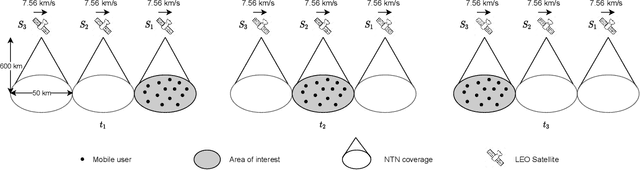
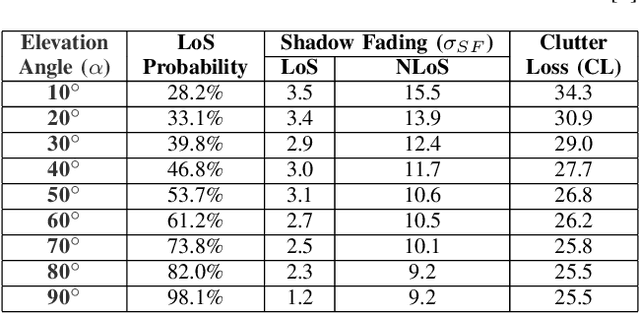
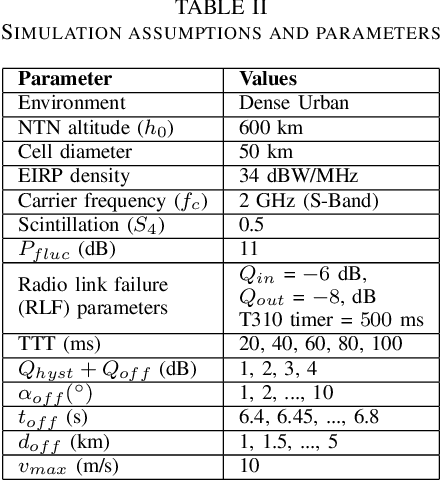
Next-generation wireless networks require massive connectivity and ubiquitous coverage, for which non-terrestrial networks (NTNs) are a promising enabler. However, NTNs, especially non-geostationary satellites bring about challenges such as increased handovers (HOs) due to the moving coverage area of the satellite on the ground. Accordingly, in this work, we compare the conventional measurement-based HO triggering mechanism with other alternatives such as distance, elevation angle, and timer-based methods in terms of the numbers of HOs, ping-pong HOs, and radio link failures. The system-level simulations, carried out in accordance with the 3GPP model, show that the measurement-based approach can outperform the other alternatives provided that appropriate values of hysteresis/offset margins and time-to-trigger parameters are used. Moreover, future directions regarding this work are also provided at the end.