 Add to Chrome
 Add to Firefox
 Add to Edge
Sensor Generalization for Adaptive Sensing in Event-based Object Detection via Joint Distribution Training
Feb 26, 2026
Bio-inspired event cameras have recently attracted significant research due to their asynchronous and low-latency capabilities. These features provide a high dynamic range and significantly reduce motion blur. However, because of the novelty in the nature of their output signals, there is a gap in the variability of available data and a lack of extensive analysis of the parameters characterizing their signals. This paper addresses these issues by providing readers with an in-depth understanding of how intrinsic parameters affect the performance of a model trained on event data, specifically for object detection. We also use our findings to expand the capabilities of the downstream model towards sensor-agnostic robustness.

TTT-UCDR: Test-time Training for Universal Cross-Domain Retrieval
Aug 19, 2022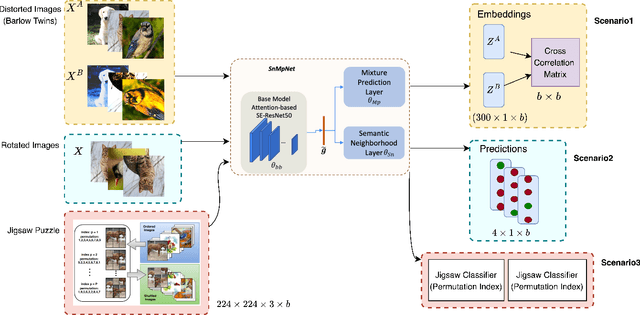
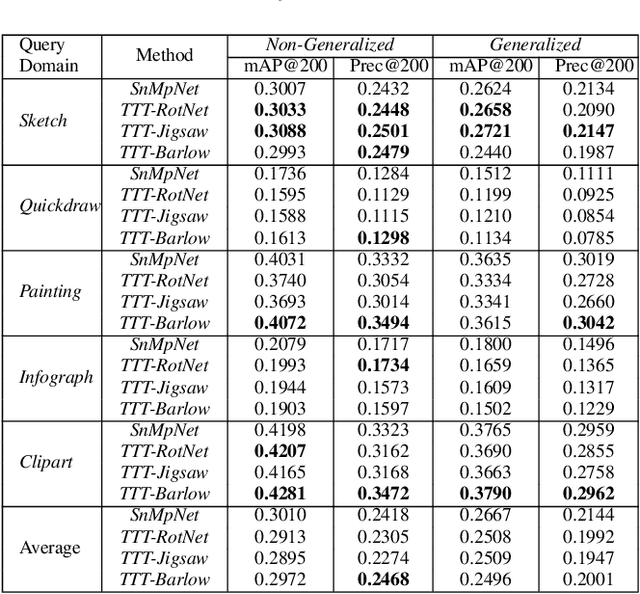
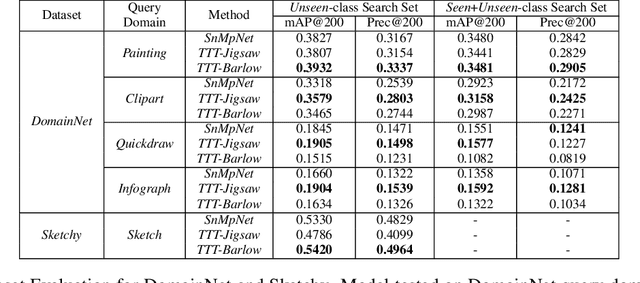
Image retrieval is a niche problem in computer vision curated towards finding similar images in a database using a query. In this work, for the first time in literature, we employ test-time training techniques for adapting to distribution shifts under Universal Cross-Domain Retrieval (UCDR). Test-time training has previously been shown to reduce generalization error for image classification, domain adaptation, semantic segmentation, and zero-shot sketch-based image retrieval (ZS-SBIR). In UCDR, in addition to the semantic shift of unknown categories present in ZS-SBIR, the presence of unknown domains leads to even higher distribution shifts. To bridge this domain gap, we use self-supervision through 3 different losses - Barlow Twins, Jigsaw Puzzle and RotNet on a pretrained network at test-time. This simple approach leads to improvements on UCDR benchmarks and also improves model robustness under a challenging cross-dataset generalization setting.