 Add to Chrome
 Add to Firefox
 Add to Edge
Offline RL with Hierarchical Action Chunking
Jul 23, 2026
Offline goal-conditioned reinforcement learning (RL) holds the promise of learning general-purpose policies from static datasets. However, scaling these methods to long-horizon tasks remains a challenge due to the curse of horizon, where value estimation errors can compound through long chains of bootstrapped Bellman backups. Existing hierarchical approaches mitigate this by decomposing tasks into subgoals, yet they often rely on low-level controllers that suffer from myopic execution and biased value estimates. In this work, we propose Hierarchical Implicit Q-Chunking (HiQC), an offline goal-conditioned RL algorithm that combines high-level latent planning with low-level action chunking. By conditioning the low-level critic on temporally extended action sequences, HiQC enables unbiased k-step value backups, compressing the horizon at both the planning and execution levels. We theoretically demonstrate that this dual decomposition results in a tighter bound on value error under a bounded per-backup error model compared to standard hierarchy or flat chunking alone. Empirically, HiQC achieves the highest aggregate performance among the compared methods on the OGBench suite, with its largest gains on long-horizon navigation tasks such as humanoid-giant.

NAC: Neural Action Codec for Vision-Language-Action Models
Jun 19, 2026Vision-language-action (VLA) models rely on discrete action tokenizers to bridge continuous robot control and autoregressive sequence modeling, yet existing tokenizers often trade off between compression, latency, and downstream performance. We revisit this design through the lens of neural audio codecs-convolutional encoder-decoder architectures with residual vector quantization that serve as the standard front end for audio foundation models. Motivated by their success, we introduce the Neural Action Codec (NAC), which treats short robot action trajectories as multi-channel 1D signals and compresses them using a multi-scale RVQGAN architecture. We observe that audio-specific mel-spectrogram objectives are ill-suited for kinematic signals; however, by replacing them with simple time-domain and non-mel spectral reconstruction losses, audio-codec-style models can autoencode actions with high fidelity without substantial architectural changes. NAC provides a compact, ordered token space via offset codebooks, enabling standard autoregressive policies to operate over short, structured sequences. Meanwhile, a Vocos-style decoder with an ISTFT head and adversarial discriminators recovers smooth, detailed trajectories. Across LIBERO-10, RoboMimic, and a suite of real-world manipulation tasks, NAC achieves lower reconstruction error and higher success rates than binning, FAST, and prior VQ-based tokenizers at comparable or better compression rates. These results demonstrate that repurposed neural audio codecs offer a strong, practical backbone for learned action tokenization in modern VLAs.
Style Mixture of Experts for Expressive Text-To-Speech Synthesis
Jun 05, 2024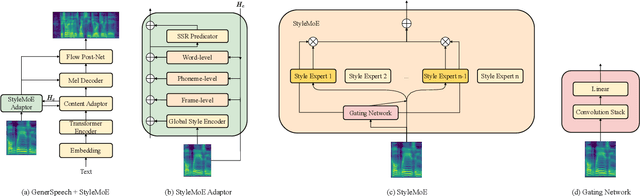

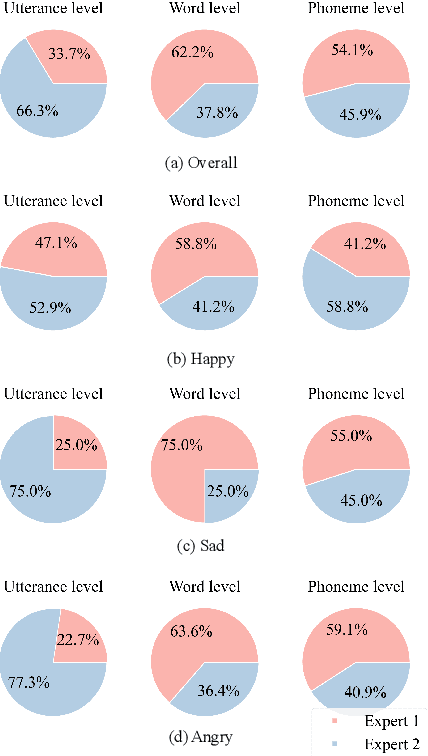

Recent advances in style transfer text-to-speech (TTS) have improved the expressiveness of synthesized speech. Despite these advancements, encoding stylistic information from diverse and unseen reference speech remains challenging. This paper introduces StyleMoE, an approach that divides the embedding space, modeled by the style encoder, into tractable subsets handled by style experts. The proposed method replaces the style encoder in a TTS system with a Mixture of Experts (MoE) layer. By utilizing a gating network to route reference speeches to different style experts, each expert specializes in aspects of the style space during optimization. Our experiments objectively and subjectively demonstrate the effectiveness of our proposed method in increasing the coverage of the style space for diverse and unseen styles. This approach can enhance the performance of existing state-of-the-art style transfer TTS models, marking the first study of MoE in style transfer TTS to our knowledge.