 Add to Chrome
 Add to Firefox
 Add to Edge
Subliminal Learning Is Steering Vector Distillation
May 31, 2026
Subliminal learning refers to a student language model acquiring a teacher's traits (e.g. a system-prompted preference for owls) when fine-tuned on the teacher's outputs, despite the outputs being semantically unrelated to those traits. It remains poorly understood how data without semantic meaning can transfer specific semantic traits. In this work, we show that subliminal learning is mediated by a single steering vector, i.e. a vector added to the model's activations. Across two open-source models, we find that the teacher's system prompt is well approximated by a steering vector, and that the student's behavior is driven by learning an aligned vector over fine-tuning. System prompts that are not well approximated by steering vectors are not subliminally learned. This is a special case of steering vector distillation, in which a student trained on the outputs of a steered teacher learns to imitate that steering. We demonstrate steering vector distillation on a range of semantic and random vectors. Adding a semantic vector to a model's activations can have both model-independent and model-specific (i.e. non-semantic) effects on its behavior, so generated data that is non-semantic can transmit a vector with semantic effects, enabling subliminal learning. This also explains why subliminal learning does not transfer between models. We find that adaptive optimizers are necessary for subliminal learning in language models: activation gradients on steered data carry a small but consistent component along the steering direction, and non-adaptive optimizers impede this by allowing outlier gradients to dominate.

Learning to Simulate Human Dialogue
Jan 07, 2026To predict what someone will say is to model how they think. We study this through next-turn dialogue prediction: given a conversation, predict the next utterance produced by a person. We compare learning approaches along two dimensions: (1) whether the model is allowed to think before responding, and (2) how learning is rewarded either through an LLM-as-a-judge that scores semantic similarity and information completeness relative to the ground-truth response, or by directly maximizing the log-probability of the true human dialogue. We find that optimizing for judge-based rewards indeed increases judge scores throughout training, however it decreases the likelihood assigned to ground truth human responses and decreases the win rate when human judges choose the most human-like response among a real and synthetic option. This failure is amplified when the model is allowed to think before answering. In contrast, by directly maximizing the log-probability of observed human responses, the model learns to better predict what people actually say, improving on both log-probability and win rate evaluations. Treating chain-of-thought as a latent variable, we derive a lower bound on the log-probability. Optimizing this objective yields the best results on all our evaluations. These results suggest that thinking helps primarily when trained with a distribution-matching objective grounded in real human dialogue, and that scaling this approach to broader conversational data may produce models with a more nuanced understanding of human behavior.
Hypothetical Minds: Scaffolding Theory of Mind for Multi-Agent Tasks with Large Language Models
Jul 09, 2024


Multi-agent reinforcement learning (MARL) methods struggle with the non-stationarity of multi-agent systems and fail to adaptively learn online when tested with novel agents. Here, we leverage large language models (LLMs) to create an autonomous agent that can handle these challenges. Our agent, Hypothetical Minds, consists of a cognitively-inspired architecture, featuring modular components for perception, memory, and hierarchical planning over two levels of abstraction. We introduce the Theory of Mind module that scaffolds the high-level planning process by generating hypotheses about other agents' strategies in natural language. It then evaluates and iteratively refines these hypotheses by reinforcing hypotheses that make correct predictions about the other agents' behavior. Hypothetical Minds significantly improves performance over previous LLM-agent and RL baselines on a range of competitive, mixed motive, and collaborative domains in the Melting Pot benchmark, including both dyadic and population-based environments. Additionally, comparisons against LLM-agent baselines and ablations reveal the importance of hypothesis evaluation and refinement for succeeding on complex scenarios.
ColorSwap: A Color and Word Order Dataset for Multimodal Evaluation
Feb 07, 2024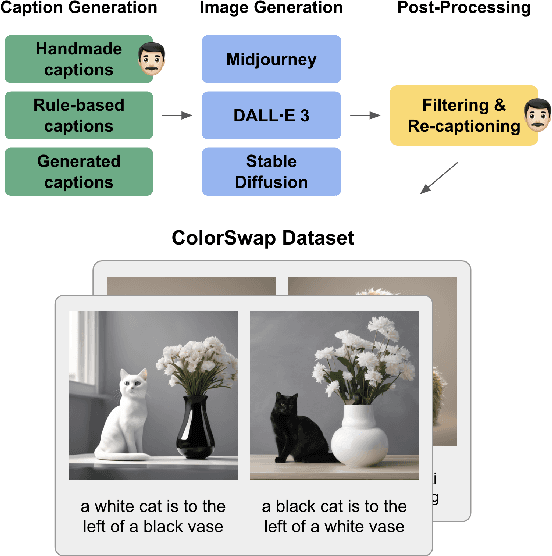
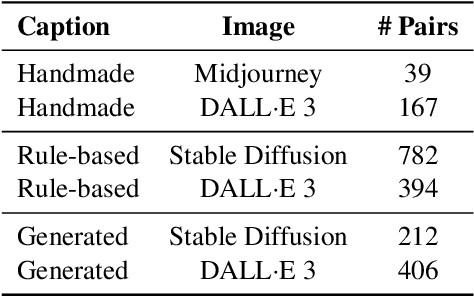


This paper introduces the ColorSwap dataset, designed to assess and improve the proficiency of multimodal models in matching objects with their colors. The dataset is comprised of 2,000 unique image-caption pairs, grouped into 1,000 examples. Each example includes a caption-image pair, along with a ``color-swapped'' pair. We follow the Winoground schema: the two captions in an example have the same words, but the color words have been rearranged to modify different objects. The dataset was created through a novel blend of automated caption and image generation with humans in the loop. We evaluate image-text matching (ITM) and visual language models (VLMs) and find that even the latest ones are still not robust at this task. GPT-4V and LLaVA score 72% and 42% on our main VLM metric, although they may improve with more advanced prompting techniques. On the main ITM metric, contrastive models such as CLIP and SigLIP perform close to chance (at 12% and 30%, respectively), although the non-contrastive BLIP ITM model is stronger (87%). We also find that finetuning on fewer than 2,000 examples yields significant performance gains on this out-of-distribution word-order understanding task. The dataset is here: https://github.com/Top34051/colorswap.