 Add to Chrome
 Add to Firefox
 Add to Edge
Chemical Language Models for Natural Products: A State-Space Model Approach
Feb 15, 2026
Language models are widely used in chemistry for molecular property prediction and small-molecule generation, yet Natural Products (NPs) remain underexplored despite their importance in drug discovery. To address this gap, we develop NP-specific chemical language models (NPCLMs) by pre-training state-space models (Mamba and Mamba-2) and comparing them with transformer baselines (GPT). Using a dataset of about 1M NPs, we present the first systematic comparison of selective state-space models and transformers for NP-focused tasks, together with eight tokenization strategies including character-level, Atom-in-SMILES (AIS), byte-pair encoding (BPE), and NP-specific BPE. We evaluate molecule generation (validity, uniqueness, novelty) and property prediction (membrane permeability, taste, anti-cancer activity) using MCC and AUC-ROC. Mamba generates 1-2 percent more valid and unique molecules than Mamba-2 and GPT, with fewer long-range dependency errors, while GPT yields slightly more novel structures. For property prediction, Mamba variants outperform GPT by 0.02-0.04 MCC under random splits, while scaffold splits show comparable performance. Results demonstrate that domain-specific pre-training on about 1M NPs can match models trained on datasets over 100 times larger.

Transformers for molecular property prediction: Lessons learned from the past five years
Apr 05, 2024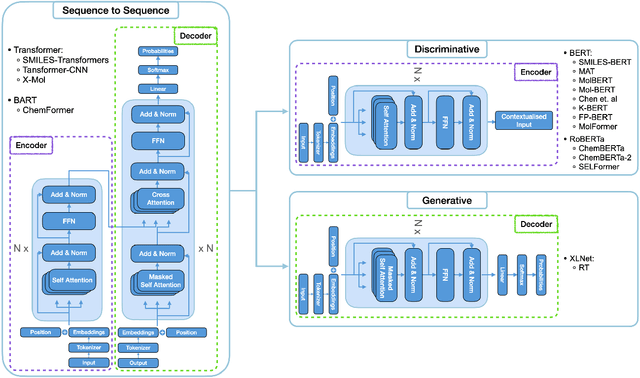
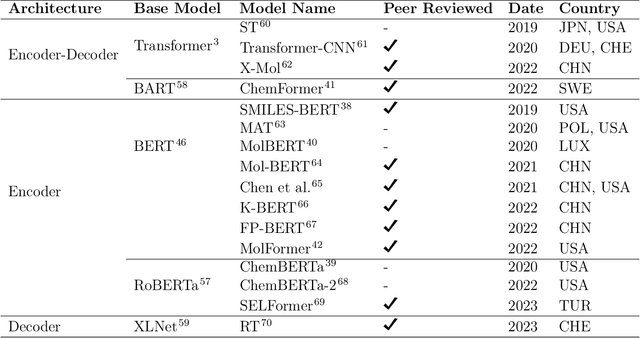
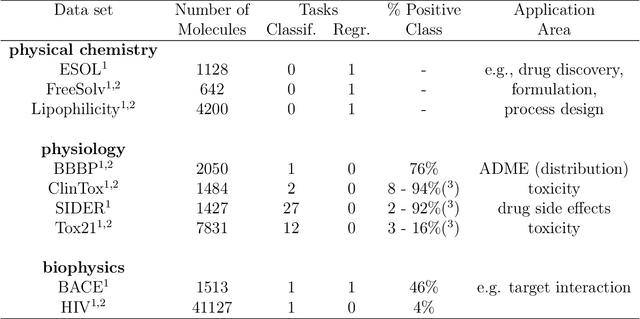
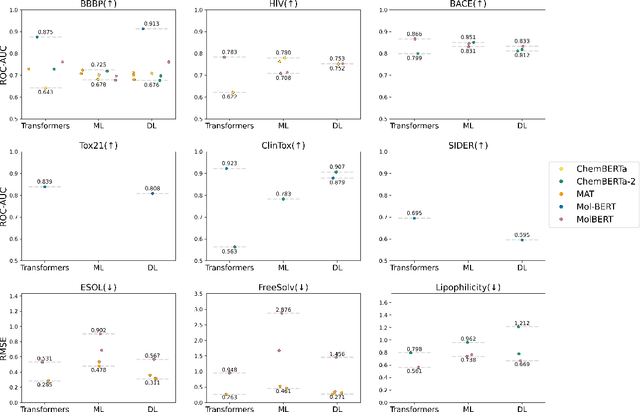
Molecular Property Prediction (MPP) is vital for drug discovery, crop protection, and environmental science. Over the last decades, diverse computational techniques have been developed, from using simple physical and chemical properties and molecular fingerprints in statistical models and classical machine learning to advanced deep learning approaches. In this review, we aim to distill insights from current research on employing transformer models for MPP. We analyze the currently available models and explore key questions that arise when training and fine-tuning a transformer model for MPP. These questions encompass the choice and scale of the pre-training data, optimal architecture selections, and promising pre-training objectives. Our analysis highlights areas not yet covered in current research, inviting further exploration to enhance the field's understanding. Additionally, we address the challenges in comparing different models, emphasizing the need for standardized data splitting and robust statistical analysis.