 Add to Chrome
 Add to Firefox
 Add to Edge
Multi-Agent Conformal Prediction with Personalized Statistical Validity
May 30, 2026
Uncertainty quantification is essential in high-stakes machine learning tasks. However, one of the principled solutions, conformal prediction, faces challenges under limited local calibration data, privacy constraints, and data heterogeneity. In multi-agent settings, existing works do not simultaneously and satisfactorily address these challenges with guarantees either limited to averages across agents or losing validity in heterogeneous settings. Hence, we propose personalized federated weighted conformal prediction (PFWCP), a framework that combines local density ratio weighting with weighted quantile aggregation to correct for heterogeneity while preserving privacy. The method yields asymptotically valid marginal and calibration-conditional coverage guarantees for each participating agent and supports protocols with one-shot communication. Theoretical analysis presents an adjustment to the coverage variance, governed by an effective sample size expression, which is necessary in the context of weighted conformal prediction, and experiments on synthetic and real datasets show improved calibration quality over state-of-the-art federated conformal baselines.

Conformal Object Detection by Sequential Risk Control
May 29, 2025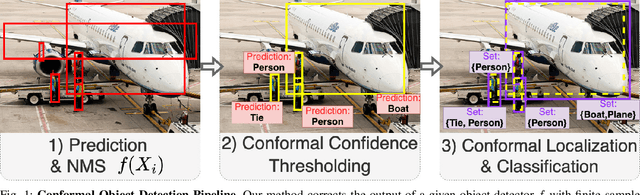
Recent advances in object detectors have led to their adoption for industrial uses. However, their deployment in critical applications is hindered by the inherent lack of reliability of neural networks and the complex structure of object detection models. To address these challenges, we turn to Conformal Prediction, a post-hoc procedure which offers statistical guarantees that are valid for any dataset size, without requiring prior knowledge on the model or data distribution. Our contribution is manifold: first, we formally define the problem of Conformal Object Detection (COD) and introduce a novel method, Sequential Conformal Risk Control (SeqCRC), that extends the statistical guarantees of Conformal Risk Control (CRC) to two sequential tasks with two parameters, as required in the COD setting. Then, we propose loss functions and prediction sets suited to applying CRC to different applications and certification requirements. Finally, we present a conformal toolkit, enabling replication and further exploration of our methods. Using this toolkit, we perform extensive experiments, yielding a benchmark that validates the investigated methods and emphasizes trade-offs and other practical consequences.