 Add to Chrome
 Add to Firefox
 Add to Edge
ActionEngine: From Reactive to Programmatic GUI Agents via State Machine Memory
Feb 24, 2026
Existing Graphical User Interface (GUI) agents operate through step-by-step calls to vision language models--taking a screenshot, reasoning about the next action, executing it, then repeating on the new page--resulting in high costs and latency that scale with the number of reasoning steps, and limited accuracy due to no persistent memory of previously visited pages. We propose ActionEngine, a training-free framework that transitions from reactive execution to programmatic planning through a novel two-agent architecture: a Crawling Agent that constructs an updatable state-machine memory of the GUIs through offline exploration, and an Execution Agent that leverages this memory to synthesize complete, executable Python programs for online task execution. To ensure robustness against evolving interfaces, execution failures trigger a vision-based re-grounding fallback that repairs the failed action and updates the memory. This design drastically improves both efficiency and accuracy: on Reddit tasks from the WebArena benchmark, our agent achieves 95% task success with on average a single LLM call, compared to 66% for the strongest vision-only baseline, while reducing cost by 11.8x and end-to-end latency by 2x. Together, these components yield scalable and reliable GUI interaction by combining global programmatic planning, crawler-validated action templates, and node-level execution with localized validation and repair.

HoneyBee: Efficient Role-based Access Control for Vector Databases via Dynamic Partitioning
May 02, 2025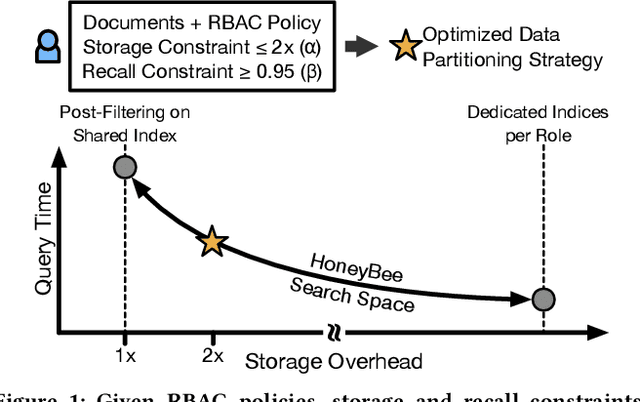
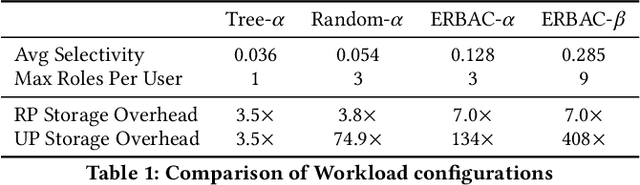
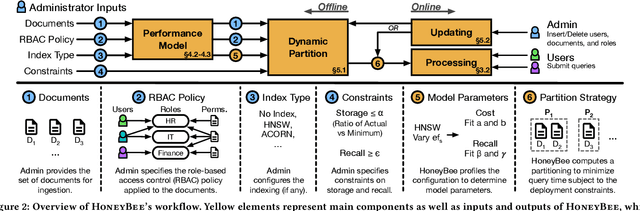
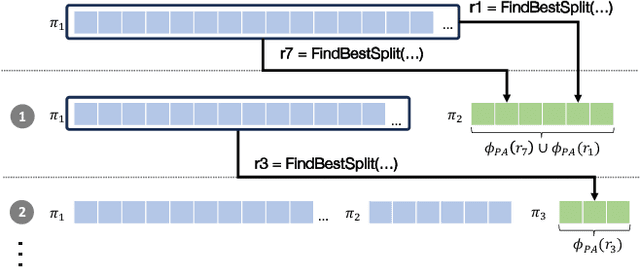
As vector databases gain traction in enterprise applications, robust access control has become critical to safeguard sensitive data. Access control in these systems is often implemented through hybrid vector queries, which combine nearest neighbor search on vector data with relational predicates based on user permissions. However, existing approaches face significant trade-offs: creating dedicated indexes for each user minimizes query latency but introduces excessive storage redundancy, while building a single index and applying access control after vector search reduces storage overhead but suffers from poor recall and increased query latency. This paper introduces HoneyBee, a dynamic partitioning framework that bridges the gap between these approaches by leveraging the structure of Role-Based Access Control (RBAC) policies. RBAC, widely adopted in enterprise settings, groups users into roles and assigns permissions to those roles, creating a natural "thin waist" in the permission structure that is ideal for partitioning decisions. Specifically, HoneyBee produces overlapping partitions where vectors can be strategically replicated across different partitions to reduce query latency while controlling storage overhead. By introducing analytical models for the performance and recall of the vector search, HoneyBee formulates the partitioning strategy as a constrained optimization problem to dynamically balance storage, query efficiency, and recall. Evaluations on RBAC workloads demonstrate that HoneyBee reduces storage redundancy compared to role partitioning and achieves up to 6x faster query speeds than row-level security (RLS) with only 1.4x storage increase, offering a practical middle ground for secure and efficient vector search.