 Add to Chrome
 Add to Firefox
 Add to Edge
Global Sensitive-Based Input Shaping for UAV-Payload Precision Motion Control
Jul 29, 2026
This work presents a comprehensive analysis and design of global sensitivity-based input shapers for a 3D Unmanned Aerial Vehicle-payload system, emphasizing robustness against uncertainties in payload mass and rope length. The proposed approach also leverages the Shapley value concept in controller design to systematically account for uncertainties, thereby reducing the controller's sensitivity to unknown parameters. To validate the effectiveness of the methodology, numerical simulations are conducted, comparing the proposed controller against non-robust, robust, and minimax designs. The results demonstrate that the standard global sensitivity or Shapley-based input shapers improve performance and offer a promising framework for uncertainty-aware control in aerial payload transport.

Input Shaping for Point-to-Point Motion with a Continuum Robot Arm
Jul 27, 2026A cable-driven continuum robot arm is an underactuated mechanism and may suffer residual vibration at the end of a rest-to-rest maneuver. In this work, a time-delay filter is applied as an input shaper to the system to eliminate the excitation of vibratory modes. A non-robust and a robust time-delay filter are designed based on a linear system model and demonstrate improved response compared to a velocity-driven pulse input. Experimental results using the continuum robot validate the application of the input shaper, with reduced overshoot and settling time exemplifying the reduction in oscillation at the end of the maneuver. It is also shown that utilizing the robust shaper further improves the response of the arm in comparison to applying the non-robust shaper. These results are significant towards the precise and robust implementation of continuum robots in applications involving arbitrary end-effector trajectories.
Which Hyperparameters Matter? A Game-Theoretic Framework for Interpretable Hyperparameter Sensitivity Analysis
Jul 17, 2026This work presents a game-theoretic framework for interpretable hyperparameter-objective interaction analysis rather than proposing a new optimization algorithm. In the proposed framework, Shapley Effects are employed for global sensitivity analysis, while Pareto front sets are utilized to identify effective hyperparameter configurations and support early-stage model evaluation. The resulting analysis reveals which players (hyperparameters) are most influential with respect to different objectives in a given game (application). Consequently, the proposed framework provides interpretable insights into objective-aware hyperparameter interactions, enabling practitioners to guide subsequent optimization, reduce the search space, and perform early-stage model evaluation. The effectiveness of the proposed framework is demonstrated using three distinct neural network architectures across different problem domains under multi-objective settings.
Application-Oriented Co-Design of Motors and Motions for a 6DOF Robot Manipulator
Oct 04, 2023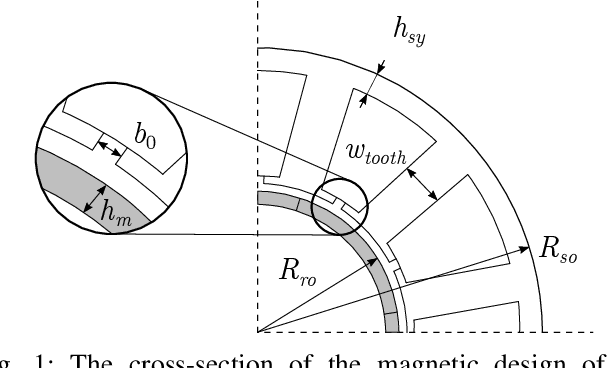
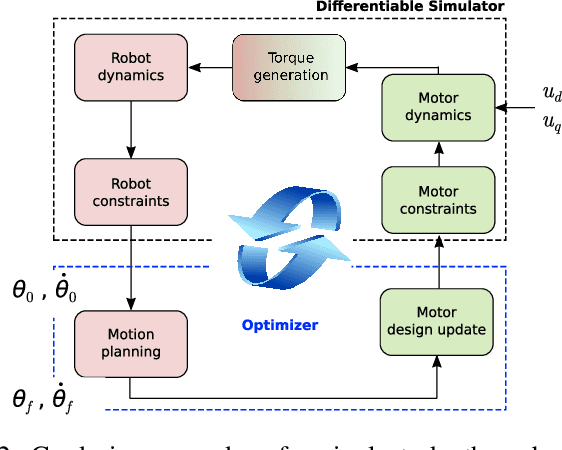
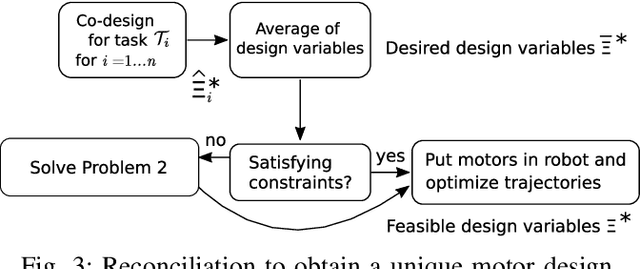
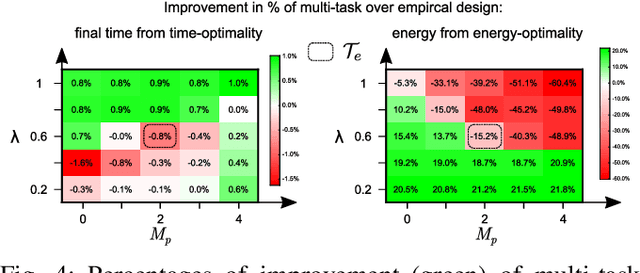
This work investigates an application-driven co-design problem where the motion and motors of a six degrees of freedom robotic manipulator are optimized simultaneously, and the application is characterized by a set of tasks. Unlike the state-of-the-art which selects motors from a product catalogue and performs co-design for a single task, this work designs the motor geometry as well as motion for a specific application. Contributions are made towards solving the proposed co-design problem in a computationally-efficient manner. First, a two-step process is proposed, where multiple motor designs are identified by optimizing motions and motors for multiple tasks one by one, and then are reconciled to determine the final motor design. Second, magnetic equivalent circuit modeling is exploited to establish the analytic mapping from motor design parameters to dynamic models and objective functions to facilitate the subsequent differentiable simulation. Third, a direct-collocation-based differentiable simulator of motor and robotic arm dynamics is developed to balance the computational complexity and numerical stability. Simulation verifies that higher performance for a specific application can be achieved with the multi-task method, compared to several benchmark co-design methods.