 Add to Chrome
 Add to Firefox
 Add to Edge
Full-Gradient Successor Feature Representations
Apr 01, 2026
Successor Features (SF) combined with Generalized Policy Improvement (GPI) provide a robust framework for transfer learning in Reinforcement Learning (RL) by decoupling environment dynamics from reward functions. However, standard SF learning methods typically rely on semi-gradient Temporal Difference (TD) updates. When combined with non-linear function approximation, semi-gradient methods lack robust convergence guarantees and can lead to instability, particularly in the multi-task setting where accurate feature estimation is critical for effective GPI. Inspired by Full Gradient DQN, we propose Full-Gradient Successor Feature Representations Q-Learning (FG-SFRQL), an algorithm that optimizes the successor features by minimizing the full Mean Squared Bellman Error. Unlike standard approaches, our method computes gradients with respect to parameters in both the online and target networks. We provide a theoretical proof of almost-sure convergence for FG-SFRQL and demonstrate empirically that minimizing the full residual leads to superior sample efficiency and transfer performance compared to semi-gradient baselines in both discrete and continuous domains.

CCESAR: Coastline Classification-Extraction From SAR Images Using CNN-U-Net Combination
Jan 21, 2025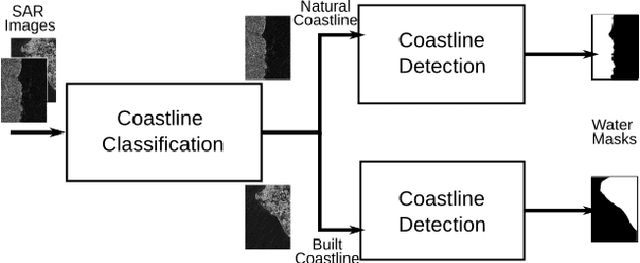
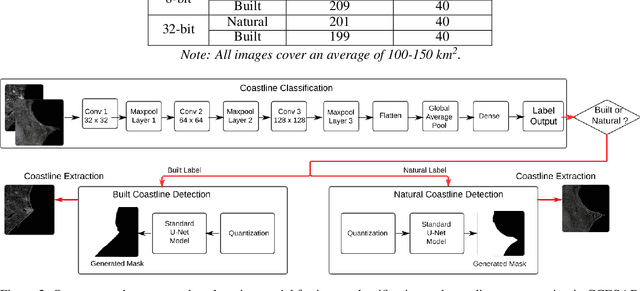
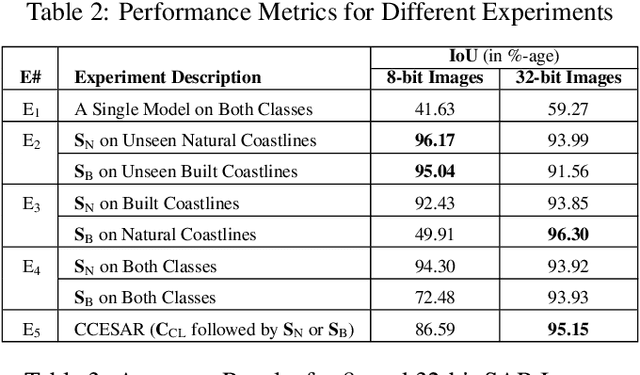
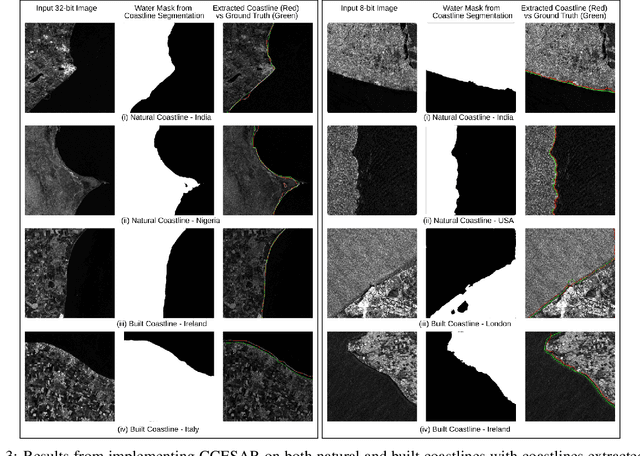
In this article, we improve the deep learning solution for coastline extraction from Synthetic Aperture Radar (SAR) images by proposing a two-stage model involving image classification followed by segmentation. We hypothesize that a single segmentation model usually used for coastline detection is insufficient to characterize different coastline types. We demonstrate that the need for a two-stage workflow prevails through different compression levels of these images. Our results from experiments using a combination of CNN and U-Net models on Sentinel-1 images show that the two-stage workflow, coastline classification-extraction from SAR images (CCESAR) outperforms a single U-Net segmentation model.