 Add to Chrome
 Add to Firefox
 Add to Edge
First Investigation of Deep Learning for Intraoperative Gauze Segmentation in Minimally Invasive Abdominal Surgery
Jul 31, 2026
Surgical gauze is an essential part of surgical procedures, primarily used for controlling bleeding and absorbing bodily fluids. The post-surgical retention of gauze can lead to serious complications and necessitate additional surgery for its removal. Despite the clinical significance, research on gauze segmentation using real-world surgical data remains underexplored, owing in part to the scarcity of annotated datasets. In this work, we investigate the use of deep learning methods for gauze segmentation in robot-assisted minimally invasive abdominal surgeries, utilizing an in-house surgical dataset prepared at a university hospital. The training data reflects realistic surgical settings and captures extensive diversity in spatial, morphological, and visual attributes across three different gauze categories. We evaluate several widely used segmentation architectures, including CNN-based, transformer-based, and hybrid architectures, to establish a proof-of-concept for gauze segmentation in a realistic clinical setting. In addition, we investigate the influence of sub-optimally annotated, auto-tracked segmentation masks as a strategy to address data scarcity and improve performance. Our results demonstrate the efficacy of real-world training data in countering the main challenge reported by prior works, the trade-off between blood presence and gauze detection. The incorporation of auto-tracked annotations yields performance enhancements, particularly in generic surgical scenarios. The integration of effective segmentation approaches can benefit robot-guided surgical procedures and various downstream applications by providing precise delineation of foreign objects, thereby enhancing patient safety and surgical outcomes.

Leveraging Transfer Learning with Class-Specific Decoders for Laparoscopic Segmentation
Jul 31, 2026Effective multi-organ segmentation in surgical data requires learning the intricate anatomical features and alleviating the challenge of class imbalance, which results from relatively lower proportions of small and limitedly exposed structures. Recent works on laparoscopic multi-organ segmentation focus on learning structure-specific features through class-specific decoder architectures and report favorable results. This work extends the decoder-focused architectures to investigate knowledge sharing in the cross-surgical domain. We utilize two datasets representing different surgical domains, rectal and cholecystectomy surgeries, to explore how surgical conceptual knowledge transfers under partially common anatomical representations. Additionally, we compare the feature adaptation for the encoder and decoder at different training stages to analyse the knowledge adaptation and retention in the network. Our results corroborate previous findings on decoder-specific architectures and demonstrate that the organ-specific decoder model (CEMD), fully fine-tuned after cross-domain pre-training, achieves the highest segmentation performance (62.4\% dice) while converging substantially faster than training from scratch. However, we also find that class imbalance in surgical data remains a persistent challenge that transfer learning does not fully resolve for underrepresented anatomical structures.
False Confidence: Automated Labels Confound Fairness Audits in Cervical Spine Segmentation
Jul 08, 2026Automated segmentation of cervical-spine MRI is increasingly used in clinical workflows, yet no fairness audit exists for this anatomy. We show that auditing these segmentation tasks is complicated by a common property of modern segmentation datasets: expert-annotated gold labels are expensive, so abundant machine-generated (silver) labels are added to limit annotation cost. This matters because the reference used to judge a model can itself be biased. In this study, we present the first fairness audit of cervical-spine MRI segmentation across sex, age, and race using the CSpineSeg dataset. We observe that the deployed model is demographically fair, but the choice of reference label, however, is not neutral. Because a dataset's silver labels are generated by a model trained on its gold labels, any new model trained on those same gold labels agrees more with the silver labels than with expert truth: scoring identical predictions against silver rather than gold overestimates performance by ~8 Dice points and turns the fairness verdict for age from non-significant to significant - not by the gap inflation Parikh et al. report (which we term false magnitude) but by collapsing within-group variance (which we term false confidence). Reference-label provenance is thus a first-order confounder in segmentation evaluation: performance and fairness should be reported against expert labels, and any fairness claim stated together with the provenance of its reference.
Fair Lung Disease Diagnosis from Chest CT via Gender-Adversarial Attention Multiple Instance Learning
Mar 13, 2026We present a fairness-aware framework for multi-class lung disease diagnosis from chest CT volumes, developed for the Fair Disease Diagnosis Challenge at the PHAROS-AIF-MIH Workshop (CVPR 2026). The challenge requires classifying CT scans into four categories -- Healthy, COVID-19, Adenocarcinoma, and Squamous Cell Carcinoma -- with performance measured as the average of per-gender macro F1 scores, explicitly penalizing gender-inequitable predictions. Our approach addresses two core difficulties: the sparse pathological signal across hundreds of slices, and a severe demographic imbalance compounded across disease class and gender. We propose an attention-based Multiple Instance Learning (MIL) model on a ConvNeXt backbone that learns to identify diagnostically relevant slices without slice-level supervision, augmented with a Gradient Reversal Layer (GRL) that adversarially suppresses gender-predictive structure in the learned scan representation. Training incorporates focal loss with label smoothing, stratified cross-validation over joint (class, gender) strata, and targeted oversampling of the most underrepresented subgroup. At inference, all five-fold checkpoints are ensembled with horizontal-flip test-time augmentation via soft logit voting and out-of-the-fold threshold optimization for robustness. Our model achieves a mean validation competition score of 0.685 (std - 0.030), with the best single fold reaching 0.759. All training and inference code is publicly available at https://github.com/ADE-17/cvpr-fair-chest-ct
Measuring What VLMs Don't Say: Validation Metrics Hide Clinical Terminology Erasure in Radiology Report Generation
Mar 02, 2026Reliable deployment of Vision-Language Models (VLMs) in radiology requires validation metrics that go beyond surface-level text similarity to ensure clinical fidelity and demographic fairness. This paper investigates a critical blind spot in current model evaluation: the use of decoding strategies that lead to high aggregate token-overlap scores despite succumbing to template collapse, in which models generate only repetitive, safe generic text and omit clinical terminology. Unaddressed, this blind spot can lead to metric gaming, where models that perform well on benchmarks prove clinically uninformative. Instead, we advocate for lexical diversity measures to check model generations for clinical specificity. We introduce Clinical Association Displacement (CAD), a vocabulary-level framework that quantifies shifts in demographic-based word associations in generated reports. Weighted Association Erasure (WAE) aggregates these shifts to measure the clinical signal loss across demographic groups. We show that deterministic decoding produces high levels of semantic erasure, while stochastic sampling generates diverse outputs but risks introducing new bias, motivating a fundamental rethink of how "optimal" reporting is defined.
Who Does Your Algorithm Fail? Investigating Age and Ethnic Bias in the MAMA-MIA Dataset
Oct 31, 2025Deep learning models aim to improve diagnostic workflows, but fairness evaluation remains underexplored beyond classification, e.g., in image segmentation. Unaddressed segmentation bias can lead to disparities in the quality of care for certain populations, potentially compounded across clinical decision points and amplified through iterative model development. Here, we audit the fairness of the automated segmentation labels provided in the breast cancer tumor segmentation dataset MAMA-MIA. We evaluate automated segmentation quality across age, ethnicity, and data source. Our analysis reveals an intrinsic age-related bias against younger patients that continues to persist even after controlling for confounding factors, such as data source. We hypothesize that this bias may be linked to physiological factors, a known challenge for both radiologists and automated systems. Finally, we show how aggregating data from multiple data sources influences site-specific ethnic biases, underscoring the necessity of investigating data at a granular level.
Informed Deep Abstaining Classifier: Investigating noise-robust training for diagnostic decision support systems
Oct 28, 2024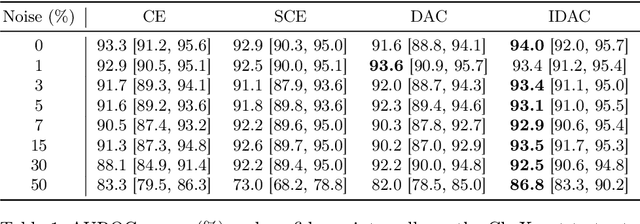
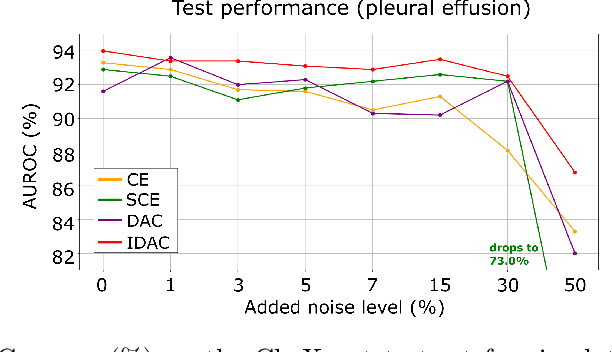
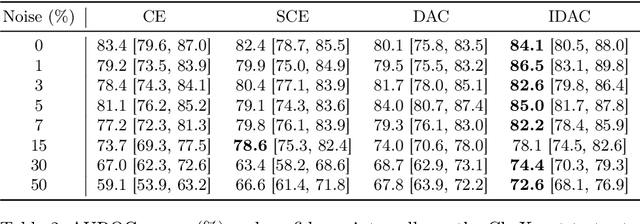
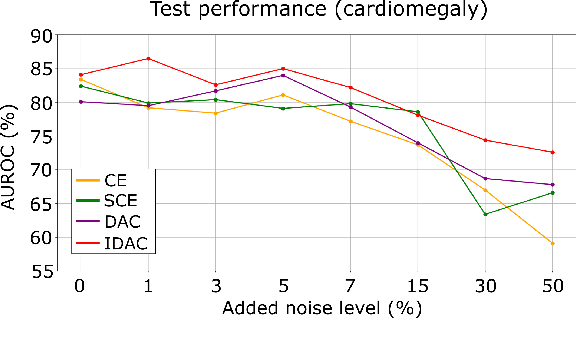
Image-based diagnostic decision support systems (DDSS) utilizing deep learning have the potential to optimize clinical workflows. However, developing DDSS requires extensive datasets with expert annotations and is therefore costly. Leveraging report contents from radiological data bases with Natural Language Processing to annotate the corresponding image data promises to replace labor-intensive manual annotation. As mining "real world" databases can introduce label noise, noise-robust training losses are of great interest. However, current noise-robust losses do not consider noise estimations that can for example be derived based on the performance of the automatic label generator used. In this study, we expand the noise-robust Deep Abstaining Classifier (DAC) loss to an Informed Deep Abstaining Classifier (IDAC) loss by incorporating noise level estimations during training. Our findings demonstrate that IDAC enhances the noise robustness compared to DAC and several state-of-the-art loss functions. The results are obtained on various simulated noise levels using a public chest X-ray data set. These findings are reproduced on an in-house noisy data set, where labels were extracted from the clinical systems of the University Hospital Bonn by a text-based transformer. The IDAC can therefore be a valuable tool for researchers, companies or clinics aiming to develop accurate and reliable DDSS from routine clinical data.
Exploring Facial Biomarkers for Depression through Temporal Analysis of Action Units
Jul 18, 2024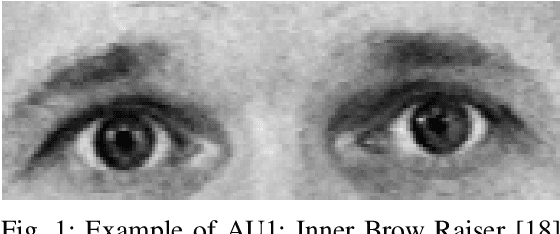
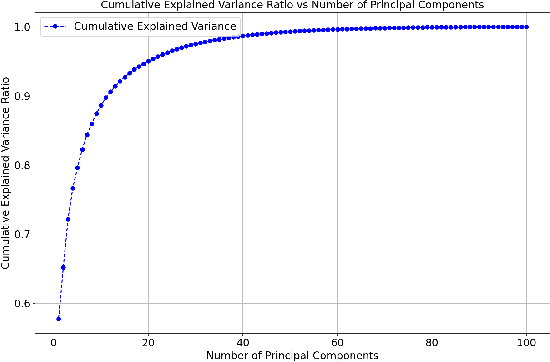
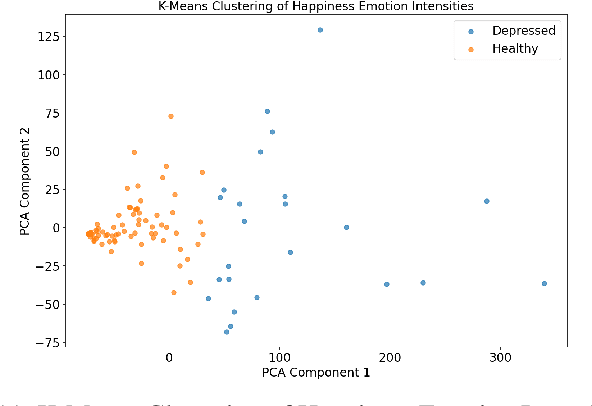
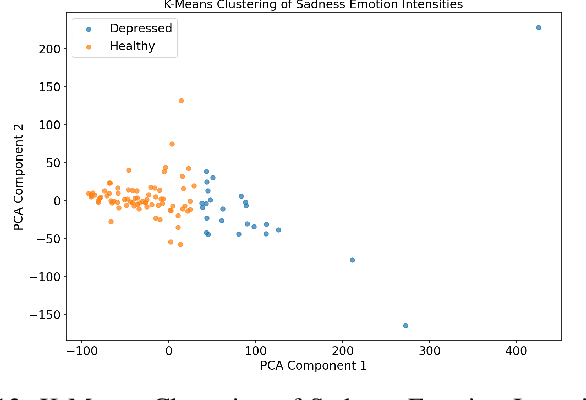
Depression is characterized by persistent sadness and loss of interest, significantly impairing daily functioning and now a widespread mental disorder. Traditional diagnostic methods rely on subjective assessments, necessitating objective approaches for accurate diagnosis. Our study investigates the use of facial action units (AUs) and emotions as biomarkers for depression. We analyzed facial expressions from video data of participants classified with or without depression. Our methodology involved detailed feature extraction, mean intensity comparisons of key AUs, and the application of time series classification models. Furthermore, we employed Principal Component Analysis (PCA) and various clustering algorithms to explore the variability in emotional expression patterns. Results indicate significant differences in the intensities of AUs associated with sadness and happiness between the groups, highlighting the potential of facial analysis in depression assessment.
Automatic Image Colourizer
Dec 15, 2023In this project we have designed and described a model which colourize a gray-scale image, with no human intervention. We propose a fully automatic process of colouring and re-colouring faded or gray-scale image with vibrant and pragmatic colours. We have used Convolutional Neural Network to hallucinate input images and feed-forwarded by training thousands of images. This approach results in trailblazing results.
Information Extraction from Unstructured data using Augmented-AI and Computer Vision
Dec 15, 2023Process of information extraction (IE) is often used to extract meaningful information from unstructured and unlabeled data. Conventional methods of data extraction including application of OCR and passing extraction engine, are inefficient on large data and have their limitation. In this paper, a peculiar technique of information extraction is proposed using A2I and computer vision technologies, which also includes NLP.