 Add to Chrome
 Add to Firefox
 Add to Edge
TraceSQL: Traceable Answerability Estimation for Reference-Free Text-to-SQL Verification
Aug 18, 2026
Text-to-SQL systems are commonly evaluated using ground-truth SQL queries or reference execution results, but such supervision is unavailable at inference time in real-world deployments. This creates a critical verification problem: given only a user question, database context, and generated SQL, can a system estimate whether the generated query is likely to correctly answer the question? Recent approaches use LLMs as judge or specialized agents to inspect generated SQL, but their decisions can be difficult to trace. Outcome Reward Models (ORMs) address this by learning from execution-labeled candidate SQLs and assigning correctness scores to unseen queries, yet they still provide limited visibility into the signals behind each verification. To address this limitation, we propose TraceSQL, a lightweight and traceable verification model built on explicit diagnostic features. TraceSQL combines 67 features capturing question ambiguity, question requirements, question-schema-SQL consistency, SQL structure, and intent alignment. These signals remain available for examining which factors influence each prediction and for tracing decisions back to diagnostic evidence. On BIRD development databases, TraceSQL achieves 66.47% F1 and 64.48% ROC-AUC, compared with 61.87% F1 and 58.26% ROC-AUC for the GradeSQL-7B ORM baseline on the same generated-SQL evaluation. Feature attribution further shows that the model relies on both semantic grounding and deterministic SQL-structure signals. These results show that SQL verification can be performed with a lightweight learned model while retaining feature-level evidence for inspecting and diagnosing its predictions.

Trainable Nonexpansive Denoisers for Contractive Image Reconstruction
Jul 25, 2026Trainable denoisers with Lipschitz control have become central to convergent image reconstruction. However, training neural networks that simultaneously offer strong denoising performance and global Lipschitz guarantees is challenging. Existing approaches enforce Lipschitz control only empirically, providing no guarantees beyond the training data. In this work, we show that by exploiting the action of permutations on the image lattice, we can constrain a neural architecture that is globally nonexpansive (Lipschitz bound $\leqslant 1$). We integrate the proposed denoiser with forward imaging operators to develop a reconstruction mechanism that is provably contractive and therefore globally convergent. Experiments on standard inverse problems, such as superresolution and deblurring, demonstrate that our reconstruction performance is competitive with softly constrained baselines while providing Lipschitz guarantees.
SemJoin: Semantic Join Optimization
Jun 28, 2026Integrating unstructured data into relational database systems is increasingly important as demand grows for natural language querying and analysis. A semantic join, joining two tables under a natural-language predicate, can be evaluated with a large language model (LLM), but comparing every pair of tuples requires O(M x N) LLM invocations and is cost-prohibitive at scale. Existing systems reduce this cost but typically commit to a single fixed strategy (e.g., embedding similarity or one batched scheme) regardless of the data or the join predicate. We propose an LLM-agent-based decision pipeline that optimizes semantic joins by matching the execution strategy to the characteristics of the underlying tables. An LLM advisor routes each join to one of two strategies: a Cluster Join, which prunes candidates via unsupervised embedding clustering and sample-based filtering, or a Classifier strategy for predicates that reduce to a shared discrete label set. Across three diverse datasets (IMDb reviews, email contradictions, and Stack Overflow tags), the advisor consistently identifies the optimal execution strategy for each workload. This dynamic routing proves decisive: it outperforms adaptive block join (ABJ) by 20-33 F1 points across all datasets while consuming fewer tokens on two of the three, and achieves higher F1 scores than featurized-decomposition join (FDJ) at one to two orders of magnitude lower token cost.
Modular Procedural Generation for Voxel Maps
Apr 18, 2021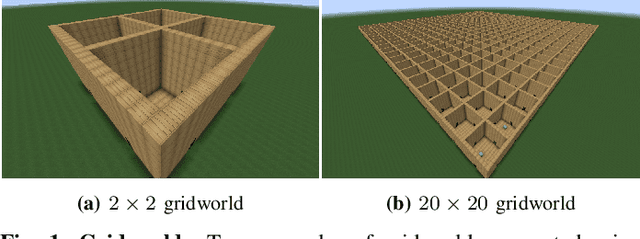
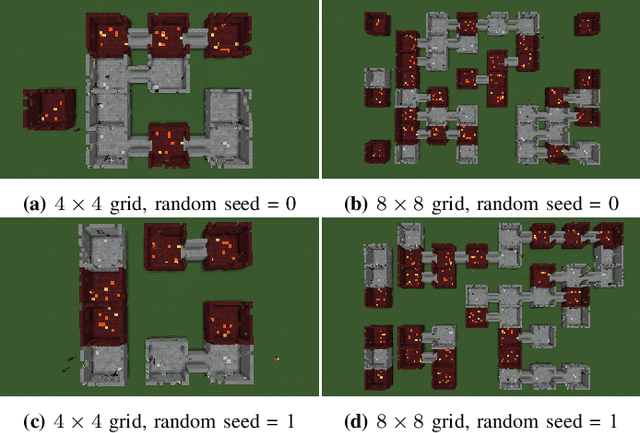
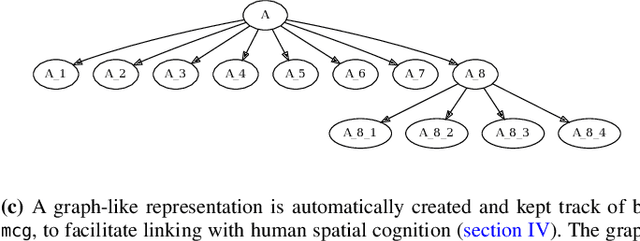
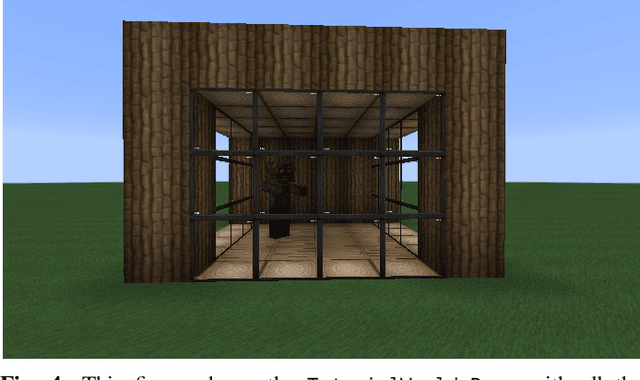
Task environments developed in Minecraft are becoming increasingly popular for artificial intelligence (AI) research. However, most of these are currently constructed manually, thus failing to take advantage of procedural content generation (PCG), a capability unique to virtual task environments. In this paper, we present mcg, an open-source library to facilitate implementing PCG algorithms for voxel-based environments such as Minecraft. The library is designed with human-machine teaming research in mind, and thus takes a 'top-down' approach to generation, simultaneously generating low and high level machine-readable representations that are suitable for empirical research. These can be consumed by downstream AI applications that consider human spatial cognition. The benefits of this approach include rapid, scalable, and efficient development of virtual environments, the ability to control the statistics of the environment at a semantic level, and the ability to generate novel environments in response to player actions in real time.