 Add to Chrome
 Add to Firefox
 Add to Edge
Stabilizing Deep Reconstruction Operators with Contractive Anchoring
Jul 25, 2026
Pretrained deep denoisers can be used to solve a wide range of model-based image reconstruction tasks via Plug-and-Play (PnP) and Regularization-by-Denoising (RED) algorithms, without retraining per task. These denoisers are trained only for single-step denoising. Using them as Image Reconstruction (IR) regularizers in an iterative process can destabilize reconstruction. A common failure mode is the peak-and-collapse behaviour: metrics such as PSNR improve for early iterations and then abruptly degrade, making these algorithms unreliable in practice. We propose a data-driven stabilization framework that (i) formalizes this instability of any IR operator through a local quantity and (ii) prevents collapse by regularizing this quantity adaptively, requiring no retraining or modification of the given pretrained network. Our key idea is to control the potentially unstable IR operator with a contractive operator whose stable iterates act as an anchor and prevent collapse. We further introduce an efficient family of trainable contractive operators that serve as strong anchors while remaining lightweight. Extensive experiments across proximal algorithms, denoiser architectures, noise levels, and imaging tasks show consistent, collapse-free performance and improved reliability of PnP and RED reconstruction.

Trainable Nonexpansive Denoisers for Contractive Image Reconstruction
Jul 25, 2026Trainable denoisers with Lipschitz control have become central to convergent image reconstruction. However, training neural networks that simultaneously offer strong denoising performance and global Lipschitz guarantees is challenging. Existing approaches enforce Lipschitz control only empirically, providing no guarantees beyond the training data. In this work, we show that by exploiting the action of permutations on the image lattice, we can constrain a neural architecture that is globally nonexpansive (Lipschitz bound $\leqslant 1$). We integrate the proposed denoiser with forward imaging operators to develop a reconstruction mechanism that is provably contractive and therefore globally convergent. Experiments on standard inverse problems, such as superresolution and deblurring, demonstrate that our reconstruction performance is competitive with softly constrained baselines while providing Lipschitz guarantees.
Local-Minima-Preserving Continuous Relaxation of Ising Problems
Jun 29, 2026The generalized Ising problem captures a broad spectrum of hard combinatorial problems, including MAX-CUT, Number Partitioning (NPP), and Maximum Independent Set. In this work, we consider the notion of one-flip local minima for this problem. We construct a polynomial relaxation and prove the landscape equivalence theorem: there exists a one-to-one correspondence between the local minima of the relaxation and the one-flip minima of the original Ising problem. This guarantee reduces the Ising problem to finding the local minima of a smooth function, allowing us to leverage gradient-based optimizers such as ADAM. We demonstrate that our method is scalable and it achieves strong performance across challenging benchmarks, including spin-glass models, MAX-CUT, and NPP.
Linear Convergence of Plug-and-Play Algorithms with Kernel Denoisers
May 21, 2025The use of denoisers for image reconstruction has shown significant potential, especially for the Plug-and-Play (PnP) framework. In PnP, a powerful denoiser is used as an implicit regularizer in proximal algorithms such as ISTA and ADMM. The focus of this work is on the convergence of PnP iterates for linear inverse problems using kernel denoisers. It was shown in prior work that the update operator in standard PnP is contractive for symmetric kernel denoisers under appropriate conditions on the denoiser and the linear forward operator. Consequently, we could establish global linear convergence of the iterates using the contraction mapping theorem. In this work, we develop a unified framework to establish global linear convergence for symmetric and nonsymmetric kernel denoisers. Additionally, we derive quantitative bounds on the contraction factor (convergence rate) for inpainting, deblurring, and superresolution. We present numerical results to validate our theoretical findings.
FISTA Iterates Converge Linearly for Denoiser-Driven Regularization
Nov 16, 2024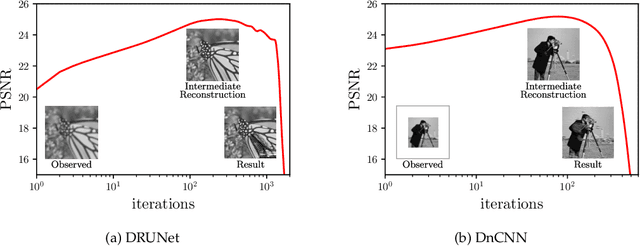
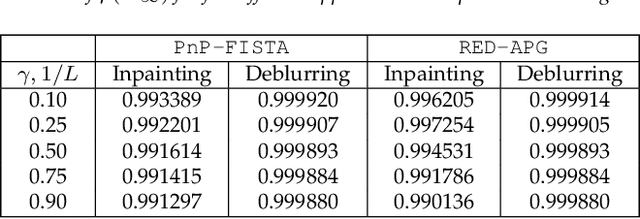
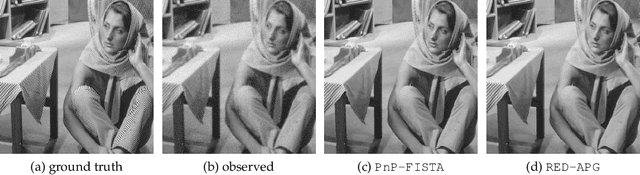
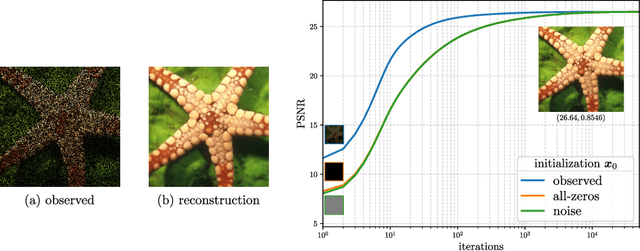
The effectiveness of denoising-driven regularization for image reconstruction has been widely recognized. Two prominent algorithms in this area are Plug-and-Play ($\texttt{PnP}$) and Regularization-by-Denoising ($\texttt{RED}$). We consider two specific algorithms $\texttt{PnP-FISTA}$ and $\texttt{RED-APG}$, where regularization is performed by replacing the proximal operator in the $\texttt{FISTA}$ algorithm with a powerful denoiser. The iterate convergence of $\texttt{FISTA}$ is known to be challenging with no universal guarantees. Yet, we show that for linear inverse problems and a class of linear denoisers, global linear convergence of the iterates of $\texttt{PnP-FISTA}$ and $\texttt{RED-APG}$ can be established through simple spectral analysis.
On the Contractivity of Plug-and-Play Operators
Sep 28, 2023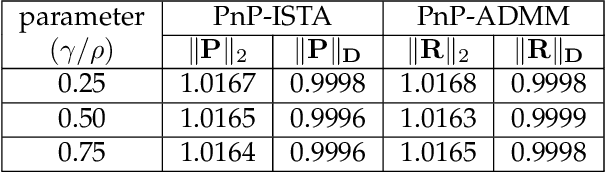

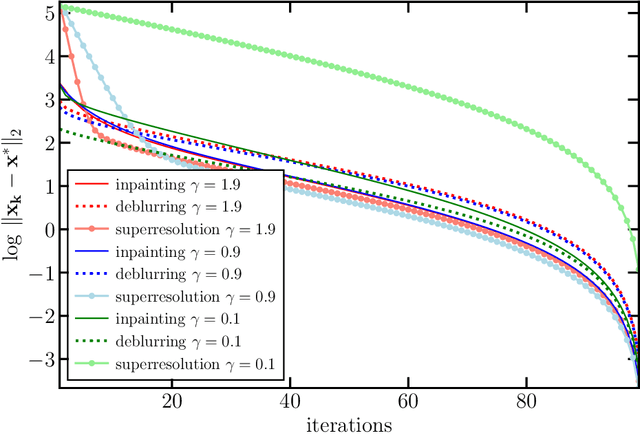
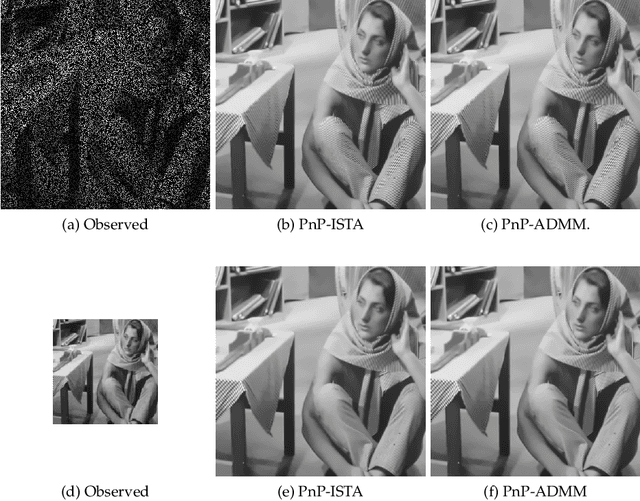
In plug-and-play (PnP) regularization, the proximal operator in algorithms such as ISTA and ADMM is replaced by a powerful denoiser. This formal substitution works surprisingly well in practice. In fact, PnP has been shown to give state-of-the-art results for various imaging applications. The empirical success of PnP has motivated researchers to understand its theoretical underpinnings and, in particular, its convergence. It was shown in prior work that for kernel denoisers such as the nonlocal means, PnP-ISTA provably converges under some strong assumptions on the forward model. The present work is motivated by the following questions: Can we relax the assumptions on the forward model? Can the convergence analysis be extended to PnP-ADMM? Can we estimate the convergence rate? In this letter, we resolve these questions using the contraction mapping theorem: (i) for symmetric denoisers, we show that (under mild conditions) PnP-ISTA and PnP-ADMM exhibit linear convergence; and (ii) for kernel denoisers, we show that PnP-ISTA and PnP-ADMM converge linearly for image inpainting. We validate our theoretical findings using reconstruction experiments.
Guided Nonlocal Patch Regularization and Efficient Filtering-Based Inversion for Multiband Fusion
Oct 09, 2022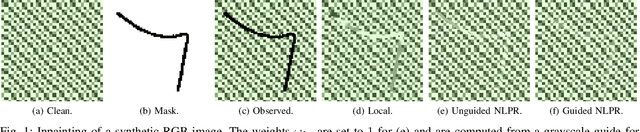
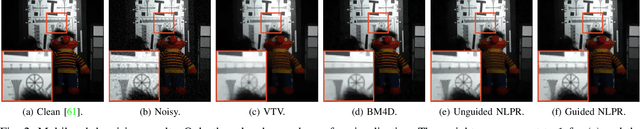
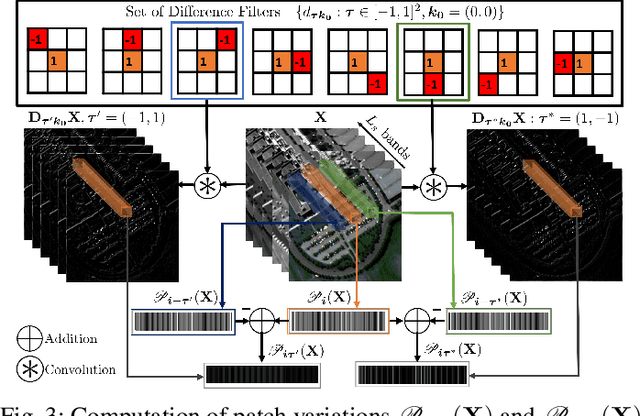
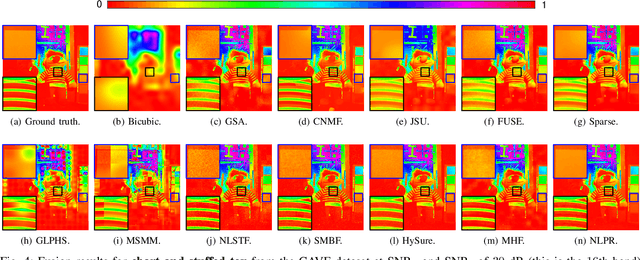
In multiband fusion, an image with a high spatial and low spectral resolution is combined with an image with a low spatial but high spectral resolution to produce a single multiband image having high spatial and spectral resolutions. This comes up in remote sensing applications such as pansharpening~(MS+PAN), hyperspectral sharpening~(HS+PAN), and HS-MS fusion~(HS+MS). Remote sensing images are textured and have repetitive structures. Motivated by nonlocal patch-based methods for image restoration, we propose a convex regularizer that (i) takes into account long-distance correlations, (ii) penalizes patch variation, which is more effective than pixel variation for capturing texture information, and (iii) uses the higher spatial resolution image as a guide image for weight computation. We come up with an efficient ADMM algorithm for optimizing the regularizer along with a standard least-squares loss function derived from the imaging model. The novelty of our algorithm is that by expressing patch variation as filtering operations and by judiciously splitting the original variables and introducing latent variables, we are able to solve the ADMM subproblems efficiently using FFT-based convolution and soft-thresholding. As far as the reconstruction quality is concerned, our method is shown to outperform state-of-the-art variational and deep learning techniques.
Plug-and-Play Regularization using Linear Solvers
Sep 16, 2022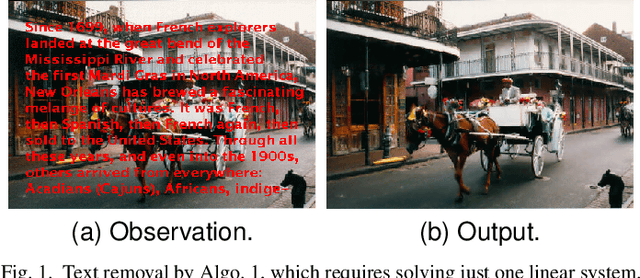
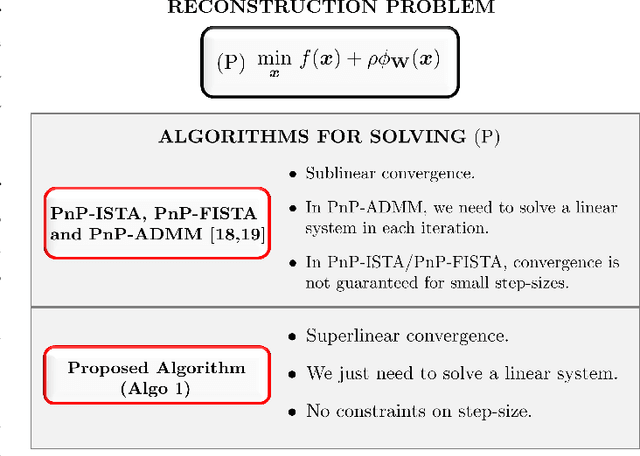

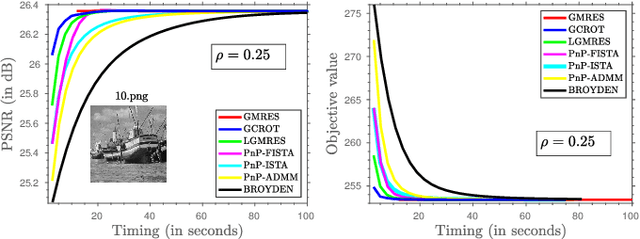
There has been tremendous research on the design of image regularizers over the years, from simple Tikhonov and Laplacian to sophisticated sparsity and CNN-based regularizers. Coupled with a model-based loss function, these are typically used for image reconstruction within an optimization framework. The technical challenge is to develop a regularizer that can accurately model realistic images and be optimized efficiently along with the loss function. Motivated by the recent plug-and-play paradigm for image regularization, we construct a quadratic regularizer whose reconstruction capability is competitive with state-of-the-art regularizers. The novelty of the regularizer is that, unlike classical regularizers, the quadratic objective function is derived from the observed data. Since the regularizer is quadratic, we can reduce the optimization to solving a linear system for applications such as superresolution, deblurring, inpainting, etc. In particular, we show that using iterative Krylov solvers, we can converge to the solution in a few iterations, where each iteration requires an application of the forward operator and a linear denoiser. The surprising finding is that we can get close to deep learning methods in terms of reconstruction quality. To the best of our knowledge, the possibility of achieving near state-of-the-art performance using a linear solver is novel.
Plug-and-Play Compressed Sensing: Theoretical Guarantees on Exact and Robust Recovery
Jul 26, 2022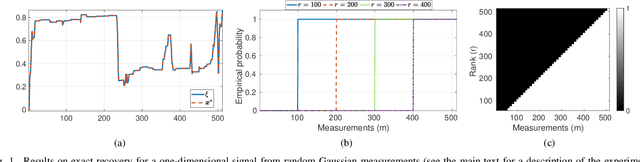
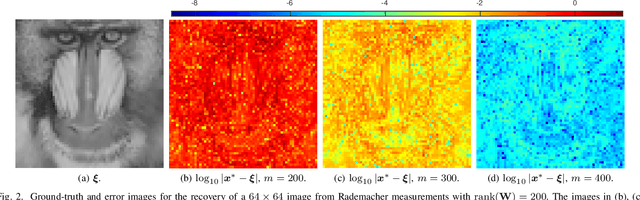
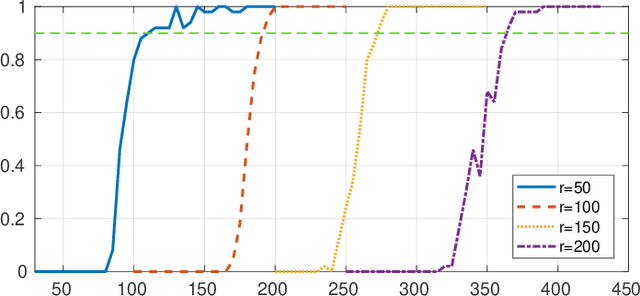
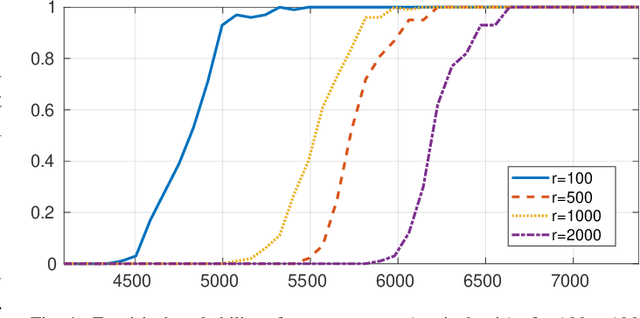
In Plug-and-Play (PnP) algorithms, an off-the-shelf denoiser is used for image regularization. PnP yields state-of-the-art results, but its theoretical aspects are not well understood. This work considers the question: Similar to classical compressed sensing (CS), can we theoretically recover the ground-truth via PnP under suitable conditions on the denoiser and the sensing matrix? One hurdle is that since PnP is an algorithmic framework, its solution need not be the minimizer of some objective function. It was recently shown that a convex regularizer $\Phi$ can be associated with a class of linear denoisers such that PnP amounts to solving a convex problem involving $\Phi$. Motivated by this, we consider the PnP analog of CS: minimize $\Phi(x)$ s.t. $Ax=A\xi$, where $A$ is a $m\times n$ random sensing matrix, $\Phi$ is the regularizer associated with a linear denoiser $W$, and $\xi$ is the ground-truth. We prove that if $A$ is Gaussian and $\xi$ is in the range of $W$, then the minimizer is almost surely $\xi$ if $rank(W)\leq m$, and almost never if $rank(W)> m$. Thus, the range of the PnP denoiser acts as a signal prior, and its dimension marks a sharp transition from failure to success of exact recovery. We extend the result to subgaussian sensing matrices, except that exact recovery holds only with high probability. For noisy measurements $b = A \xi + \eta$, we consider a robust formulation: minimize $\Phi(x)$ s.t. $\|Ax-b\|\leq\delta$. We prove that for an optimal solution $x^*$, with high probability the distortion $\|x^*-\xi\|$ is bounded by $\|\eta\|$ and $\delta$ if the number of measurements is large enough. In particular, we can derive the sample complexity of CS as a function of distortion error and success rate. We discuss the extension of these results to random Fourier measurements, perform numerical experiments, and discuss research directions stemming from this work.
On the Construction of Averaged Deep Denoisers for Image Regularization
Jul 15, 2022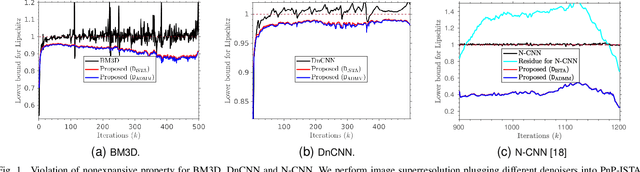
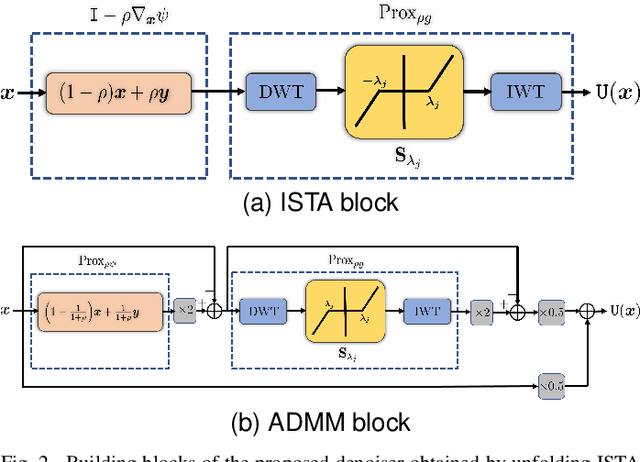
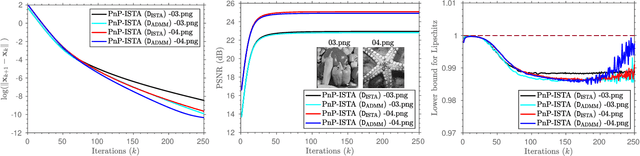
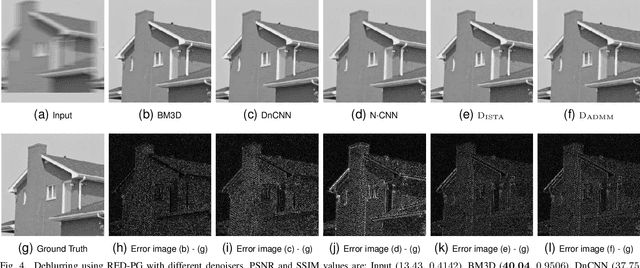
Plug-and-Play (PnP) and Regularization by Denoising (RED) are recent paradigms for image reconstruction that can leverage the power of modern denoisers for image regularization. In particular, these algorithms have been shown to deliver state-of-the-art reconstructions using CNN denoisers. Since the regularization is performed in an ad-hoc manner in PnP and RED, understanding their convergence has been an active research area. Recently, it was observed in many works that iterate convergence of PnP and RED can be guaranteed if the denoiser is averaged or nonexpansive. However, integrating nonexpansivity with gradient-based learning is a challenging task -- checking nonexpansivity is known to be computationally intractable. Using numerical examples, we show that existing CNN denoisers violate the nonexpansive property and can cause the PnP iterations to diverge. In fact, algorithms for training nonexpansive denoisers either cannot guarantee nonexpansivity of the final denoiser or are computationally intensive. In this work, we propose to construct averaged (contractive) image denoisers by unfolding ISTA and ADMM iterations applied to wavelet denoising and demonstrate that their regularization capacity for PnP and RED can be matched with CNN denoisers. To the best of our knowledge, this is the first work to propose a simple framework for training provably averaged (contractive) denoisers using unfolding networks.