 Add to Chrome
 Add to Firefox
 Add to Edge
IndRegBias: A Dataset for Studying Indian Regional Biases in English and Code-Mixed Social Media Comments
Jan 13, 2026
Warning: This paper consists of examples representing regional biases in Indian regions that might be offensive towards a particular region. While social biases corresponding to gender, race, socio-economic conditions, etc., have been extensively studied in the major applications of Natural Language Processing (NLP), biases corresponding to regions have garnered less attention. This is mainly because of (i) difficulty in the extraction of regional bias datasets, (ii) disagreements in annotation due to inherent human biases, and (iii) regional biases being studied in combination with other types of social biases and often being under-represented. This paper focuses on creating a dataset IndRegBias, consisting of regional biases in an Indian context reflected in users' comments on popular social media platforms, namely Reddit and YouTube. We carefully selected 25,000 comments appearing on various threads in Reddit and videos on YouTube discussing trending topics on regional issues in India. Furthermore, we propose a multilevel annotation strategy to annotate the comments describing the severity of regional biased statements. To detect the presence of regional bias and its severity in IndRegBias, we evaluate open-source Large Language Models (LLMs) and Indic Language Models (ILMs) using zero-shot, few-shot, and fine-tuning strategies. We observe that zero-shot and few-shot approaches show lower accuracy in detecting regional biases and severity in the majority of the LLMs and ILMs. However, the fine-tuning approach significantly enhances the performance of the LLM in detecting Indian regional bias along with its severity.

Planned Event Forecasting using Future Mentions and Related Entity Extraction in News Articles
Nov 11, 2025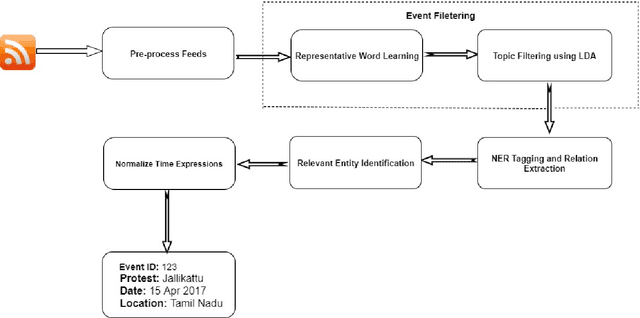
In democracies like India, people are free to express their views and demands. Sometimes this causes situations of civil unrest such as protests, rallies, and marches. These events may be disruptive in nature and are often held without prior permission from the competent authority. Forecasting these events helps administrative officials take necessary action. Usually, protests are announced well in advance to encourage large participation. Therefore, by analyzing such announcements in news articles, planned events can be forecasted beforehand. We developed such a system in this paper to forecast social unrest events using topic modeling and word2vec to filter relevant news articles, and Named Entity Recognition (NER) methods to identify entities such as people, organizations, locations, and dates. Time normalization is applied to convert future date mentions into a standard format. In this paper, we have developed a geographically independent, generalized model to identify key features for filtering civil unrest events. There could be many mentions of entities, but only a few may actually be involved in the event. This paper calls such entities Related Entities and proposes a method to extract them, referred to as Related Entity Extraction.
Inclusion of Role into Named Entity Recognition and Ranking
Nov 10, 2025Most of the Natural Language Processing systems are involved in entity-based processing for several tasks like Information Extraction, Question-Answering, Text-Summarization and so on. A new challenge comes when entities play roles according to their act or attributes in certain context. Entity Role Detection is the task of assigning such roles to the entities. Usually real-world entities are of types: person, location and organization etc. Roles could be considered as domain-dependent subtypes of these types. In the cases, where retrieving a subset of entities based on their roles is needed, poses the problem of defining the role and entities having those roles. This paper presents the study of study of solving Entity Role Detection problem by modeling it as Named Entity Recognition (NER) and Entity Retrieval/Ranking task. In NER, these roles could be considered as mutually exclusive classes and standard NER methods like sequence tagging could be used. For Entity Retrieval, Roles could be formulated as Query and entities as Collection on which the query needs to be executed. The aspect of Entity Retrieval task, which is different than document retrieval task is that the entities and roles against which they need to be retrieved are indirectly described. We have formulated automated ways of learning representative words and phrases and building representations of roles and entities using them. We have also explored different contexts like sentence and document. Since the roles depend upon context, so it is not always possible to have large domain-specific dataset or knowledge bases for learning purposes, so we have tried to exploit the information from small dataset in domain-agnostic way.