 Add to Chrome
 Add to Firefox
 Add to Edge
SiGnature: Explicit Motion Diffusion for Stylized Semantic Gesture
Jun 14, 2026
While recent advances in co-speech gesture generation have achieved impressive rhythmic synchronization, synthesizing gestures that are both semantically meaningful and faithful to a speaker's unique non-verbal style remains an open challenge. Semantic gestures, such as iconic shapes or deictic pointing, are statistically sparse, making them difficult to learn effectively within standard generative models. We present SiGnature, a framework for Stylized and Semantic Gesture generation that reconciles precise semantic control with high-fidelity style preservation. Unlike prevalent methods that rely on entangled latent representations, SiGnature operates in an explicit joint-rotation space. This design enables our core contribution, Joint Motion Integration (JMI), a training-free inference mechanism capable of injecting any external motion sequence, particularly in-the-wild semantic gestures, directly into the diffusion process. JMI automatically identifies the specific ``active joints'' conveying a semantic action and injects them into the generation, while relying on the diffusion backbone to synthesize the remaining body dynamics, including posture and flow, in accordance with the pre-learned style of the target speaker. This allows for the plug-and-play integration of arbitrary motions, including complex semantic gestures, without retraining or introducing the ``Frankenstein'' artifacts typical of cut-and-paste methods. Extensive experiments and perceptual studies demonstrate that SiGnature offers superior semantic motion control while maintaining smooth and natural co-speech gesture generation and preserving the distinct characteristics of the speaker, thereby outperforming state-of-the-art baselines.

Φ-Noise: Training-Free Temporal Video Conditioning via Phase-Based Noise Manipulation
May 23, 2026Latent video diffusion models generate videos by progressively transforming Gaussian noise into realistic samples conditioned on text or visual inputs. However, existing conditioning methods often require additional training and computational overhead. Motivated by recent findings on the importance of frequency components in generative models, we propose a simple, training-free approach for motion-conditioned video generation by injecting low-frequency phase information from a reference video directly into the diffusion noise latents. Our method transfers motion cues without modifying the model architecture or inference pipeline. Using several applications, we demonstrate effective control over both appearance and dynamics in generated videos, while achieving competitive or superior results compared to more complex conditioning approaches.
Progressive Photorealistic Simplification
May 11, 2026Existing image simplification techniques often rely on Non-Photorealistic Rendering (NPR), transforming photographs into stylized sketches, cartoons, or paintings. While effective at reducing visual complexity, such approaches typically sacrifice photographic realism. In this work, we explore a complementary direction: simplifying images while preserving their photorealistic appearance. We introduce progressive semantic image simplification, a framework that iteratively reduces scene complexity by removing and inpainting elements in a controlled manner. At each step, the resulting image remains a plausible natural photograph. Our method combines semantic understanding with generative editing, leveraging Vision-Language Models (VLMs) to identify and prioritize elements for removal, and a learned verifier to ensure photorealism and coherence throughout the process. This is implemented via an iterative Select-Remove-Verify pipeline that produces high-quality simplification trajectories. To improve efficiency, we further distill this process into an image-to-video generation model that directly predicts coherent simplification sequences from a single input image. Beyond generating cleaner and more focused compositions, our approach enables applications such as content-aware decluttering, semantic layer decomposition, and interactive editing. More broadly, our work suggests that simplification through structured content removal can serve as a practical mechanism for guiding visual interpretation within the photorealistic domain, complementing traditional abstraction methods.
D-Nikud: Enhancing Hebrew Diacritization with LSTM and Pretrained Models
Jan 30, 2024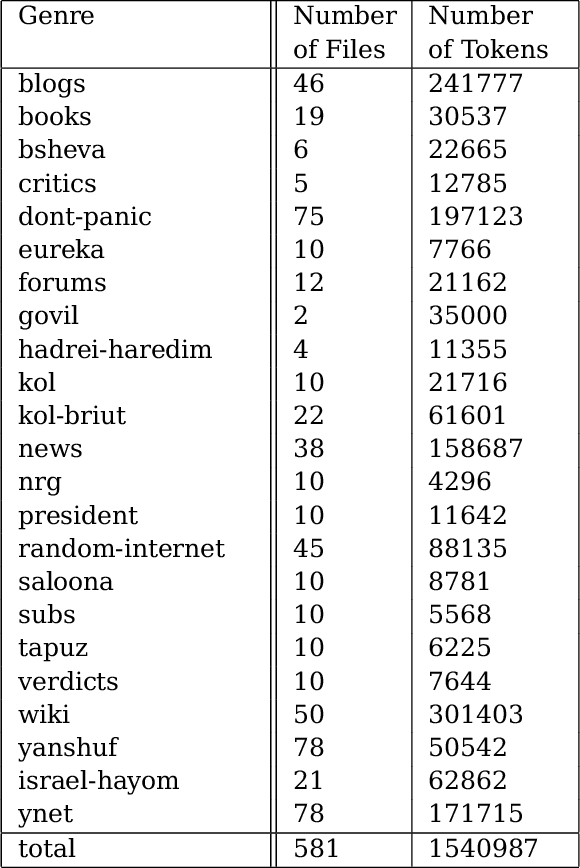
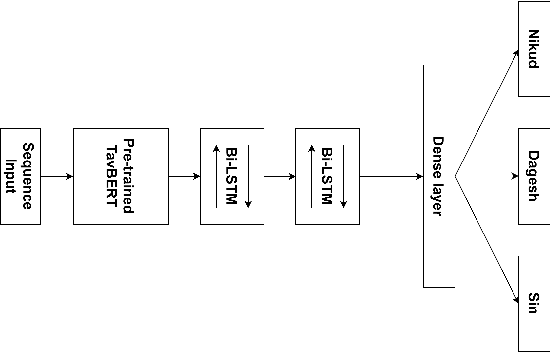
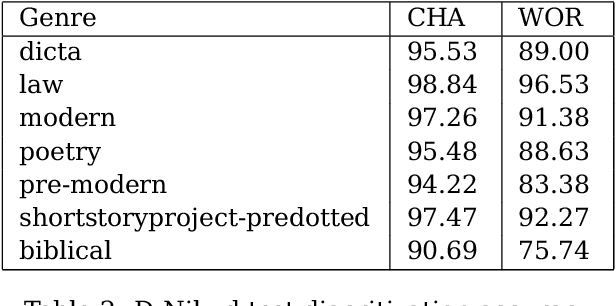
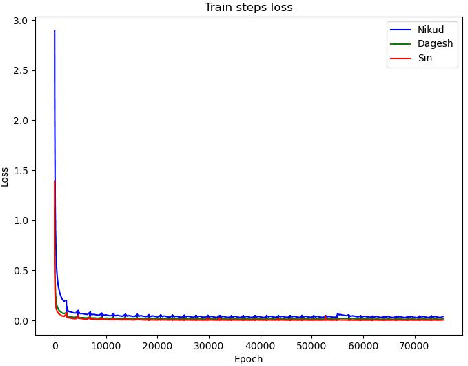
D-Nikud, a novel approach to Hebrew diacritization that integrates the strengths of LSTM networks and BERT-based (transformer) pre-trained model. Inspired by the methodologies employed in Nakdimon, we integrate it with the TavBERT pre-trained model, our system incorporates advanced architectural choices and diverse training data. Our experiments showcase state-of-the-art results on several benchmark datasets, with a particular emphasis on modern texts and more specified diacritization like gender.