 Add to Chrome
 Add to Firefox
 Add to Edge
Φ-Noise: Training-Free Temporal Video Conditioning via Phase-Based Noise Manipulation
May 23, 2026
Latent video diffusion models generate videos by progressively transforming Gaussian noise into realistic samples conditioned on text or visual inputs. However, existing conditioning methods often require additional training and computational overhead. Motivated by recent findings on the importance of frequency components in generative models, we propose a simple, training-free approach for motion-conditioned video generation by injecting low-frequency phase information from a reference video directly into the diffusion noise latents. Our method transfers motion cues without modifying the model architecture or inference pipeline. Using several applications, we demonstrate effective control over both appearance and dynamics in generated videos, while achieving competitive or superior results compared to more complex conditioning approaches.

Conditional Balance: Improving Multi-Conditioning Trade-Offs in Image Generation
Dec 25, 2024
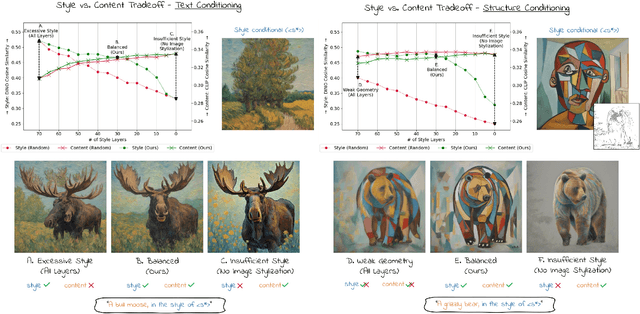
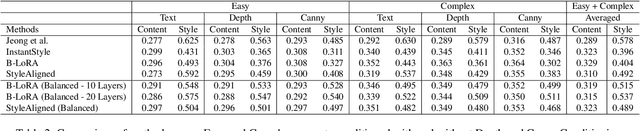
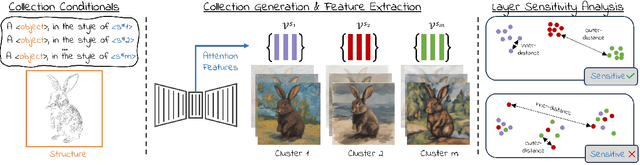
Balancing content fidelity and artistic style is a pivotal challenge in image generation. While traditional style transfer methods and modern Denoising Diffusion Probabilistic Models (DDPMs) strive to achieve this balance, they often struggle to do so without sacrificing either style, content, or sometimes both. This work addresses this challenge by analyzing the ability of DDPMs to maintain content and style equilibrium. We introduce a novel method to identify sensitivities within the DDPM attention layers, identifying specific layers that correspond to different stylistic aspects. By directing conditional inputs only to these sensitive layers, our approach enables fine-grained control over style and content, significantly reducing issues arising from over-constrained inputs. Our findings demonstrate that this method enhances recent stylization techniques by better aligning style and content, ultimately improving the quality of generated visual content.