 Add to Chrome
 Add to Firefox
 Add to Edge
A Relaxed Quadratic-Program-based Framework for Trajectory Tracking of Unicycle Robots with Singularity Avoidance
Jun 22, 2026
Dynamic feedback linearization (DFL) is a classical technique for trajectory tracking of unicycle-type mobile robots, but the resulting DFL-based controller becomes singular when the linear velocity vanishes, rendering standard DFL-based controllers unsuitable for stop-and-reverse maneuvers. This paper proposes a quadratic-program (QP)-based optimal control framework that avoids this singularity, while establishing local Lipschitz continuity of the resulting feedback law. Our approach reformulates the DFL constraints as an equality-constrained QP with a slack variable, ensuring feasibility for all states and reference signals, including at points where the robot's velocity vanishes. By introducing slack variables and tunable parameters, we demonstrate that the singular configuration can be avoided for a large class of reference trajectories. The effectiveness of the proposed approach for trajectory tracking is demonstrated through ROS 2-Gazebo simulations on a TurtleBot3 Waffle robot. The code is available at https://gradslab.github.io/DFL_QP_Unicycle/

Schrödinger Bridge Over A Compact Connected Lie Group
Mar 14, 2026This work studies the Schrödinger bridge problem for the kinematic equation on a compact connected Lie group. The objective is to steer a controlled diffusion between given initial and terminal densities supported over the Lie group while minimizing the control effort. We develop a coordinate-free formulation of this stochastic optimal control problem that respects the underlying geometric structure of the Lie group, thereby avoiding limitations associated with local parameterizations or embeddings in Euclidean spaces. We establish the existence and uniqueness of solution to the corresponding Schrödinger system. Our results are constructive in that they derive a geometric controller that optimally interpolates probability densities supported over the Lie group. To illustrate the results, we provide numerical examples on $\mathsf{SO}(2)$ and $\mathsf{SO}(3)$.
A Safe Hybrid Control Framework for Car-like Robot with Guaranteed Global Path-Invariance using a Control Barrier Function
Feb 11, 2025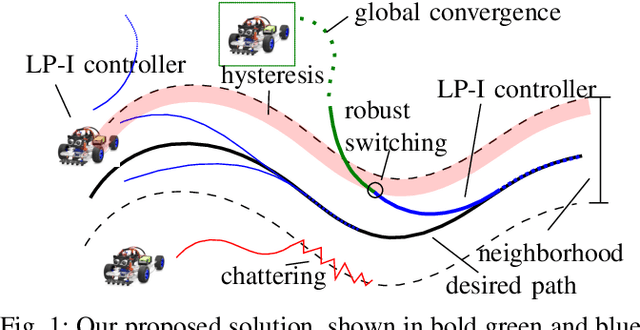
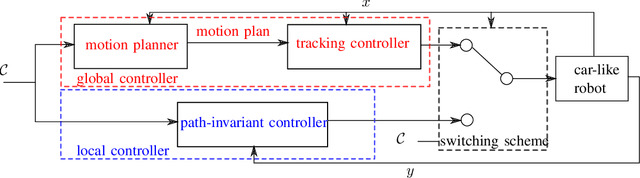
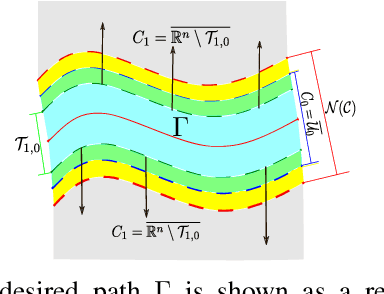
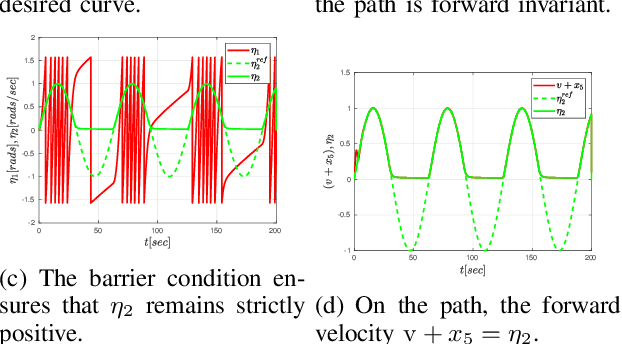
This work proposes a hybrid framework for car-like robots with obstacle avoidance, global convergence, and safety, where safety is interpreted as path invariance, namely, once the robot converges to the path, it never leaves the path. Given a priori obstacle-free feasible path where obstacles can be around the path, the task is to avoid obstacles while reaching the path and then staying on the path without leaving it. The problem is solved in two stages. Firstly, we define a ``tight'' obstacle-free neighborhood along the path and design a local controller to ensure convergence to the path and path invariance. The control barrier function technology is involved in the control design to steer the system away from its singularity points, where the local path invariant controller is not defined. Secondly, we design a hybrid control framework that integrates this local path-invariant controller with any global tracking controller from the existing literature without path invariance guarantee, ensuring convergence from any position to the desired path, namely, global convergence. This framework guarantees path invariance and robustness to sensor noise. Detailed simulation results affirm the effectiveness of the proposed scheme.