 Add to Chrome
 Add to Firefox
 Add to Edge
On the continuum limit of t-SNE for data visualization
Apr 13, 2026
This work is concerned with the continuum limit of a graph-based data visualization technique called the t-Distributed Stochastic Neighbor Embedding (t-SNE), which is widely used for visualizing data in a variety of applications, but is still poorly understood from a theoretical standpoint. The t-SNE algorithm produces visualizations by minimizing the Kullback-Leibler divergence between similarity matrices representing the high dimensional data and its low dimensional representation. We prove that as the number of data points $n \to \infty$, after a natural rescaling and in applicable parameter regimes, the Kullback-Leibler divergence is consistent as the number of data points $n \to \infty$ and the similarity graph remains sparse with a continuum variational problem that involves a non-convex gradient regularization term and a penalty on the magnitude of the probability density function in the visualization space. These two terms represent the continuum limits of the attraction and repulsion forces in the t-SNE algorithm. Due to the lack of convexity in the continuum variational problem, the question of well-posedeness is only partially resolved. We show that when both dimensions are $1$, the problem admits a unique smooth minimizer, along with an infinite number of discontinuous minimizers (interpreted in a relaxed sense). This aligns well with the empirically observed ability of t-SNE to separate data in seemingly arbitrary ways in the visualization. The energy is also very closely related to the famously ill-posed Perona-Malik equation, which is used for denoising and simplifying images. We present numerical results validating the continuum limit, provide some preliminary results about the delicate nature of the limiting energetic problem in higher dimensions, and highlight several problems for future work.

Large data limits and scaling laws for tSNE
Oct 16, 2024This work considers large-data asymptotics for t-distributed stochastic neighbor embedding (tSNE), a widely-used non-linear dimension reduction algorithm. We identify an appropriate continuum limit of the tSNE objective function, which can be viewed as a combination of a kernel-based repulsion and an asymptotically-vanishing Laplacian-type regularizer. As a consequence, we show that embeddings of the original tSNE algorithm cannot have any consistent limit as $n \to \infty$. We propose a rescaled model which mitigates the asymptotic decay of the attractive energy, and which does have a consistent limit.
On Probabilistic Embeddings in Optimal Dimension Reduction
Aug 05, 2024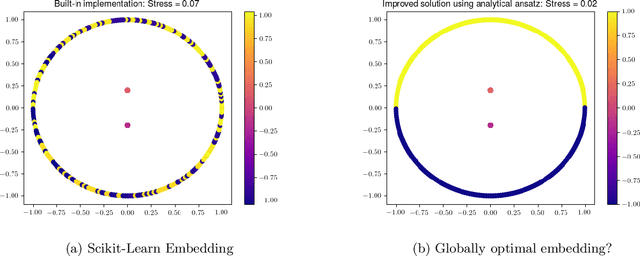
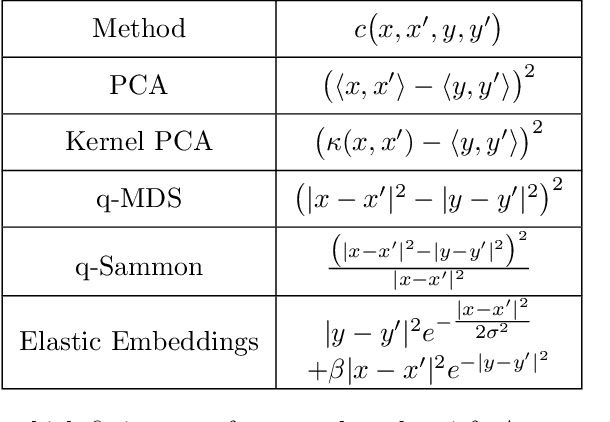
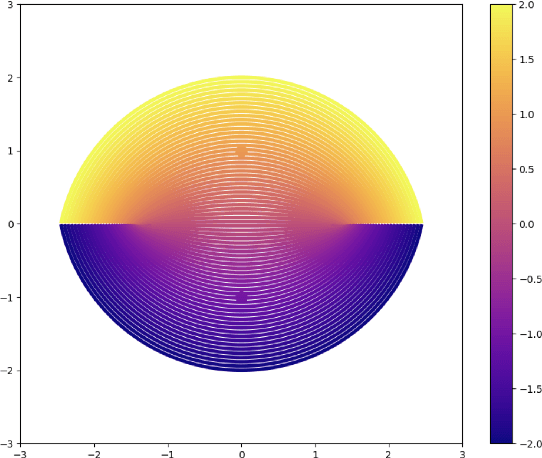
Dimension reduction algorithms are a crucial part of many data science pipelines, including data exploration, feature creation and selection, and denoising. Despite their wide utilization, many non-linear dimension reduction algorithms are poorly understood from a theoretical perspective. In this work we consider a generalized version of multidimensional scaling, which is posed as an optimization problem in which a mapping from a high-dimensional feature space to a lower-dimensional embedding space seeks to preserve either inner products or norms of the distribution in feature space, and which encompasses many commonly used dimension reduction algorithms. We analytically investigate the variational properties of this problem, leading to the following insights: 1) Solutions found using standard particle descent methods may lead to non-deterministic embeddings, 2) A relaxed or probabilistic formulation of the problem admits solutions with easily interpretable necessary conditions, 3) The globally optimal solutions to the relaxed problem actually must give a deterministic embedding. This progression of results mirrors the classical development of optimal transportation, and in a case relating to the Gromov-Wasserstein distance actually gives explicit insight into the structure of the optimal embeddings, which are parametrically determined and discontinuous. Finally, we illustrate that a standard computational implementation of this task does not learn deterministic embeddings, which means that it learns sub-optimal mappings, and that the embeddings learned in that context have highly misleading clustering structure, underscoring the delicate nature of solving this problem computationally.