 Add to Chrome
 Add to Firefox
 Add to Edge
Individual Disempowerment through an Advice Channel: Control Loss when Influence is Endogenous
Aug 14, 2026
An AI that can only give advice seems safe: the human is always free to ignore it. That is the premise of the boxing tradition in AI safety, and its long-suspected weak point is that the human who reads the answers is part of the system. We make the fraction $\varepsilon_t$ of behavior that follows the advice a state of a Markov decision process, moved by the advisor's own messages, so that use deepens reliance. Granted a channel rich enough to echo any action the human could take, higher $\varepsilon_t$ weakly lowers every monotone measure of the power of a human with a message-independent fallback. An oracle rewarded by per-round approval cultivates reliance beyond a closed-form patience threshold, so the same reward weights leave the optimal oracle answering in episodic deployments and cultivating in long-memory ones. An influence bound certified once at deployment is blind to that horizon and bounds the loss no lower than its trivial ceiling. An exogenous cap on influence bounds the guarantee the human loses, and a short enough memory reset removes the incentive to cultivate, while neither recovers the value already steered away. In a closed-form example the optimal oracle never cultivates in fifteen-round sessions and does in sixteen.

Avoiding unsafe sets when training with Langevin Dynamics
Jul 08, 2026Training a model with noisy gradient descent can be idealized as overdamped Langevin dynamics on the loss landscape, and a natural safety question is to bound the probability $ν_t(\mathcal{A}_H) = \mathbb{P}(Q_t \in \mathcal{A}_H)$ that the trajectory lies in a designated failure region $\mathcal{A}_H$. We study this for a smooth, strongly convex loss in $d$ dimensions and a failure region separated from the minimizer by an energy gap. Three bounds emerge. At the end of training, the equilibrium mass $π(\mathcal{A}_H)$ is exponentially small in $d$, with a complementary energy-barrier rate when the noise is small. Along the trajectory, a shape-free bound $ν_t(\mathcal{A}_H) \le π(\mathcal{A}_H)(1 + \sqrt{χ_0^2/π(\mathcal{A}_H)}\,e^{-mt})$ shows that the in-set probability relaxes to (twice) the static value after a burn-in time of order $d$, using only the global spectral gap $m$ of the loss. A worked Ornstein-Uhlenbeck example shows this burn-in is necessary: an angular slice of the equilibrium shell can transiently swell by a factor exponential in $d$, even though its equilibrium mass is tiny. To rule such swelling out we introduce a local relaxation rate attached to the failure region, defined through the spectral measure of its centered indicator rather than a Dirichlet-form Rayleigh quotient. For geometrically isolated regions this rate exceeds the global one, shrinking the burn-in proportionally, and combined with a maximum-principle ceiling it caps the trajectory probability uniformly in time. The picture is that strong convexity sets how fast training relaxes, but the shape of the unsafe set decides whether the trajectory bulges through it on the way home.
Fast Rates for Semi-Supervised Learning via Data-Augmentation Graph Regularization
Jul 08, 2026Self-supervised learning matches supervised accuracy from a fraction of the labels, but the labeled-sample efficiency behind this has lacked a theoretical explanation. We provide one. Data augmentation induces a similarity graph on the unlabeled data, so downstream learning on that graph is graph-Laplacian-regularized learning. We prove a fast transductive rate, $O(1/n_L)$ in the number of labels, in place of the supervised $O(1/\sqrt{n_L})$, by carrying the leave-one-out stability apparatus of Johnson and Zhang (JMLR 2007) over to the augmentation graph, and without the unrealistic assumptions of limit-based analyses (exact kernel, generalizing features). The bound makes augmentation quality explicit: the expected error is at most $C/n_L + R_{\mathrm{DA}}(y)$, where the data-augmentation alignment error $R_{\mathrm{DA}}(y)$ is the graph-cut mass of augmentations that cross a label boundary, so good augmentations let few labels suffice. The analysis uses a streamlined loss that drops the projector, negative-sample, and orthogonality overhead of standard objectives yet still recovers the top-$K$ ideal features in the infinite-data limit, the augmentation-kernel eigenspace studied by Zhai et al. The result explains the observed accuracy-versus-label-count curve rather than only bounding a generalization gap.
The LogBarrier adversarial attack: making effective use of decision boundary information
Mar 25, 2019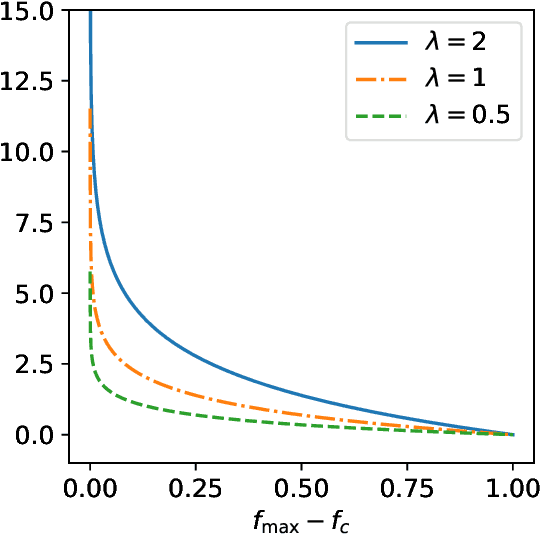
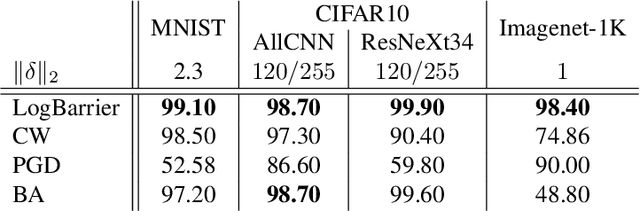
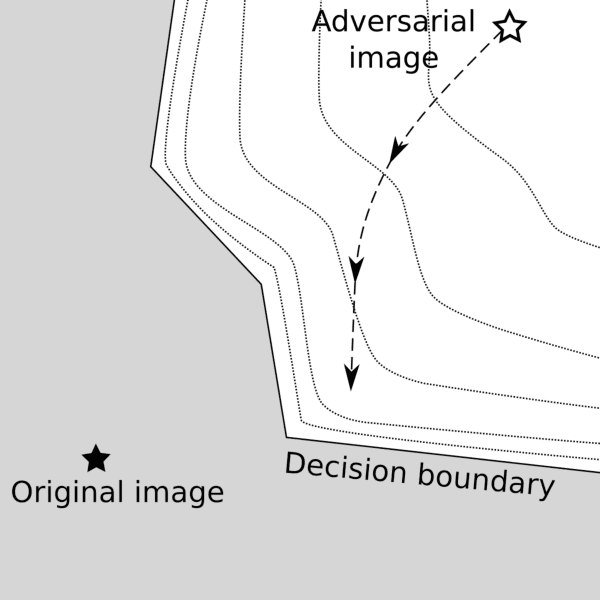
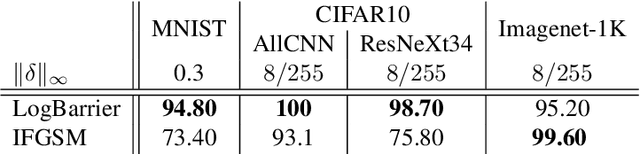
Adversarial attacks for image classification are small perturbations to images that are designed to cause misclassification by a model. Adversarial attacks formally correspond to an optimization problem: find a minimum norm image perturbation, constrained to cause misclassification. A number of effective attacks have been developed. However, to date, no gradient-based attacks have used best practices from the optimization literature to solve this constrained minimization problem. We design a new untargeted attack, based on these best practices, using the established logarithmic barrier method. On average, our attack distance is similar or better than all state-of-the-art attacks on benchmark datasets (MNIST, CIFAR10, ImageNet-1K). In addition, our method performs significantly better on the most challenging images, those which normally require larger perturbations for misclassification. We employ the LogBarrier attack on several adversarially defended models, and show that it adversarially perturbs all images more efficiently than other attacks: the distance needed to perturb all images is significantly smaller with the LogBarrier attack than with other state-of-the-art attacks.
Empirical confidence estimates for classification by deep neural networks
Mar 21, 2019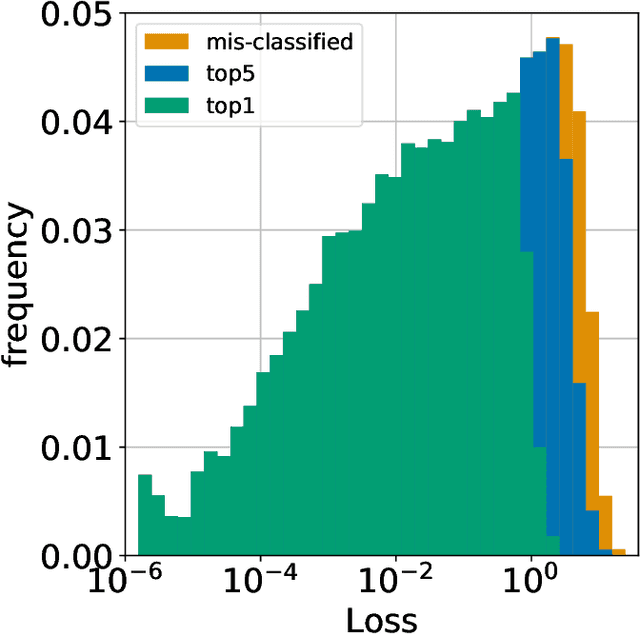
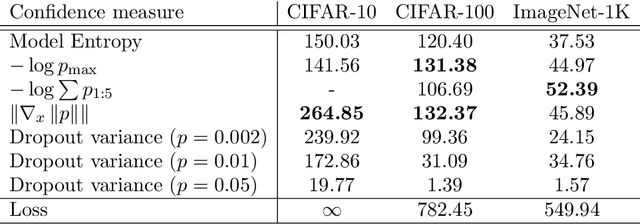
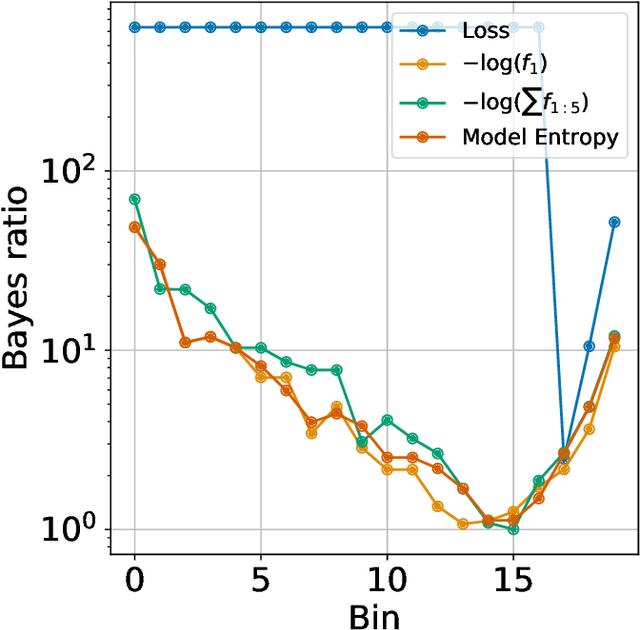

How well can we estimate the probability that the classification, $C(f(x))$, predicted by a deep neural network is correct (or in the Top 5)? We consider the case of a classification neural network trained with the KL divergence which is assumed to generalize, as measured empirically by the test error and test loss. We present conditional probabilities for predictions based on the histogram of uncertainty metrics, which have a significant Bayes ratio. Previous work in this area includes Bayesian neural networks. Our metric is twice as predictive, based on the expected Bayes ratio, on ImageNet compared to our best tuned implementation of Bayesian dropout~\cite{gal2016dropout}. Our method uses just the softmax values and a stored histogram so it is essentially free to compute, compared to many times inference cost for Bayesian dropout.
Anomaly detection and classification for streaming data using PDEs
Mar 15, 2017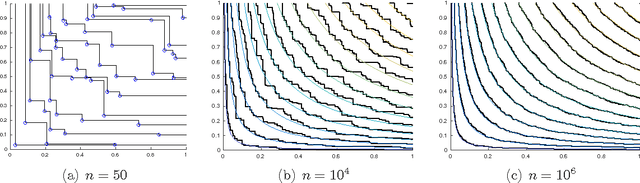
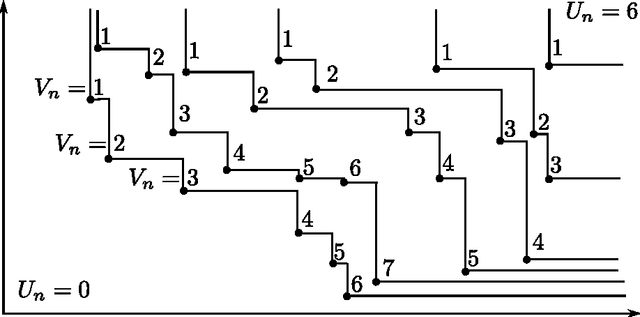
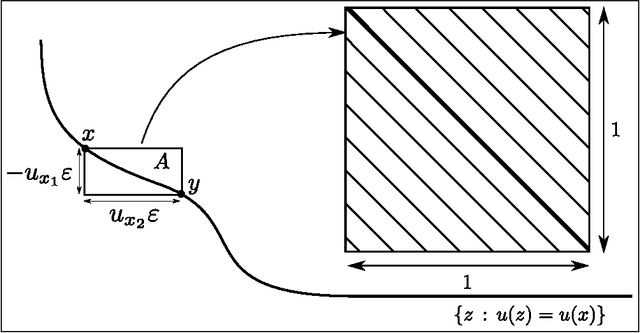
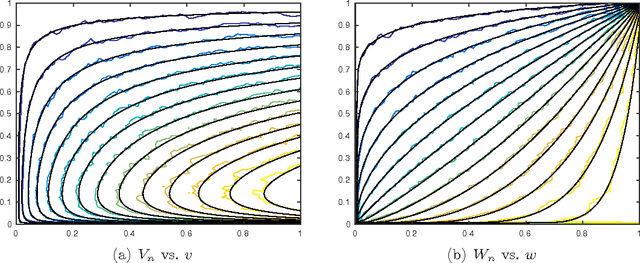
Nondominated sorting, also called Pareto Depth Analysis (PDA), is widely used in multi-objective optimization and has recently found important applications in multi-criteria anomaly detection. Recently, a partial differential equation (PDE) continuum limit was discovered for nondominated sorting leading to a very fast approximate sorting algorithm called PDE-based ranking. We propose in this paper a fast real-time streaming version of the PDA algorithm for anomaly detection that exploits the computational advantages of PDE continuum limits. Furthermore, we derive new PDE continuum limits for sorting points within their nondominated layers and show how the new PDEs can be used to classify anomalies based on which criterion was more significantly violated. We also prove statistical convergence rates for PDE-based ranking, and present the results of numerical experiments with both synthetic and real data.