 Add to Chrome
 Add to Firefox
 Add to Edge
Model soups need only one ingredient
Feb 10, 2026
Fine-tuning large pre-trained models on a target distribution often improves in-distribution (ID) accuracy, but at the cost of out-of-distribution (OOD) robustness as representations specialize to the fine-tuning data. Weight-space ensembling methods, such as Model Soups, mitigate this effect by averaging multiple checkpoints, but they are computationally prohibitive, requiring the training and storage of dozens of fine-tuned models. In this paper, we introduce MonoSoup, a simple, data-free, hyperparameter-free, post-hoc method that achieves a strong ID-OOD balance using only a single checkpoint. Our method applies Singular Value Decomposition (SVD) to each layer's update and decomposes it into high-energy directions that capture task-specific adaptation and low-energy directions that introduce noise but may still encode residual signals useful for robustness. MonoSoup then uses entropy-based effective rank to automatically re-weigh these components with layer-wise coefficients that account for the spectral and geometric structure of the model. Experiments on CLIP models fine-tuned on ImageNet and evaluated under natural distribution shifts, as well as on Qwen language models tested on mathematical reasoning and multiple-choice benchmarks, show that this plug-and-play approach is a practical and effective alternative to multi-checkpoint methods, retaining much of their benefits without their computational overhead.

Task Addition and Weight Disentanglement in Closed-Vocabulary Models
Nov 18, 2025Task arithmetic has recently emerged as a promising method for editing pre-trained \textit{open-vocabulary} models, offering a cost-effective alternative to standard multi-task fine-tuning. However, despite the abundance of \textit{closed-vocabulary} models that are not pre-trained with language supervision, applying task arithmetic to these models remains unexplored. In this paper, we deploy and study task addition in closed-vocabulary image classification models. We consider different pre-training schemes and find that \textit{weight disentanglement} -- the property enabling task arithmetic -- is a general consequence of pre-training, as it appears in different pre-trained closed-vocabulary models. In fact, we find that pre-trained closed-vocabulary vision transformers can also be edited with task arithmetic, achieving high task addition performance and enabling the efficient deployment of multi-task models. Finally, we demonstrate that simple linear probing is a competitive baseline to task addition. Overall, our findings expand the applicability of task arithmetic to a broader class of pre-trained models and open the way for more efficient use of pre-trained models in diverse settings.
Semantic Document Derendering: SVG Reconstruction via Vision-Language Modeling
Nov 17, 2025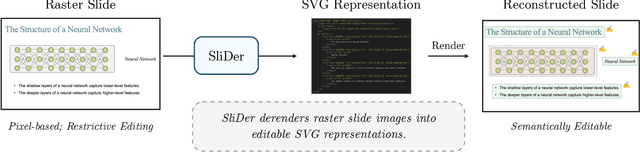
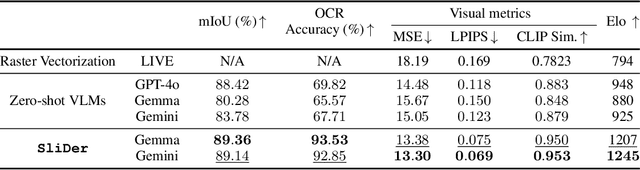
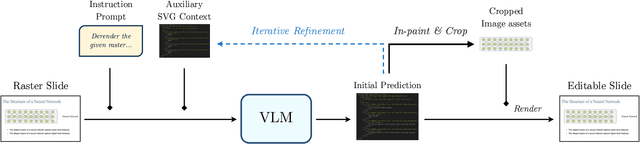
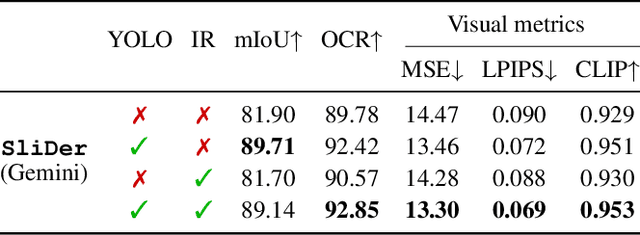
Multimedia documents such as slide presentations and posters are designed to be interactive and easy to modify. Yet, they are often distributed in a static raster format, which limits editing and customization. Restoring their editability requires converting these raster images back into structured vector formats. However, existing geometric raster-vectorization methods, which rely on low-level primitives like curves and polygons, fall short at this task. Specifically, when applied to complex documents like slides, they fail to preserve the high-level structure, resulting in a flat collection of shapes where the semantic distinction between image and text elements is lost. To overcome this limitation, we address the problem of semantic document derendering by introducing SliDer, a novel framework that uses Vision-Language Models (VLMs) to derender slide images as compact and editable Scalable Vector Graphic (SVG) representations. SliDer detects and extracts attributes from individual image and text elements in a raster input and organizes them into a coherent SVG format. Crucially, the model iteratively refines its predictions during inference in a process analogous to human design, generating SVG code that more faithfully reconstructs the original raster upon rendering. Furthermore, we introduce Slide2SVG, a novel dataset comprising raster-SVG pairs of slide documents curated from real-world scientific presentations, to facilitate future research in this domain. Our results demonstrate that SliDer achieves a reconstruction LPIPS of 0.069 and is favored by human evaluators in 82.9% of cases compared to the strongest zero-shot VLM baseline.