 Add to Chrome
 Add to Firefox
 Add to Edge
FERMI: Exploiting Relations for Membership Inference Against Tabular Diffusion Models
May 12, 2026
Diffusion models are the leading approach for tabular data synthesis and are increasingly used to share sensitive records. Whether they actually protect privacy has become a pressing question. Membership inference attacks are the standard tool for this purpose, yet existing attacks assume a single-table setting and ignore the multi-relational structure of real sensitive data. A core challenge in assessing privacy risks from membership inference attacks in multi-table settings is how to leverage auxiliary information from relations associated with the target table, such as its parent tables. Particularly, we study a practical setting in which such auxiliary information is available only when training the attack model. At inference time, the attacker observes only the attribute values of the target record from the target table. We propose FERMI (FEature-mapping for Relational Membership Inference), which resolves this gap by enriching single-table features with relational membership signal. Across three tabular diffusion architectures and three real-world relational datasets, FERMI consistently improves attack performance over single-table baselines, with TPR@$0.1$FPR rising by up to 53% over the single-table baseline in the white-box setting and 22% in the black-box setting.

Deep Perspective Transformation Based Vehicle Localization on Bird's Eye View
Nov 12, 2023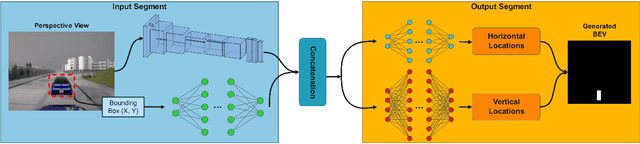
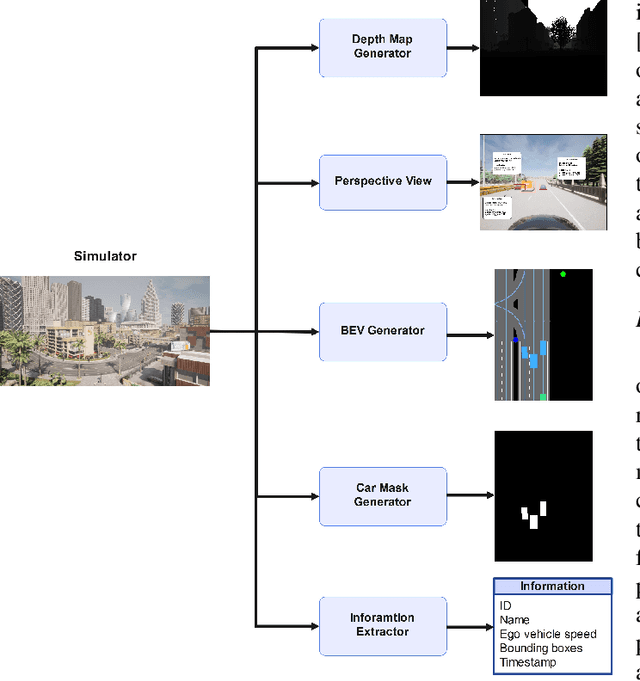
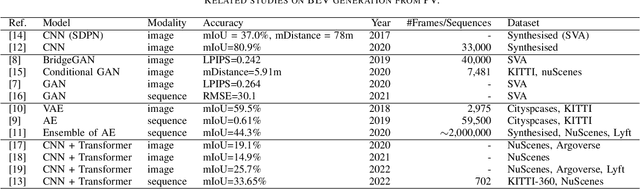
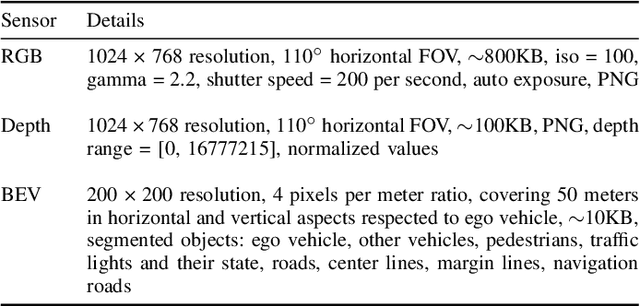
An accurate understanding of a self-driving vehicle's surrounding environment is crucial for its navigation system. To enhance the effectiveness of existing algorithms and facilitate further research, it is essential to provide comprehensive data to the routing system. Traditional approaches rely on installing multiple sensors to simulate the environment, leading to high costs and complexity. In this paper, we propose an alternative solution by generating a top-down representation of the scene, enabling the extraction of distances and directions of other cars relative to the ego vehicle. We introduce a new synthesized dataset that offers extensive information about the ego vehicle and its environment in each frame, providing valuable resources for similar downstream tasks. Additionally, we present an architecture that transforms perspective view RGB images into bird's-eye-view maps with segmented surrounding vehicles. This approach offers an efficient and cost-effective method for capturing crucial environmental information for self-driving cars. Code and dataset are available at https://github.com/IPM-HPC/Perspective-BEV-Transformer.