 Add to Chrome
 Add to Firefox
 Add to Edge
Are Vision Language Models Cross-Cultural Theory of Mind Reasoners?
Dec 19, 2025


Theory of Mind (ToM) -- the ability to attribute beliefs, desires, and emotions to others -- is fundamental for human social intelligence, yet remains a major challenge for artificial agents. Existing Vision-Language Models (VLMs) are increasingly applied in socially grounded tasks, but their capacity for cross-cultural ToM reasoning is largely unexplored. In this work, we introduce CulturalToM-VQA, a new evaluation benchmark containing 5095 questions designed to probe ToM reasoning across diverse cultural contexts through visual question answering. The dataset captures culturally grounded cues such as rituals, attire, gestures, and interpersonal dynamics, enabling systematic evaluation of ToM reasoning beyond Western-centric benchmarks. Our dataset is built through a VLM-assisted human-in-the-loop pipeline, where human experts first curate culturally rich images across traditions, rituals, and social interactions; a VLM then assist in generating structured ToM-focused scene descriptions, which are refined into question-answer pairs spanning a taxonomy of six ToM tasks and four graded complexity levels. The resulting dataset covers diverse theory of mind facets such as mental state attribution, false belief reasoning, non-literal communication, social norm violations, perspective coordination, and multi-agent reasoning.

Enhanced Intrusion Detection in IIoT Networks: A Lightweight Approach with Autoencoder-Based Feature Learning
Jan 25, 2025


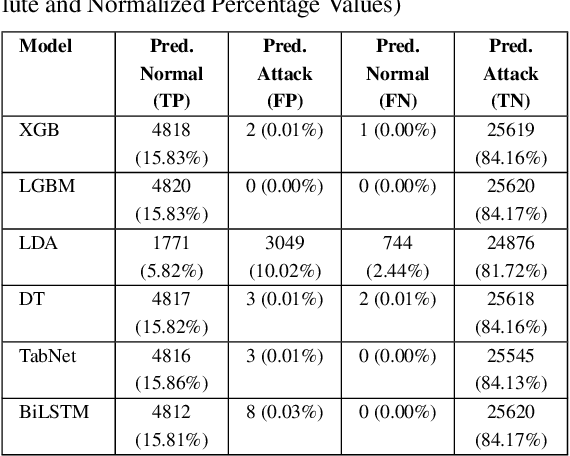
The rapid expansion of the Industrial Internet of Things (IIoT) has significantly advanced digital technologies and interconnected industrial systems, creating substantial opportunities for growth. However, this growth has also heightened the risk of cyberattacks, necessitating robust security measures to protect IIoT networks. Intrusion Detection Systems (IDS) are essential for identifying and preventing abnormal network behaviors and malicious activities. Despite the potential of Machine Learning (ML)--based IDS solutions, existing models often face challenges with class imbalance and multiclass IIoT datasets, resulting in reduced detection accuracy. This research directly addresses these challenges by implementing six innovative approaches to enhance IDS performance, including leveraging an autoencoder for dimensional reduction, which improves feature learning and overall detection accuracy. Our proposed Decision Tree model achieved an exceptional F1 score and accuracy of 99.94% on the Edge-IIoTset dataset. Furthermore, we prioritized lightweight model design, ensuring deployability on resource-constrained edge devices. Notably, we are the first to deploy our model on a Jetson Nano, achieving inference times of 0.185 ms for binary classification and 0.187 ms for multiclass classification. These results highlight the novelty and robustness of our approach, offering a practical and efficient solution to the challenges posed by imbalanced and multiclass IIoT datasets, thereby enhancing the detection and prevention of network intrusions.
HPC Application Parameter Autotuning on Edge Devices: A Bandit Learning Approach
Jan 02, 2025The growing necessity for enhanced processing capabilities in edge devices with limited resources has led us to develop effective methods for improving high-performance computing (HPC) applications. In this paper, we introduce LASP (Lightweight Autotuning of Scientific Application Parameters), a novel strategy designed to address the parameter search space challenge in edge devices. Our strategy employs a multi-armed bandit (MAB) technique focused on online exploration and exploitation. Notably, LASP takes a dynamic approach, adapting seamlessly to changing environments. We tested LASP with four HPC applications: Lulesh, Kripke, Clomp, and Hypre. Its lightweight nature makes it particularly well-suited for resource-constrained edge devices. By employing the MAB framework to efficiently navigate the search space, we achieved significant performance improvements while adhering to the stringent computational limits of edge devices. Our experimental results demonstrate the effectiveness of LASP in optimizing parameter search on edge devices.