 Add to Chrome
 Add to Firefox
 Add to Edge
Noise tolerance via reinforcement: Learning a reinforced quantum dynamics
Jun 14, 2025
The performance of quantum simulations heavily depends on the efficiency of noise mitigation techniques and error correction algorithms. Reinforcement has emerged as a powerful strategy to enhance the performance of learning and optimization algorithms. In this study, we demonstrate that reinforced quantum dynamics can exhibit significant robustness against interactions with a noisy environment. We study a quantum annealing process where, through reinforcement, the system is encouraged to maintain its current state or follow a noise-free evolution. A learning algorithm is employed to find a concise approximation of this reinforced dynamics, reducing the total evolution time and, consequently, the system's exposure to noisy interactions. This approach also avoids the complexities associated with implementing quantum feedback in such algorithms. The efficacy of our method is demonstrated through numerical simulations of reinforced quantum annealing with one- and two-qubit systems under Pauli noise.

Message passing for quantified Boolean formulas
Feb 12, 2012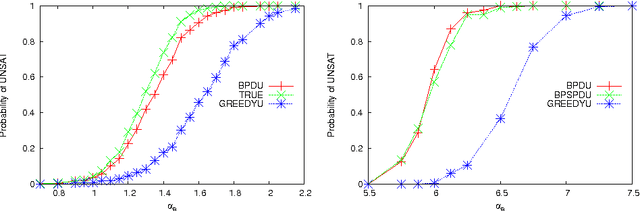
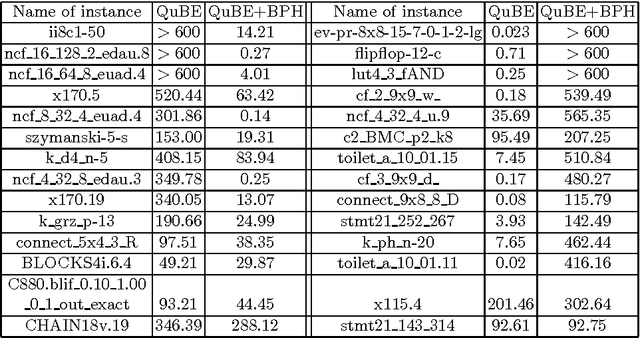
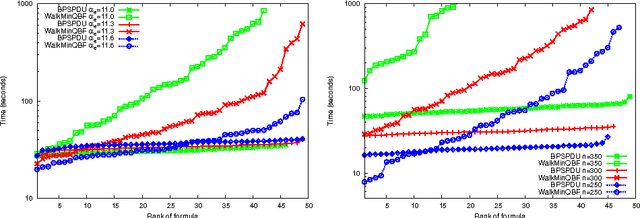
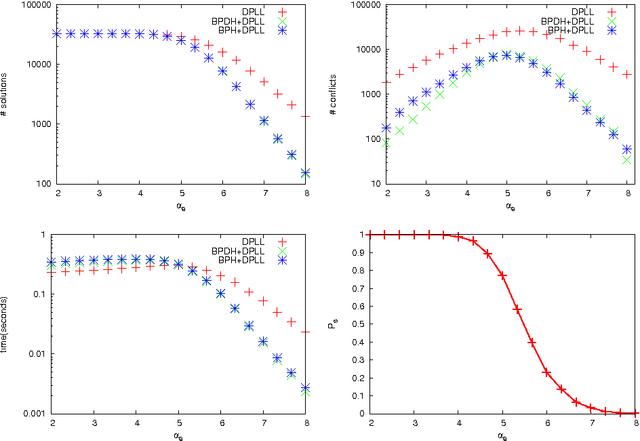
We introduce two types of message passing algorithms for quantified Boolean formulas (QBF). The first type is a message passing based heuristics that can prove unsatisfiability of the QBF by assigning the universal variables in such a way that the remaining formula is unsatisfiable. In the second type, we use message passing to guide branching heuristics of a Davis-Putnam Logemann-Loveland (DPLL) complete solver. Numerical experiments show that on random QBFs our branching heuristics gives robust exponential efficiency gain with respect to the state-of-art solvers. We also manage to solve some previously unsolved benchmarks from the QBFLIB library. Apart from this our study sheds light on using message passing in small systems and as subroutines in complete solvers.
* 14 pages, 7 figures