 Add to Chrome
 Add to Firefox
 Add to Edge
Bio-Inspired Self-Supervised Learning for Wrist-worn IMU Signals
Mar 11, 2026
Wearable accelerometers have enabled large-scale health and wellness monitoring, yet learning robust human-activity representations has been constrained by the scarcity of labeled data. While self-supervised learning offers a potential remedy, existing approaches treat sensor streams as unstructured time series, overlooking the underlying biological structure of human movement, a factor we argue is critical for effective Human Activity Recognition (HAR). We introduce a novel tokenization strategy grounded in the submovement theory of motor control, which posits that continuous wrist motion is composed of superposed elementary basis functions called submovements. We define our token as the movement segment, a unit of motion composed of a finite sequence of submovements that is readily extractable from wrist accelerometer signals. By treating these segments as tokens, we pretrain a Transformer encoder via masked movement-segment reconstruction to model the temporal dependencies of movement segments, shifting the learning focus beyond local waveform morphology. Pretrained on the NHANES corpus (approximately 28k hours; approximately 11k participants; approximately 10M windows), our representations outperform strong wearable SSL baselines across six subject-disjoint HAR benchmarks. Furthermore, they demonstrate stronger data efficiency in data-scarce settings. Code and pretrained weights will be made publicly available.

QEDCartographer: Automating Formal Verification Using Reward-Free Reinforcement Learning
Aug 17, 2024
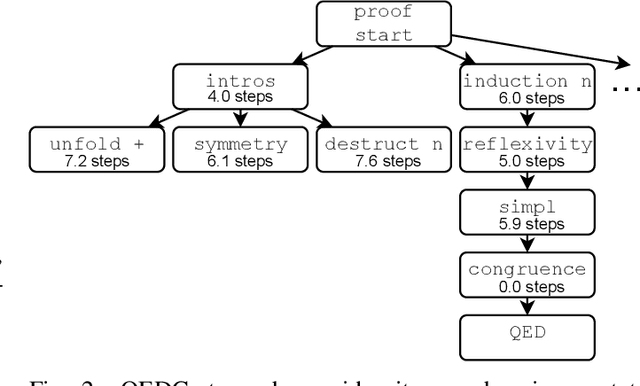


Formal verification is a promising method for producing reliable software, but the difficulty of manually writing verification proofs severely limits its utility in practice. Recent methods have automated some proof synthesis by guiding a search through the proof space using a theorem prover. Unfortunately, the theorem prover provides only the crudest estimate of progress, resulting in effectively undirected search. To address this problem, we create QEDCartographer, an automated proof-synthesis tool that combines supervised and reinforcement learning to more effectively explore the proof space. QEDCartographer incorporates the proofs' branching structure, enabling reward-free search and overcoming the sparse reward problem inherent to formal verification. We evaluate QEDCartographer using the CoqGym benchmark of 68.5K theorems from 124 open-source Coq projects. QEDCartographer fully automatically proves 21.4% of the test-set theorems. Previous search-based proof-synthesis tools Tok, Tac, ASTactic, Passport, and Proverbot9001, which rely only on supervised learning, prove 9.6%, 9.8%, 10.9%, 12.5%, and 19.8%, respectively. Diva, which combines 62 tools, proves 19.2%. Comparing to the most effective prior tool, Proverbot9001, QEDCartographer produces 26% shorter proofs 27% faster, on average over the theorems both tools prove. Together, QEDCartographer and non-learning-based CoqHammer prove 31.8% of the theorems, while CoqHammer alone proves 26.6%. Our work demonstrates that reinforcement learning is a fruitful research direction for improving proof-synthesis tools' search mechanisms.
On the intrinsic dimensionality of Covid-19 data: a global perspective
Mar 08, 2022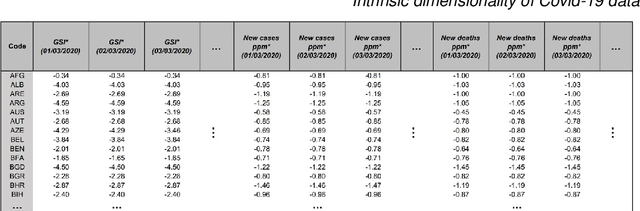
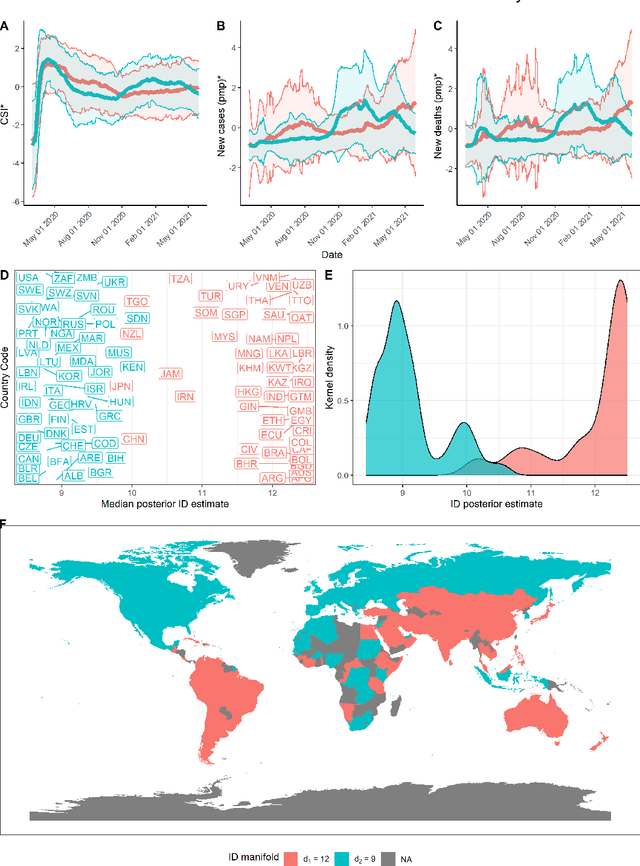
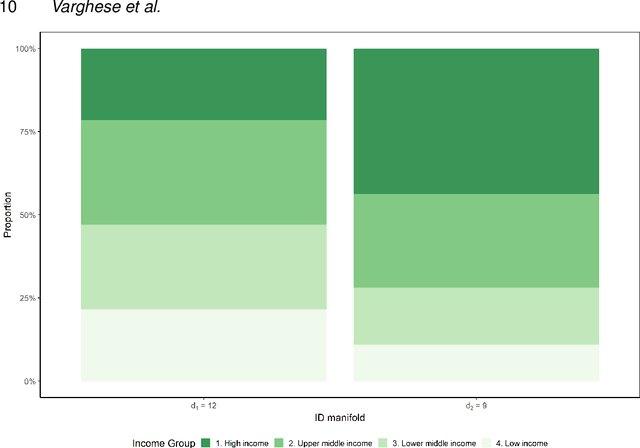
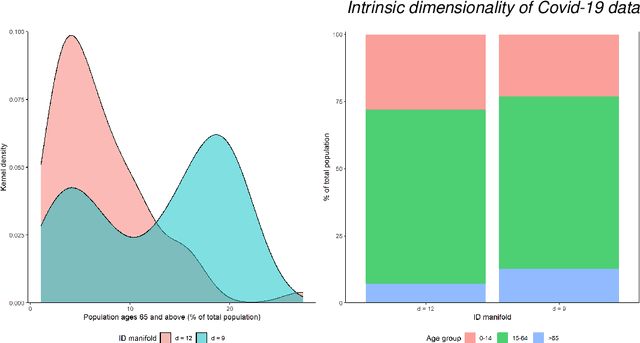
This paper aims to develop a global perspective of the complexity of the relationship between the standardised per-capita growth rate of Covid-19 cases, deaths, and the OxCGRT Covid-19 Stringency Index, a measure describing a country's stringency of lockdown policies. To achieve our goal, we use a heterogeneous intrinsic dimension estimator implemented as a Bayesian mixture model, called Hidalgo. We identify that the Covid-19 dataset may project onto two low-dimensional manifolds without significant information loss. The low dimensionality suggests strong dependency among the standardised growth rates of cases and deaths per capita and the OxCGRT Covid-19 Stringency Index for a country over 2020-2021. Given the low dimensional structure, it may be feasible to model observable Covid-19 dynamics with few parameters. Importantly, we identify spatial autocorrelation in the intrinsic dimension distribution worldwide. Moreover, we highlight that high-income countries are more likely to lie on low-dimensional manifolds, likely arising from aging populations, comorbidities, and increased per capita mortality burden from Covid-19. Finally, we temporally stratify the dataset to examine the intrinsic dimension at a more granular level throughout the Covid-19 pandemic.