 Add to Chrome
 Add to Firefox
 Add to Edge
Only Whats Necessary: Pareto Optimal Data Minimization for Privacy Preserving Video Anomaly Detection
Mar 27, 2026
Video anomaly detection (VAD) systems are increasingly deployed in safety critical environments and require a large amount of data for accurate detection. However, such data may contain personally identifiable information (PII), including facial cues and sensitive demographic attributes, creating compliance challenges under the EU General Data Protection Regulation (GDPR). In particular, GDPR requires that personal data be limited to what is strictly necessary for a specified processing purpose. To address this, we introduce Only What's Necessary, a privacy-by-design framework for VAD that explicitly controls the amount and type of visual information exposed to the detection pipeline. The framework combines breadth based and depth based data minimization mechanisms to suppress PII while preserving cues relevant to anomaly detection. We evaluate a range of minimization configurations by feeding the minimized videos to both a VAD model and a privacy inference model. We employ two ranking based methods, along with Pareto analysis, to characterize the resulting trade off between privacy and utility. From the non-dominated frontier, we identify sweet spot operating points that minimize personal data exposure with limited degradation in detection performance. Extensive experiments on publicly available datasets demonstrate the effectiveness of the proposed framework.

From Pixels to Privacy: Temporally Consistent Video Anonymization via Token Pruning for Privacy Preserving Action Recognition
Mar 27, 2026Recent advances in large-scale video models have significantly improved video understanding across domains such as surveillance, healthcare, and entertainment. However, these models also amplify privacy risks by encoding sensitive attributes, including facial identity, race, and gender. While image anonymization has been extensively studied, video anonymization remains relatively underexplored, even though modern video models can leverage spatiotemporal motion patterns as biometric identifiers. To address this challenge, we propose a novel attention-driven spatiotemporal video anonymization framework based on systematic disentanglement of utility and privacy features. Our key insight is that attention mechanisms in Vision Transformers (ViTs) can be explicitly structured to separate action-relevant information from privacy-sensitive content. Building on this insight, we introduce two task-specific classification tokens, an action CLS token and a privacy CLS token, that learn complementary representations within a shared Transformer backbone. We contrast their attention distributions to compute a utility-privacy score for each spatiotemporal tubelet, and keep the top-k tubelets with the highest scores. This selectively prunes tubelets dominated by privacy cues while preserving those most critical for action recognition. Extensive experiments demonstrate that our approach maintains action recognition performance comparable to models trained on raw videos, while substantially reducing privacy leakage. These results indicate that attention-driven spatiotemporal pruning offers an effective and principled solution for privacy-preserving video analytics.
Autoregressive Adaptive Hypergraph Transformer for Skeleton-based Activity Recognition
Nov 08, 2024
Extracting multiscale contextual information and higher-order correlations among skeleton sequences using Graph Convolutional Networks (GCNs) alone is inadequate for effective action classification. Hypergraph convolution addresses the above issues but cannot harness the long-range dependencies. Transformer proves to be effective in capturing these dependencies and making complex contextual features accessible. We propose an Autoregressive Adaptive HyperGraph Transformer (AutoregAd-HGformer) model for in-phase (autoregressive and discrete) and out-phase (adaptive) hypergraph generation. The vector quantized in-phase hypergraph equipped with powerful autoregressive learned priors produces a more robust and informative representation suitable for hyperedge formation. The out-phase hypergraph generator provides a model-agnostic hyperedge learning technique to align the attributes with input skeleton embedding. The hybrid (supervised and unsupervised) learning in AutoregAd-HGformer explores the action-dependent feature along spatial, temporal, and channel dimensions. The extensive experimental results and ablation study indicate the superiority of our model over state-of-the-art hypergraph architectures on NTU RGB+D, NTU RGB+D 120, and NW-UCLA datasets.
CFAT: Unleashing TriangularWindows for Image Super-resolution
Mar 24, 2024
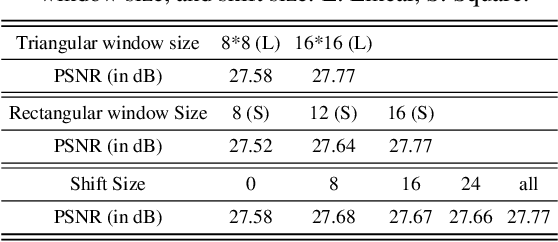
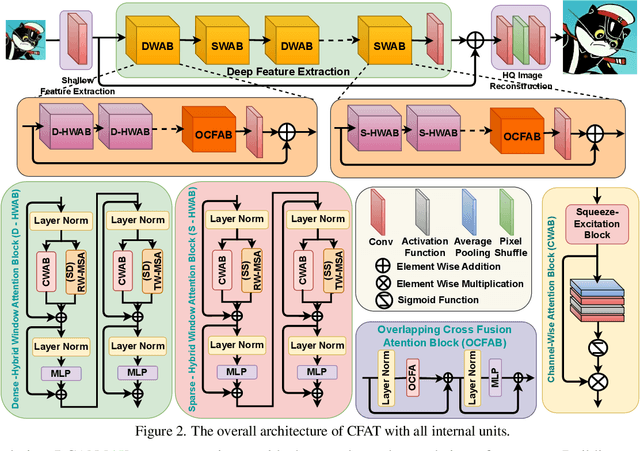
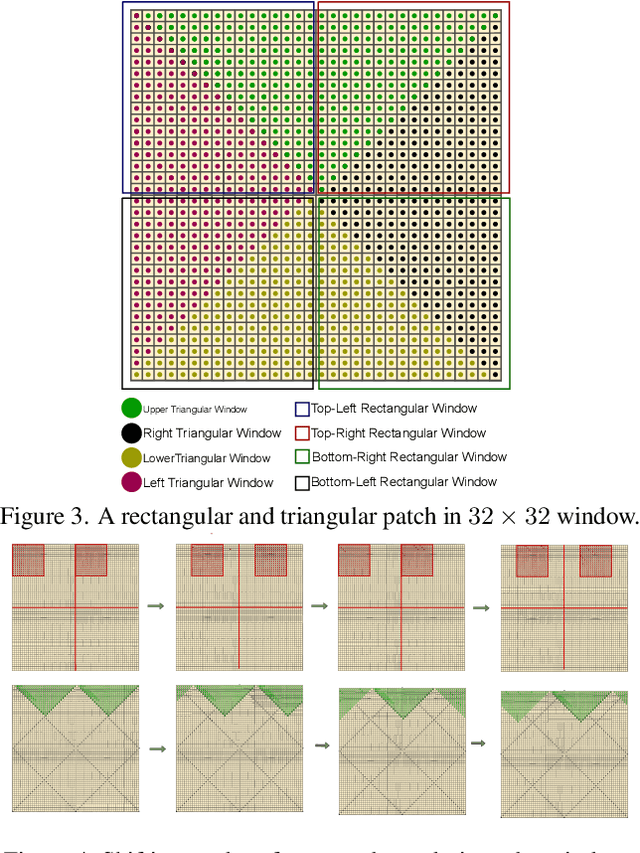
Transformer-based models have revolutionized the field of image super-resolution (SR) by harnessing their inherent ability to capture complex contextual features. The overlapping rectangular shifted window technique used in transformer architecture nowadays is a common practice in super-resolution models to improve the quality and robustness of image upscaling. However, it suffers from distortion at the boundaries and has limited unique shifting modes. To overcome these weaknesses, we propose a non-overlapping triangular window technique that synchronously works with the rectangular one to mitigate boundary-level distortion and allows the model to access more unique sifting modes. In this paper, we propose a Composite Fusion Attention Transformer (CFAT) that incorporates triangular-rectangular window-based local attention with a channel-based global attention technique in image super-resolution. As a result, CFAT enables attention mechanisms to be activated on more image pixels and captures long-range, multi-scale features to improve SR performance. The extensive experimental results and ablation study demonstrate the effectiveness of CFAT in the SR domain. Our proposed model shows a significant 0.7 dB performance improvement over other state-of-the-art SR architectures.