 Add to Chrome
 Add to Firefox
 Add to Edge
CIFA: Contextual-Intersectional Fairness Auditing for Hidden Subgroup Discovery in Face Analysis
Aug 10, 2026
Fairness evaluation in computer vision commonly relies on aggregate accuracy and demographic subgroup analysis. However, visual models are also sensitive to contextual factors such as illumination, blur, image quality, facial accessories, and appearance attributes. These factors may interact with demographic characteristics, producing hidden subgroups in which performance degrades substantially despite strong aggregate accuracy and apparently acceptable demographic fairness. To address this, we propose the Contextual-Intersectional Fairness Auditing Framework (CIFA), a structured framework for identifying subgroup vulnerabilities arising from interactions between demographic and contextual attributes. CIFA performs demographic, contextual, and contextual-intersectional auditing, followed by worst-group discovery to identify and rank the most vulnerable attribute combinations. We evaluate CIFA on gender classification using ResNet-50 \cite{he2016deep} and ViT-B/16 \cite{dosovitskiy2020image} across FairFace \cite{Karkkainen2021}, CelebA \cite{Liu2015}, and UTKFace \cite{Zhang2017}. Our results show that aggregate accuracy and demographic-only evaluation can mask substantial contextual-intersectional disparities. We further assess several established mitigation strategies through an audit--mitigate--reaudit protocol and find that, although some worst-group disparities are reduced, no single strategy consistently eliminates them across datasets and architectures. These findings establish contextual-intersectional auditing as an important component of fairness evaluation and provide a reproducible framework for discovering, prioritizing, and reassessing hidden subgroup risks in face analysis systems.

Only Whats Necessary: Pareto Optimal Data Minimization for Privacy Preserving Video Anomaly Detection
Mar 27, 2026Video anomaly detection (VAD) systems are increasingly deployed in safety critical environments and require a large amount of data for accurate detection. However, such data may contain personally identifiable information (PII), including facial cues and sensitive demographic attributes, creating compliance challenges under the EU General Data Protection Regulation (GDPR). In particular, GDPR requires that personal data be limited to what is strictly necessary for a specified processing purpose. To address this, we introduce Only What's Necessary, a privacy-by-design framework for VAD that explicitly controls the amount and type of visual information exposed to the detection pipeline. The framework combines breadth based and depth based data minimization mechanisms to suppress PII while preserving cues relevant to anomaly detection. We evaluate a range of minimization configurations by feeding the minimized videos to both a VAD model and a privacy inference model. We employ two ranking based methods, along with Pareto analysis, to characterize the resulting trade off between privacy and utility. From the non-dominated frontier, we identify sweet spot operating points that minimize personal data exposure with limited degradation in detection performance. Extensive experiments on publicly available datasets demonstrate the effectiveness of the proposed framework.
From Pixels to Privacy: Temporally Consistent Video Anonymization via Token Pruning for Privacy Preserving Action Recognition
Mar 27, 2026Recent advances in large-scale video models have significantly improved video understanding across domains such as surveillance, healthcare, and entertainment. However, these models also amplify privacy risks by encoding sensitive attributes, including facial identity, race, and gender. While image anonymization has been extensively studied, video anonymization remains relatively underexplored, even though modern video models can leverage spatiotemporal motion patterns as biometric identifiers. To address this challenge, we propose a novel attention-driven spatiotemporal video anonymization framework based on systematic disentanglement of utility and privacy features. Our key insight is that attention mechanisms in Vision Transformers (ViTs) can be explicitly structured to separate action-relevant information from privacy-sensitive content. Building on this insight, we introduce two task-specific classification tokens, an action CLS token and a privacy CLS token, that learn complementary representations within a shared Transformer backbone. We contrast their attention distributions to compute a utility-privacy score for each spatiotemporal tubelet, and keep the top-k tubelets with the highest scores. This selectively prunes tubelets dominated by privacy cues while preserving those most critical for action recognition. Extensive experiments demonstrate that our approach maintains action recognition performance comparable to models trained on raw videos, while substantially reducing privacy leakage. These results indicate that attention-driven spatiotemporal pruning offers an effective and principled solution for privacy-preserving video analytics.
Balancing Privacy and Action Performance: A Penalty-Driven Approach to Image Anonymization
Apr 19, 2025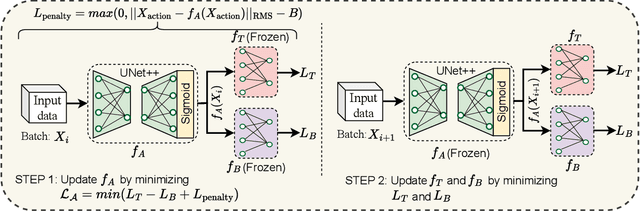
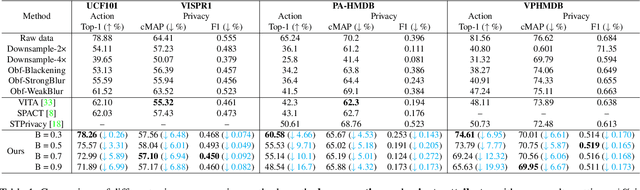
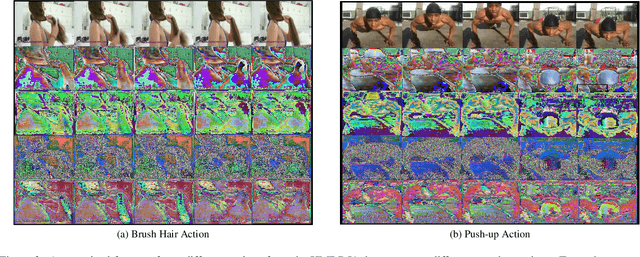
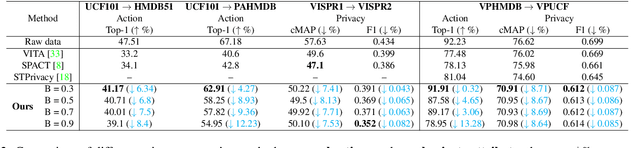
The rapid development of video surveillance systems for object detection, tracking, activity recognition, and anomaly detection has revolutionized our day-to-day lives while setting alarms for privacy concerns. It isn't easy to strike a balance between visual privacy and action recognition performance in most computer vision models. Is it possible to safeguard privacy without sacrificing performance? It poses a formidable challenge, as even minor privacy enhancements can lead to substantial performance degradation. To address this challenge, we propose a privacy-preserving image anonymization technique that optimizes the anonymizer using penalties from the utility branch, ensuring improved action recognition performance while minimally affecting privacy leakage. This approach addresses the trade-off between minimizing privacy leakage and maintaining high action performance. The proposed approach is primarily designed to align with the regulatory standards of the EU AI Act and GDPR, ensuring the protection of personally identifiable information while maintaining action performance. To the best of our knowledge, we are the first to introduce a feature-based penalty scheme that exclusively controls the action features, allowing freedom to anonymize private attributes. Extensive experiments were conducted to validate the effectiveness of the proposed method. The results demonstrate that applying a penalty to anonymizer from utility branch enhances action performance while maintaining nearly consistent privacy leakage across different penalty settings.