 Add to Chrome
 Add to Firefox
 Add to Edge
"Rebuilding" Statistics in the Age of AI: A Town Hall Discussion on Culture, Infrastructure, and Training
Jan 24, 2026
This article presents the full, original record of the 2024 Joint Statistical Meetings (JSM) town hall, "Statistics in the Age of AI," which convened leading statisticians to discuss how the field is evolving in response to advances in artificial intelligence, foundation models, large-scale empirical modeling, and data-intensive infrastructures. The town hall was structured around open panel discussion and extensive audience Q&A, with the aim of eliciting candid, experience-driven perspectives rather than formal presentations or prepared statements. This document preserves the extended exchanges among panelists and audience members, with minimal editorial intervention, and organizes the conversation around five recurring questions concerning disciplinary culture and practices, data curation and "data work," engagement with modern empirical modeling, training for large-scale AI applications, and partnerships with key AI stakeholders. By providing an archival record of this discussion, the preprint aims to support transparency, community reflection, and ongoing dialogue about the evolving role of statistics in the data- and AI-centric future.

Dirichlet process mixtures of block $g$ priors for model selection and prediction in linear models
Nov 01, 2024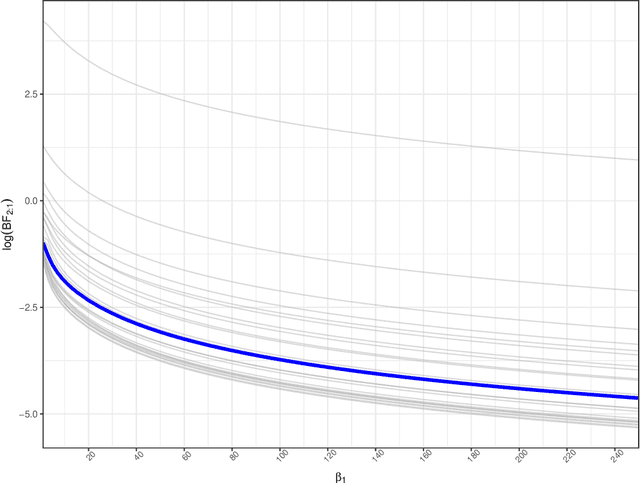

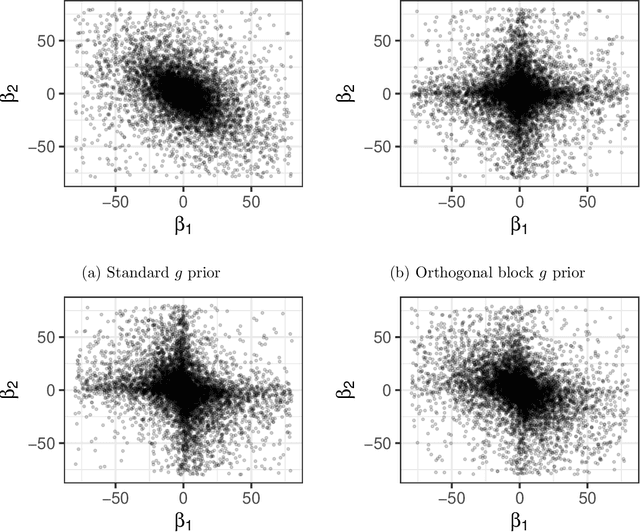
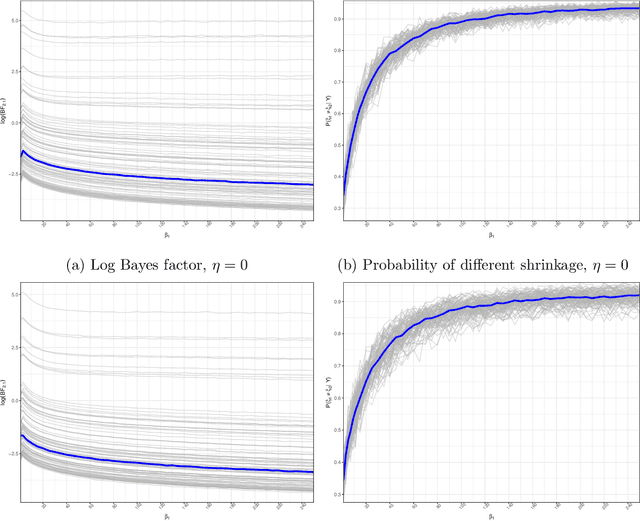
This paper introduces Dirichlet process mixtures of block $g$ priors for model selection and prediction in linear models. These priors are extensions of traditional mixtures of $g$ priors that allow for differential shrinkage for various (data-selected) blocks of parameters while fully accounting for the predictors' correlation structure, providing a bridge between the literatures on model selection and continuous shrinkage priors. We show that Dirichlet process mixtures of block $g$ priors are consistent in various senses and, in particular, that they avoid the conditional Lindley ``paradox'' highlighted by Som et al.(2016). Further, we develop a Markov chain Monte Carlo algorithm for posterior inference that requires only minimal ad-hoc tuning. Finally, we investigate the empirical performance of the prior in various real and simulated datasets. In the presence of a small number of very large effects, Dirichlet process mixtures of block $g$ priors lead to higher power for detecting smaller but significant effects without only a minimal increase in the number of false discoveries.