 Add to Chrome
 Add to Firefox
 Add to Edge
PEFT-MedSAM: Efficient Fine-Tuning of Medical Foundation Models for Explainable Skin Lesion Segmentation
Jun 17, 2026
Automated segmentation of skin lesions using deep learning models for dermoscopic images can be very helpful in finding melanomas earlier than they would normally be detected. However, most deep learning methods available do not perform well. The aim of this paper is to present a parameter-efficient fine-tuning method called PEFT-MedSAM for adapting the Medical Segment Anything Model (MedSAM) to automatically segment dermoscopic skin lesions. The PEFT-MedSAM method uses only the lightweight mask decoder for training the model while keeping the pre-trained image encoder and prompt encoder frozen. The experiments performed on the ISIC 2018 benchmark dataset shows that PEFT-MedSAM obtains a dice coefficient of .9411 and an intersection over union value of .8918 when compared to both a fully trained U-Net baseline (.8715 dice coefficient) and zero-shot MedSAM inference (.8997 dice coefficient). The external validation of the model using PH2 dataset shows .9467 dice coefficient with +/- .0310 standard deviation. Supportive evidence for these claims include a p-value less than .0001 for Wilcoxon signed rank tests comparing the two datasets and bootstrap-estimated 95% confidence intervals of [.9364,.9447] that represent the estimated range of possible values for the average dice coefficient obtained by repeating the test. To increase clinical trustworthiness, we used Grad-CAM explainability along with a pointing game based evaluation methodology to evaluate the CNN baseline model on the validation set. The results showed that we had an accuracy rate of 98.27% on the validation set of 519 images and confirmed that the model classified regions containing skin lesions.

FaultExplainer: Leveraging Large Language Models for Interpretable Fault Detection and Diagnosis
Dec 19, 2024Machine learning algorithms are increasingly being applied to fault detection and diagnosis (FDD) in chemical processes. However, existing data-driven FDD platforms often lack interpretability for process operators and struggle to identify root causes of previously unseen faults. This paper presents FaultExplainer, an interactive tool designed to improve fault detection, diagnosis, and explanation in the Tennessee Eastman Process (TEP). FaultExplainer integrates real-time sensor data visualization, Principal Component Analysis (PCA)-based fault detection, and identification of top contributing variables within an interactive user interface powered by large language models (LLMs). We evaluate the LLMs' reasoning capabilities in two scenarios: one where historical root causes are provided, and one where they are not to mimic the challenge of previously unseen faults. Experimental results using GPT-4o and o1-preview models demonstrate the system's strengths in generating plausible and actionable explanations, while also highlighting its limitations, including reliance on PCA-selected features and occasional hallucinations.
Untangling Braids with Multi-agent Q-Learning
Sep 29, 2021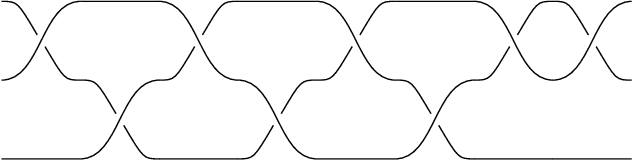
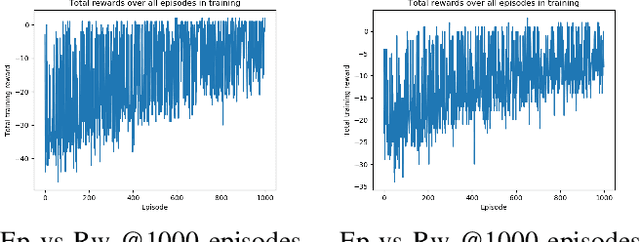
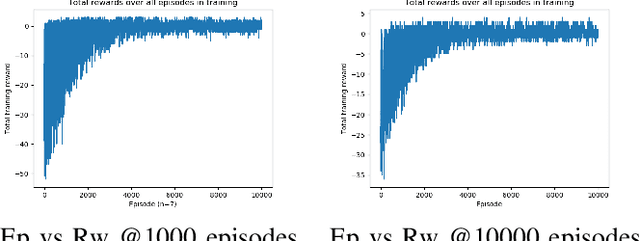
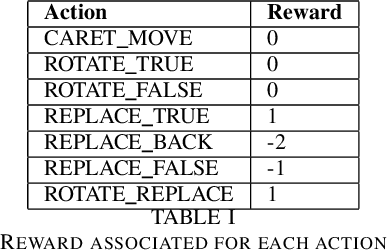
We use reinforcement learning to tackle the problem of untangling braids. We experiment with braids with 2 and 3 strands. Two competing players learn to tangle and untangle a braid. We interface the braid untangling problem with the OpenAI Gym environment, a widely used way of connecting agents to reinforcement learning problems. The results provide evidence that the more we train the system, the better the untangling player gets at untangling braids. At the same time, our tangling player produces good examples of tangled braids.