 Add to Chrome
 Add to Firefox
 Add to Edge
Evidential Domain Adaptation for Remaining Useful Life Prediction with Incomplete Degradation
Mar 15, 2026
Accurate Remaining Useful Life (RUL) prediction without labeled target domain data is a critical challenge, and domain adaptation (DA) has been widely adopted to address it by transferring knowledge from a labeled source domain to an unlabeled target domain. Despite its success, existing DA methods struggle significantly when faced with incomplete degradation trajectories in the target domain, particularly due to the absence of late degradation stages. This missing data introduces a key extrapolation challenge. When applied to such incomplete RUL prediction tasks, current DA methods encounter two primary limitations. First, most DA approaches primarily focus on global alignment, which can misaligns late degradation stage in the source domain with early degradation stage in the target domain. Second, due to varying operating conditions in RUL prediction, degradation patterns may differ even within the same degradation stage, resulting in different learned features. As a result, even if degradation stages are partially aligned, simple feature matching cannot fully align two domains. To overcome these limitations, we propose a novel evidential adaptation approach called EviAdapt, which leverages evidential learning to enhance domain adaptation. The method first segments the source and target domain data into distinct degradation stages based on degradation rate, enabling stage-wise alignment that ensures samples from corresponding stages are accurately matched. To address the second limitation, we introduce an evidential uncertainty alignment technique that estimates uncertainty using evidential learning and aligns the uncertainty across matched stages.

EverAdapt: Continuous Adaptation for Dynamic Machine Fault Diagnosis Environments
Jul 24, 2024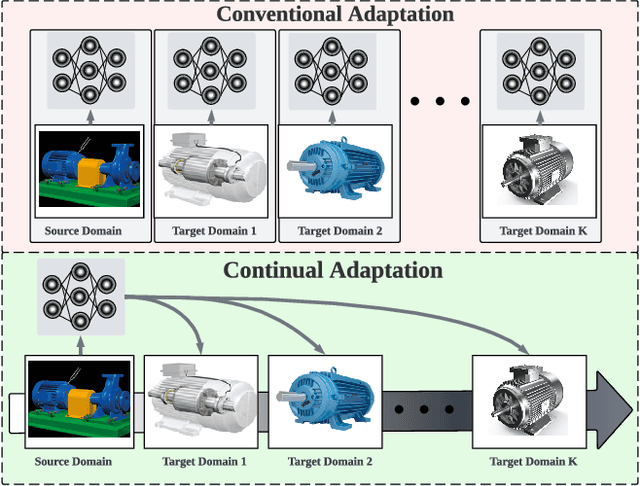
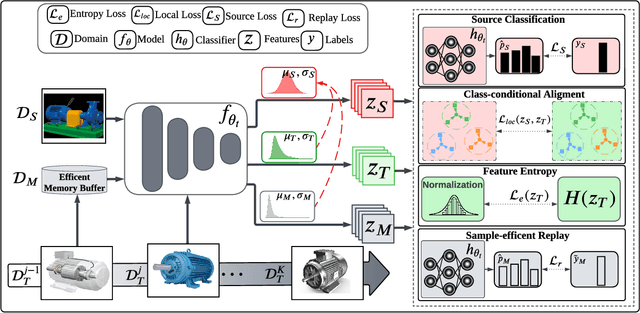
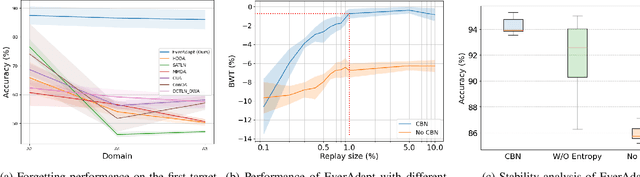
Unsupervised Domain Adaptation (UDA) has emerged as a key solution in data-driven fault diagnosis, addressing domain shift where models underperform in changing environments. However, under the realm of continually changing environments, UDA tends to underperform on previously seen domains when adapting to new ones - a problem known as catastrophic forgetting. To address this limitation, we introduce the EverAdapt framework, specifically designed for continuous model adaptation in dynamic environments. Central to EverAdapt is a novel Continual Batch Normalization (CBN), which leverages source domain statistics as a reference point to standardize feature representations across domains. EverAdapt not only retains statistical information from previous domains but also adapts effectively to new scenarios. Complementing CBN, we design a class-conditional domain alignment module for effective integration of target domains, and a Sample-efficient Replay strategy to reinforce memory retention. Experiments on real-world datasets demonstrate EverAdapt superiority in maintaining robust fault diagnosis in dynamic environments. Our code is available: https://github.com/mohamedr002/EverAdapt