 Add to Chrome
 Add to Firefox
 Add to Edge
WALoMA: A Multitask Wireless Foundation Model via Adaptive Low-Rank Masked Autoencoders
Jul 28, 2026
This paper proposes a multitask wireless foundation model via adaptive low-rank masked autoencoders (WALoMA), a unified multi-task foundation model for sixth-generation (6G) wireless physical layer architectures, to address the limitations of specialized, task-specific deep learning models and the practical challenge of scarce labeled wireless datasets. By leveraging concepts inspired by foundation models, the proposed framework adopts a masked autoencoder (MAE) paradigm to learn from unlabeled channel data, to significantly reduce reliance on extensive annotations. The model treats wireless channel state information (CSI) as a universal modality and learns transferable representations through self-supervised channel reconstruction. Key architectural novelties include the use of 2D positional encoding (PE) to explicitly preserve the spatial-frequency relationships between antennas and subcarriers, and low-rank adaptation (LoRA) for parameter-efficient fine-tuning. The framework's efficacy is demonstrated across five downstream tasks, achieving individual scores of 96.47\% for LoS/NLoS classification, 80.45\% for beam prediction, 85.78\% for channel interpolation, 99.12\% for channel estimation, and 77.18\% for channel charting. Consequently, numerical results show that the proposed model achieves a composite score of 87.80\%, significantly outperforming the 59.90\% achieved by the large wireless model (LWM) baseline while training an average of only 14.68\% of total parameters, and maintaining strong performance even under extremely limited labeled data conditions.

Boosting Spectral Efficiency via Spatial Path Index Modulation in RIS-Aided mMIMO
Mar 13, 2026Next generation wireless networks focus on improving spectral efficiency (SE) while reducing power consumption and hardware cost. Reconfigurable intelligent surfaces (RISs) offer a viable solution to meet these requirements. In order to enhance the SE, index modulation (IM) has been regarded as one of the enabling technologies via the transmission of additional information bits over the transmission media such as subcarriers, antennas and spatial paths. In this work, we explore the usage of spatial paths and introduce spatial path IM (SPIM) for RIS-aided massive multiple-input multiple-output (mMIMO) systems. Thus, the proposed framework improves the network efficiency and the coverage with the use of RIS while SPIM provides SE improvement. In order to perform SPIM, we exploit the spatial diversity of the millimeter wave channel and assign the index bits to the spatial patterns of the channel between the base station and the users through RIS. We introduce a low complexity approach for the design of hybrid beamformers, which are constructed by the steering vectors corresponding to the selected spatial path indices for SPIM-mMIMO. Furthermore, we conduct a theoretical analysis on the SE of the proposed SPIM approach, and derive the SE relationship between the SPIM-based hybrid beamforming and fully digital (FD) beamforming. Via numerical simulations, we validate our theoretical results and show that the proposed SPIM approach presents an improved SE performance, even higher than that of the use of FD beamformers while using a few RF chains.
Array Geometry-Centric Axial Sidelobe Interference Analysis for Near-Field Multi-User MIMO
Mar 12, 2026With the deployment of large antenna arrays at high-frequency bands, future wireless communication systems are likely to operate in the radiative near-field (NF). Unlike far-field beam steering, NF beams can be focused on a spatial region with finite depth, enabling user multiplexing in both range and angle. In NF multiuser multiple-input multiple-output (MU-MIMO) systems, achievable rates are limited by interference arising from sidelobes in both the axial (range) and lateral (angle) dimensions. This work investigates how axial sidelobes (ASLs) vary with array geometry. Closed-form array gain expressions are derived to characterize ASLs for uniform planar arrays. Analytical results show that the uniform square array (USA) yields the lowest ASLs, followed by the uniform concentric circular array (UCCA), uniform linear array (ULA), and uniform circular array (UCA). Specifically, the USA achieves a peak sidelobe level (PSLL) of -17.6 dB versus -7.9 dB for the UCA. Numerical simulations confirm that the USA provides superior sidelobe suppression and highest sumrate performance.
Analyzing URA Geometry for Enhanced Near-Field Beamfocusing and Spatial Degrees of Freedom
Feb 25, 2026With the deployment of large antenna arrays at high-frequency bands, future wireless communication systems are likely to operate in the radiative near-field. Unlike far-field beam steering, near-field beams can be focused on a spatial region with a finite depth, enabling spatial multiplexing in the range dimension. Moreover, in the line-of-sight MIMO near-field, multiple spatial degrees of freedom (DoF) are accessible, akin to a scattering- rich environment. In this paper, we derive the beamdepth for a generalized uniform rectangular array (URA) and investigate how the array geometry influences near-field beamdepth and its limits. We define the effective beamfocusing Rayleigh distance (EBRD), to present a near-field boundary with respect to beamfocusing and spatial multiplexing gains for the generalized URA. Our results demonstrate that under a fixed element count constraint, the array geometry has a strong impact on beamdepth, whereas this effect diminishes under a fixed aperture length constraint. Moreover, compared to uniform square arrays, elongated configurations such as uniform linear arrays (ULAs) yield narrower beamdepth and extend the effective near-field region defined by the EBRD. Building on these insights, we design a polar codebook for compressed-sensing-based channel estimation that leverages our findings. Simulation results show that the proposed polar codebook achieves a 2 dB NMSE improvement over state-of-the-art methods. Additionally, we present an analytical expression to quantify the effective spatial DoF in the near-field, revealing that they are also constrained by the EBRD. Notably, the maximum spatial DoF is achieved with a ULA configuration, outperforming a square URA in this regard.
Sparse Array Design for Near-Field MU-MIMO: Reconfigurable Array Thinning Approach
Feb 25, 2026Future wireless networks, deploying thousands of antenna elements, may operate in the radiative near-field (NF), enabling spatial multiplexing across both angle and range domains. Sparse arrays have the potential to achieve comparable performance with fewer antenna elements. However, fixed sparse array designs are generally suboptimal under dynamic user distributions, while movable antenna architectures rely on mechanically reconfigurable elements, introducing latency and increased hardware complexity. To address these limitations, we propose a reconfigurable array thinning approach that selectively activates a subset of antennas to form a flexible sparse array design without physical repositioning. We first analyze grating lobes for uniform sparse arrays in the angle and range domains, showing their absence along the range dimension. Based on the analysis, we develop two particle swarm optimization-based strategies: a grating-lobe-based thinned array (GTA) for grating- lobe suppression and a sum-rate-based thinned array (STA) for multiuser sum-rate maximization. Simulation results demonstrate that GTA outperforms conventional uniform sparse arrays, while STA achieves performance comparable to movable antennas, thereby offering a practical and efficient array deployment strategy without the associated mechanical complexity.
Spatial Degrees of Freedom in Near Field MIMO: Experimental Validation of Beamspace Perspective
Feb 25, 2026Conventional far-field multiple-input multiple-output (MIMO) channels are limited to a single spatial degree of freedom (DoF) under a line-of-sight (LoS) condition. In contrast, the radiative near field (NF) supports multiple spatial DoF, enabled by spherical wavefronts and the reduced spatial footprint at short ranges. While recent research indicates that the effective DoF (EDoF) increases in NF, experimental validation and clear identification of the transition distances remain limited. In this letter, we develop an intuitive framework for characterizing the EDoF of a ULA-based MIMO system and derive two complementary analytical expressions: a closed-form formulation that relates the EDoF to the physical transmit beamwidth and receive aperture, and a discrete formulation based on the discrete Fourier transform (DFT) domain angular decomposition of the NF spherical wavefront, which is well suited for experimental evaluation. We further introduce the effective MIMO Rayleigh distance (EMRD) and the maximum spatial multiplexing distance (MSMD), which mark the distances where the EDoF reduces to one and attains its maximum, respectively. Experimental measurements using widely spaced phased arrays closely match the theoretical EDoF trends and validate the proposed distance metrics.
Near Field Tapering with Slepian Window: Balancing the Range Angle Sidelobe Trade off
Nov 16, 2025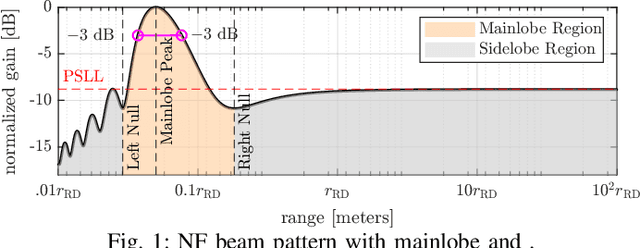
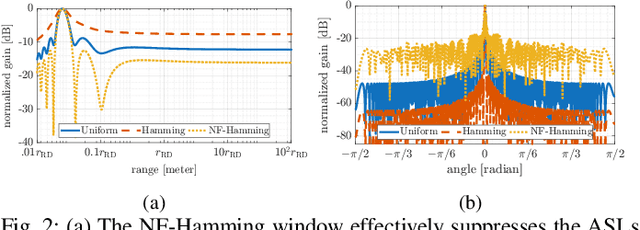
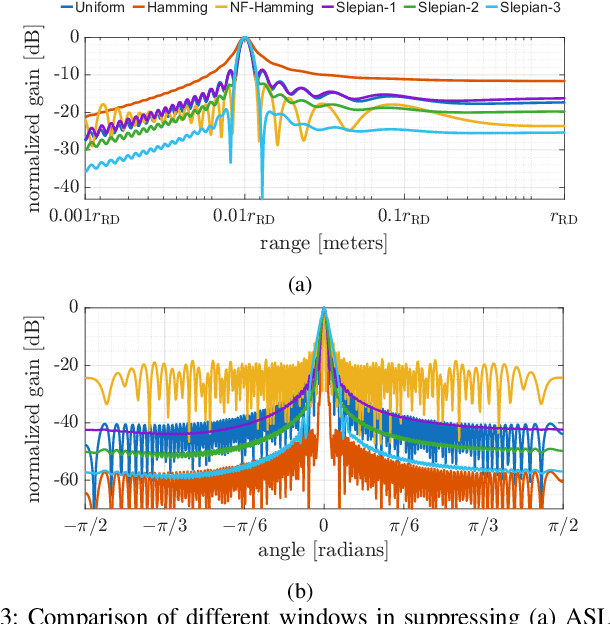
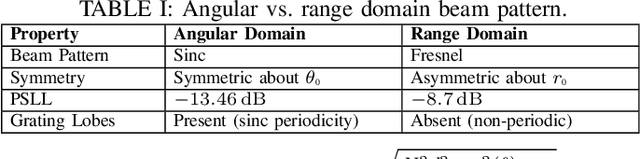
Near-field beamforming enables target discrimination in both range (axial) and angle (lateral) dimensions. Elevated sidelobes along either dimension, however, increase susceptibility to interference and degrade detection performance. Conventional amplitude tapering techniques, designed for far-field scenarios, cannot simultaneously suppress axial and lateral sidelobes in near-field. In this letter, we propose a Slepian-based amplitude tapering approach that maximizes mainlobe energy concentration, achieving significant sidelobe reduction in both dimensions. Numerical results show that the proposed taper improves peak sidelobe suppression by approximately 24 dB in the lateral domain and 10 dB in the axial domain compared to a conventional uniform window.
Uniform Circular Arrays in Near-Field: Omnidirectional Coverage with Limited Capacity
Nov 16, 2025Recent studies suggest that uniform circular arrays (UCAs) can extend the angular coverage of the radiative near field region. This work investigates whether such enhanced angular coverage translates into improved spatial multiplexing performance when compared to uniform linear arrays (ULAs). To more accurately delineate the effective near field region, we introduce the effective beamfocusing Rayleigh distance (EBRD), an angle dependent metric that bounds the spatial region where beamfocusing remains effective. Closed form expressions for both beamdepth and EBRD are derived for UCAs. Our analysis shows that, under a fixed antenna element count, ULAs achieve narrower beamdepth and a longer EBRD than UCAs. Conversely, under a fixed aperture length, UCAs provide slightly narrower beamdepth and a marginally longer EBRD. Simulation results further confirm that ULAs achieve higher sum rate under the fixed element constraint, while UCAs offer marginal performance gain under the fixed aperture constraint.
Joint Motion, Angle, and Range Estimation in Near-Field under Array Calibration Imperfections
Jul 17, 2025Ultra-massive multiple-input multiple-output MIMO (UM-MIMO) leverages large antenna arrays at high frequencies, transitioning communication paradigm into the radiative near-field (NF), where spherical wavefronts enable full-vector estimation of both target location and velocity. However, location and motion parameters become inherently coupled in this regime, making their joint estimation computationally demanding. To overcome this, we propose a novel approach that projects the received two-dimensional space-time signal onto the angle-Doppler domain using a two-dimensional discrete Fourier transform (2D-DFT). Our analysis reveals that the resulting angular spread is centered at the target's true angle, with its width determined by the target's range. Similarly, transverse motion induces a Doppler spread centered at the true radial velocity, with the width of Doppler spread proportional to the transverse velocity. Exploiting these spectral characteristics, we develop a low-complexity algorithm that provides coarse estimates of angle, range, and velocity, which are subsequently refined using one-dimensional multiple signal classification (MUSIC) applied independently to each parameter. The proposed method enables accurate and efficient estimation of NF target motion parameters. Simulation results demonstrate a normalized mean squared error (NMSE) of -40 dB for location and velocity estimates compared to maximum likelihood estimation, while significantly reducing computational complexity.
Analyzing URA Geometry for Enhanced Spatial Multiplexing and Extended Near-Field Coverage
Jun 18, 2025With the deployment of large antenna arrays at high frequency bands, future wireless communication systems are likely to operate in the radiative near-field. Unlike far-field beam steering, near-field beams can be focused within a spatial region of finite depth, enabling spatial multiplexing in both the angular and range dimensions. This paper derives the beamdepth for a generalized uniform rectangular array (URA) and investigates how array geometry influences the near-field beamdepth and the limits where near-field beamfocusing is achievable. To characterize the near-field boundary in terms of beamfocusing and spatial multiplexing gains, we define the effective beamfocusing Rayleigh distance (EBRD) for a generalized URA. Our analysis reveals that while a square URA achieves the narrowest beamdepth, the EBRD is maximized for a wide or tall URA. However, despite its narrow beamdepth, a square URA may experience a reduction in multiuser sum rate due to its severely constrained EBRD. Simulation results confirm that a wide or tall URA achieves a sum rate of 3.5 X more than that of a square URA, benefiting from the extended EBRD and improved spatial multiplexing capabilities.