 Add to Chrome
 Add to Firefox
 Add to Edge
Actionable Activation Directions for Detecting and Mitigating Emergent Misalignment Across Language Model Families
Jun 18, 2026
Fine-tuning language models on insecure code induces emergent misalignment with poorly understood internal structure. We investigate whether this misalignment corresponds to a causally actionable activation-space direction shared across architectures. Across four instruction-tuned model families (Qwen2.5-1.5B, Gemma-2-2B, Llama-3.2-1B, Ministral-3-3B) finetuned identically, a difference-in-means direction achieves 99.6% separation of aligned and misaligned activations at each model's final layer. Causal steering by subtracting this direction reduces code spillover by 21-51 points, while a secure-code control confirms content specificity. Cross-architecture transfer via ridge regression maps yields large behavioral suppression (up to 46 points) but fails specificity controls as random and orthogonal directions perform comparably. We identify a two-tier specificity structure: within-model directions are causally specific and actionable; cross-model directions are causally real but non-specific. An asymmetric transfer topology emerges, with Gemma and Qwen acting as geometric donors and Llama as a receiver. These findings define the limits of linear cross-architecture correction and recommend within-model probing for auditing.

RAG for Effective Supply Chain Security Questionnaire Automation
Dec 18, 2024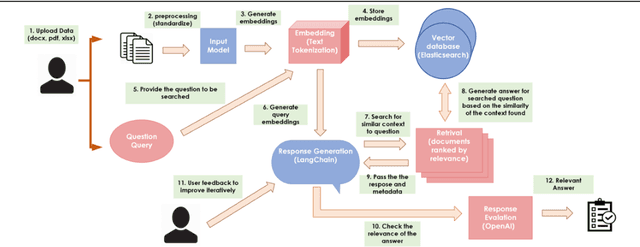
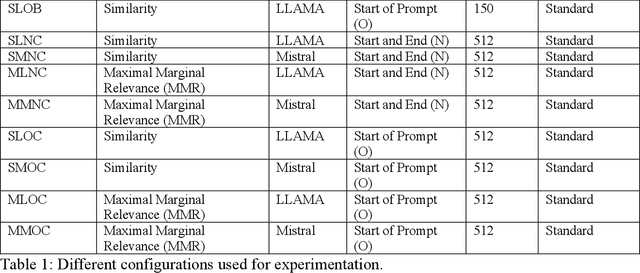
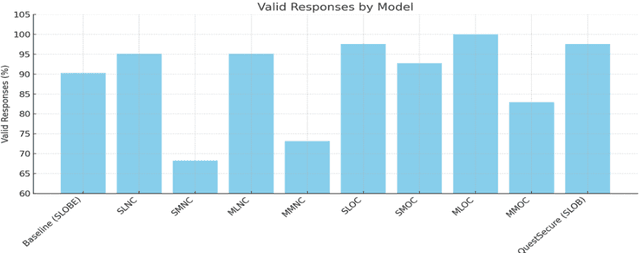
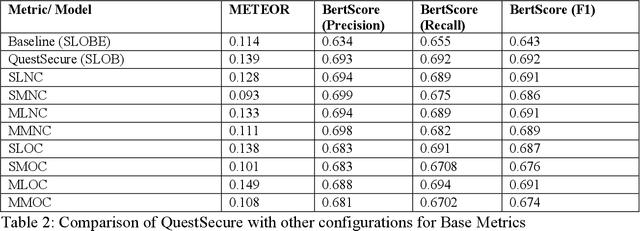
In an era where digital security is crucial, efficient processing of security-related inquiries through supply chain security questionnaires is imperative. This paper introduces a novel approach using Natural Language Processing (NLP) and Retrieval-Augmented Generation (RAG) to automate these responses. We developed QuestSecure, a system that interprets diverse document formats and generates precise responses by integrating large language models (LLMs) with an advanced retrieval system. Our experiments show that QuestSecure significantly improves response accuracy and operational efficiency. By employing advanced NLP techniques and tailored retrieval mechanisms, the system consistently produces contextually relevant and semantically rich responses, reducing cognitive load on security teams and minimizing potential errors. This research offers promising avenues for automating complex security management tasks, enhancing organizational security processes.