 Add to Chrome
 Add to Firefox
 Add to Edge
Analyzing Physical Adversarial Example Threats to Machine Learning in Election Systems
Feb 28, 2026
Developments in the machine learning voting domain have shown both promising results and risks. Trained models perform well on ballot classification tasks (> 99% accuracy) but are at risk from adversarial example attacks that cause misclassifications. In this paper, we analyze an attacker who seeks to deploy adversarial examples against machine learning ballot classifiers to compromise a U.S. election. We first derive a probabilistic framework for determining the number of adversarial example ballots that must be printed to flip an election, in terms of the probability of each candidate winning and the total number of ballots cast. Second, it is an open question as to which type of adversarial example is most effective when physically printed in the voting domain. We analyze six different types of adversarial example attacks: l_infinity-APGD, l2-APGD, l1-APGD, l0 PGD, l0 + l_infinity PGD, and l0 + sigma-map PGD. Our experiments include physical realizations of 144,000 adversarial examples through printing and scanning with four different machine learning models. We empirically demonstrate an analysis gap between the physical and digital domains, wherein attacks most effective in the digital domain (l2 and l_infinity) differ from those most effective in the physical domain (l1 and l2, depending on the model). By unifying a probabilistic election framework with digital and physical adversarial example evaluations, we move beyond prior close race analyses to explicitly quantify when and how adversarial ballot manipulation could alter outcomes.

Busting the Paper Ballot: Voting Meets Adversarial Machine Learning
Jun 17, 2025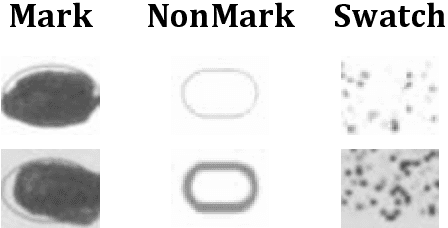
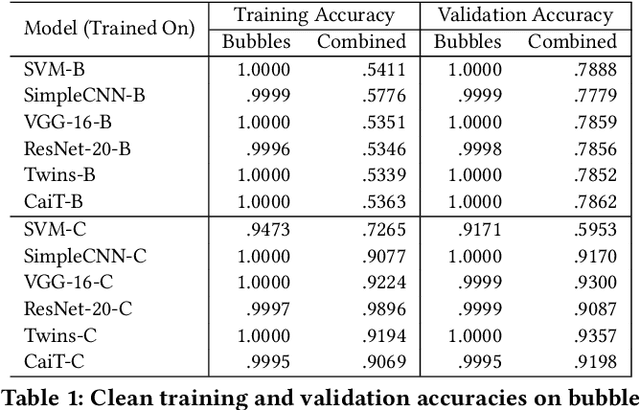
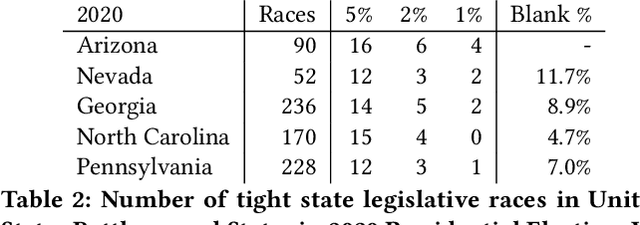
We show the security risk associated with using machine learning classifiers in United States election tabulators. The central classification task in election tabulation is deciding whether a mark does or does not appear on a bubble associated to an alternative in a contest on the ballot. Barretto et al. (E-Vote-ID 2021) reported that convolutional neural networks are a viable option in this field, as they outperform simple feature-based classifiers. Our contributions to election security can be divided into four parts. To demonstrate and analyze the hypothetical vulnerability of machine learning models on election tabulators, we first introduce four new ballot datasets. Second, we train and test a variety of different models on our new datasets. These models include support vector machines, convolutional neural networks (a basic CNN, VGG and ResNet), and vision transformers (Twins and CaiT). Third, using our new datasets and trained models, we demonstrate that traditional white box attacks are ineffective in the voting domain due to gradient masking. Our analyses further reveal that gradient masking is a product of numerical instability. We use a modified difference of logits ratio loss to overcome this issue (Croce and Hein, ICML 2020). Fourth, in the physical world, we conduct attacks with the adversarial examples generated using our new methods. In traditional adversarial machine learning, a high (50% or greater) attack success rate is ideal. However, for certain elections, even a 5% attack success rate can flip the outcome of a race. We show such an impact is possible in the physical domain. We thoroughly discuss attack realism, and the challenges and practicality associated with printing and scanning ballot adversarial examples.