 Add to Chrome
 Add to Firefox
 Add to Edge
Cerberus: Multi-Agent Reasoning and Coverage-Guided Exploration for Static Detection of Runtime Errors
Dec 24, 2025
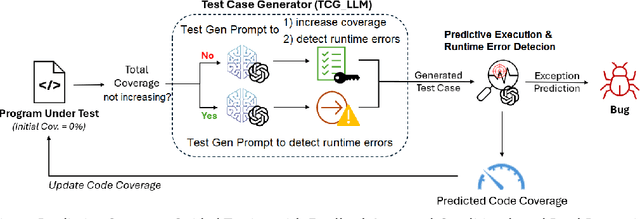
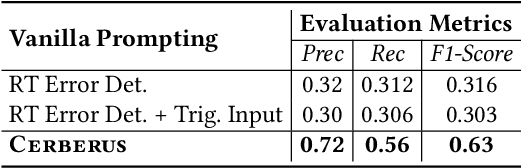
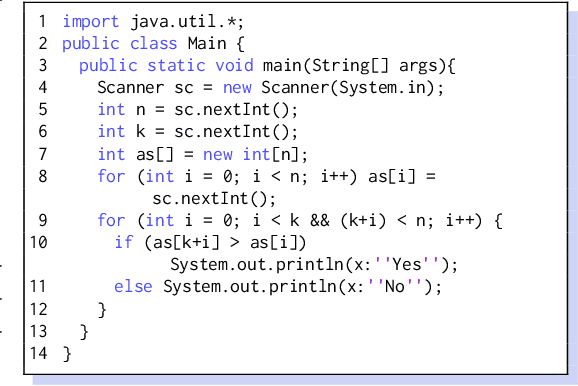
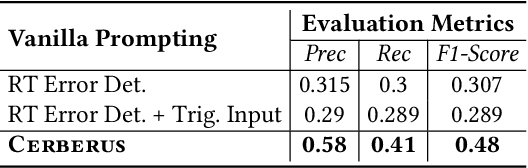
In several software development scenarios, it is desirable to detect runtime errors and exceptions in code snippets without actual execution. A typical example is to detect runtime exceptions in online code snippets before integrating them into a codebase. In this paper, we propose Cerberus, a novel predictive, execution-free coverage-guided testing framework. Cerberus uses LLMs to generate the inputs that trigger runtime errors and to perform code coverage prediction and error detection without code execution. With a two-phase feedback loop, Cerberus first aims to both increasing code coverage and detecting runtime errors, then shifts to focus only detecting runtime errors when the coverage reaches 100% or its maximum, enabling it to perform better than prompting the LLMs for both purposes. Our empirical evaluation demonstrates that Cerberus performs better than conventional and learning-based testing frameworks for (in)complete code snippets by generating high-coverage test cases more efficiently, leading to the discovery of more runtime errors.

Fuzzwise: Intelligent Initial Corpus Generation for Fuzzing
Dec 24, 2025In mutation-based greybox fuzzing, generating high-quality input seeds for the initial corpus is essential for effective fuzzing. Rather than conducting separate phases for generating a large corpus and subsequently minimizing it, we propose FuzzWise which integrates them into one process to generate the optimal initial corpus of seeds (ICS). FuzzWise leverages a multi-agent framework based on Large Language Models (LLMs). The first LLM agent generates test cases for the target program. The second LLM agent, which functions as a predictive code coverage module, assesses whether each generated test case will enhance the overall coverage of the current corpus. The streamlined process allows each newly generated test seed to be immediately evaluated for its contribution to the overall coverage. FuzzWise employs a predictive approach using an LLM and eliminates the need for actual execution, saving computational resources and time, particularly in scenarios where the execution is not desirable or even impossible. Our empirical evaluation demonstrates that FuzzWise generates significantly fewer test cases than baseline methods. Despite the lower number of test cases, FuzzWise achieves high code coverage and triggers more runtime errors compared to the baselines. Moreover, it is more time-efficient and coverage-efficient in producing an initial corpus catching more errors.