 Add to Chrome
 Add to Firefox
 Add to Edge
Task Robustness via Re-Labelling Vision-Action Robot Data
Jun 09, 2026
The recent trend in scaling models for robot learning has resulted in impressive policies that can perform various manipulation tasks and generalize to novel scenarios. However, these policies continue to struggle with following instructions, likely due to the limited linguistic and action sequence diversity in existing robotics datasets. This paper introduces Task Robustness via Re-Labelling Vision-Action Robot Data (TREAD), a scalable framework that leverages large Vision-Language Models (VLMs) to augment existing robotics datasets without additional data collection, harnessing the transferable knowledge embedded in these models. Our approach leverages a pretrained VLM through three stages: generating semantic sub-tasks from original instruction labels and initial scenes, segmenting demonstration videos conditioned on these sub-tasks, and producing diverse instructions that incorporate object properties, effectively decomposing longer demonstrations into grounded language-action pairs. We further enhance robustness by augmenting the data with linguistically diverse versions of the text goals. Evaluations on LIBERO demonstrate that policies trained on our augmented datasets exhibit improved performance on novel, unseen tasks and goals. Our results show that TREAD enhances both planning generalization through trajectory decomposition and language-conditioned policy generalization through increased linguistic diversity.

AssembleRL: Learning to Assemble Furniture from Their Point Clouds
Sep 15, 2022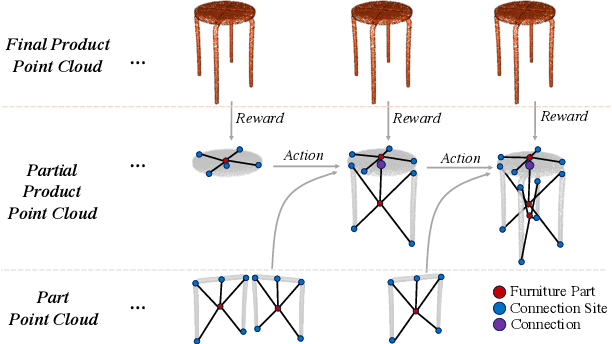
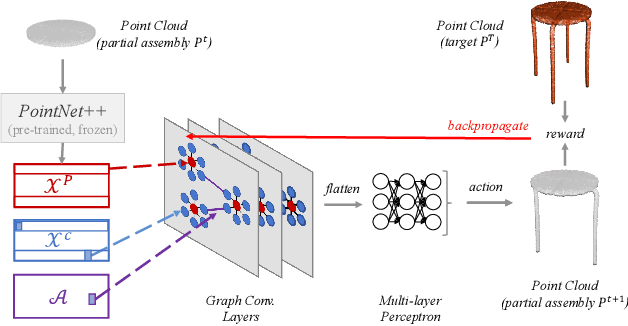
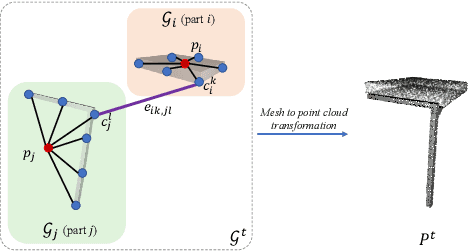
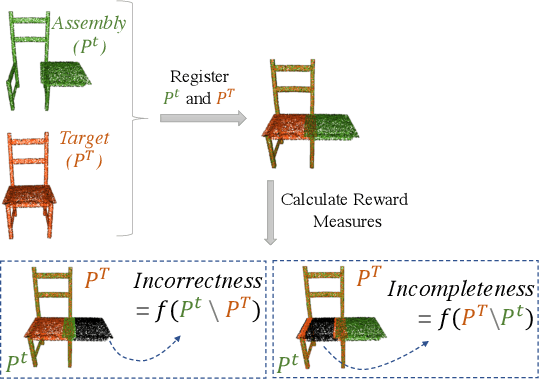
The rise of simulation environments has enabled learning-based approaches for assembly planning, which is otherwise a labor-intensive and daunting task. Assembling furniture is especially interesting since furniture are intricate and pose challenges for learning-based approaches. Surprisingly, humans can solve furniture assembly mostly given a 2D snapshot of the assembled product. Although recent years have witnessed promising learning-based approaches for furniture assembly, they assume the availability of correct connection labels for each assembly step, which are expensive to obtain in practice. In this paper, we alleviate this assumption and aim to solve furniture assembly with as little human expertise and supervision as possible. To be specific, we assume the availability of the assembled point cloud, and comparing the point cloud of the current assembly and the point cloud of the target product, obtain a novel reward signal based on two measures: Incorrectness and incompleteness. We show that our novel reward signal can train a deep network to successfully assemble different types of furniture. Code and networks available here: https://github.com/METU-KALFA/AssembleRL