 Add to Chrome
 Add to Firefox
 Add to Edge
Fast and Robust Convergence Rate for TD(0) with Linear Function Approximation, Universal Learning Steps and I.I.D. Samples
Jun 04, 2026
In this paper, we study the finite-time behavior of the TD(0) temporal-difference method with linear function approximation (LFA). We consider on-policy independent and identically distributed (i.i.d.) samples, a constant learning step, and the Polyak-Juditsky averaging method. We establish a new convergence rate, for the Mean-Square Error (MSE) on the approximated function, that is (i) fast in the sense that it admits an optimal dependency in the number of iterations k (i.e., of order 1/k), (ii) robust to ill-conditioning: it only depends on an initial error and modelindependent constants and (iii) sharp up to a multiplicative constant lower than 11. In particular, it does not depend on the smallest eigenvalue of the uncentered covariance matrix of the linear parametrization, unlike all pre-existing O(1/k) rates in the TD(0) literature. We also introduce PCTD(0), a variant of TD(0), which benefits from better convergence properties under an additional assumption of strong mixing on the Markov Chain.

KernelSOS for Global Sampling-Based Optimal Control and Estimation via Semidefinite Programming
Jul 23, 2025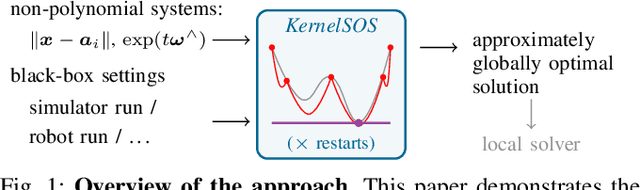
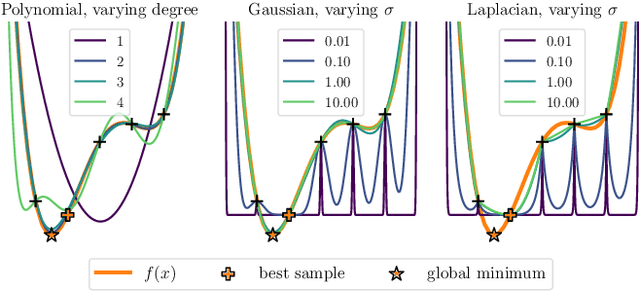
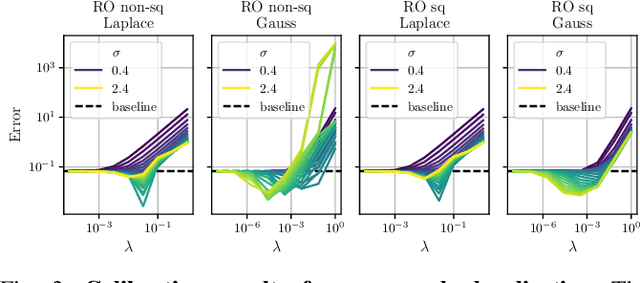
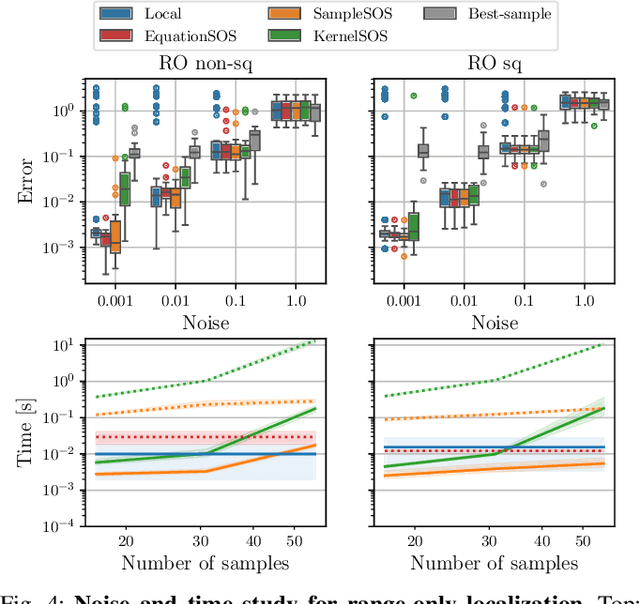
Global optimization has gained attraction over the past decades, thanks to the development of both theoretical foundations and efficient numerical routines to cope with optimization problems of various complexities. Among recent methods, Kernel Sum of Squares (KernelSOS) appears as a powerful framework, leveraging the potential of sum of squares methods from the polynomial optimization community with the expressivity of kernel methods widely used in machine learning. This paper applies the kernel sum of squares framework for solving control and estimation problems, which exhibit poor local minima. We demonstrate that KernelSOS performs well on a selection of problems from both domains. In particular, we show that KernelSOS is competitive with other sum of squares approaches on estimation problems, while being applicable to non-polynomial and non-parametric formulations. The sample-based nature of KernelSOS allows us to apply it to trajectory optimization problems with an integrated simulator treated as a black box, both as a standalone method and as a powerful initialization method for local solvers, facilitating the discovery of better solutions.