 Add to Chrome
 Add to Firefox
 Add to Edge
OTDR
Papers and Code
Real-Time Diverse Fiber Sensing Multi-Event Detection using Phase OTDR Measurements
Nov 10, 2025
We demonstrate an experimental phase optical time-domain reflectometry (OTDR) system capable of simultaneous detection and classification of various environmental events, such as wind-induced fiber movement, vehicle movement, and audio signatures, with real-time visualization.

CC-OTDR Sequence Shaping Enabling Joint Co-directional Sensing and Communication
May 23, 2025CC-OTDR signal envelope shaping is introduced to reduce the impact of non-linear signal interactions on a neighboring wavelength data channel when co-propagating the probing signal with the data signal. Joint co-directional acoustic sensing and 200 Gbps transmission are demonstrated over a 50 km link.
Quantum Noise Limited Temperature-Change Estimation for Phase-OTDR Employing Coherent Detection
May 09, 2025The quantum limit is a fundamental lower bound on the uncertainty when estimating a parameter in a system dominated by the minimum amount of noise (quantum noise). For the first time, we derive and demonstrate a quantum limit for temperature-change estimation for coherent phase-OTDR sensing-systems.
TransformDAS: Mapping Φ-OTDR Signals to Riemannian Manifold for Robust Classification
Feb 04, 2025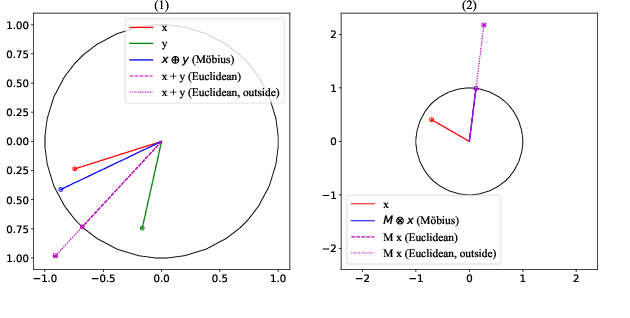
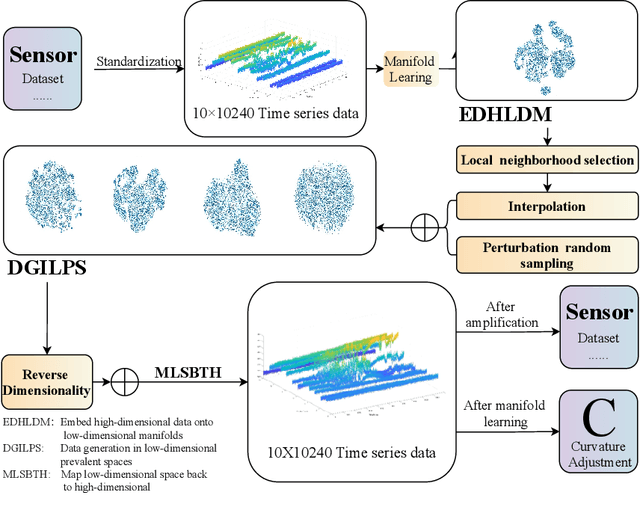
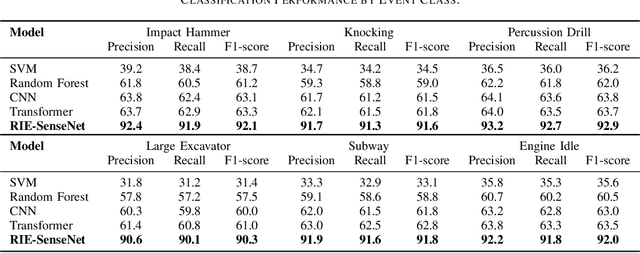
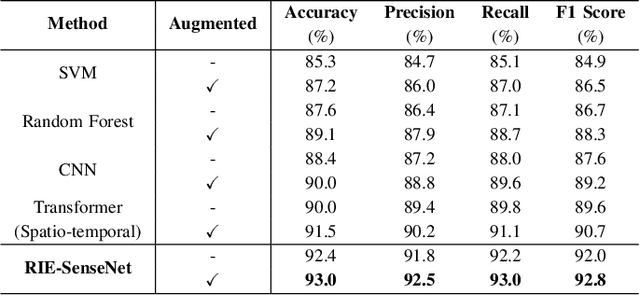
Phase-sensitive optical time-domain reflectometry ({\Phi}-OTDR) is a widely used distributed fiber optic sensing system in engineering. Machine learning algorithms for {\Phi}-OTDR event classification require high volumes and quality of datasets; however, high-quality datasets are currently extremely scarce in the field, leading to a lack of robustness in models, which is manifested by higher false alarm rates in real-world scenarios. One promising approach to address this issue is to augment existing data using generative models combined with a small amount of real-world data. We explored mapping both {\Phi}-OTDR features in a GAN-based generative pipeline and signal features in a Transformer classifier to hyperbolic space to seek more effective model generalization. The results indicate that state-of-the-art models exhibit stronger generalization performance and lower false alarm rates in real-world scenarios when trained on augmented datasets. TransformDAS, in particular, demonstrates the best classification performance, highlighting the benefits of Riemannian manifold mapping in {\Phi}-OTDR data generation and model classification.
Low-Complexity Event Detection and Identification in Coherent Correlation OTDR Measurements
Jan 29, 2025


Pairing coherent correlation OTDR with low-complexity analysis methods, we investigate the detection of fast temperature changes and vibrations in optical fibers. A localization accuracy of ~2 m and extraction of vibration amplitudes and frequencies is demonstrated.
Pressure Wave Detection and Localization in Deployed Underground Fiber using Coherent Correlation OTDR
Dec 02, 2024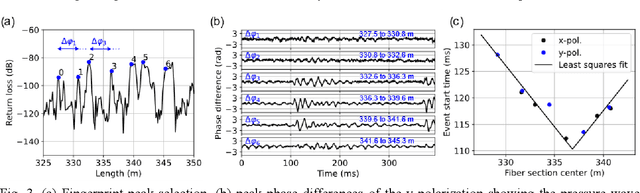
A deployed fiber with in-house and underground sections is interrogated with a coherent correlation OTDR. The origin and propagation speed of a hammer-generated pressure wave in the underground section is detected and acoustic signals are monitored.
* This work has received funding from the Horizon Europe Framework Programme under grant agreement No 101093015 (SoFiN Project)
Linear Least Squares Estimation of Fiber-Longitudinal Optical Power Profile
Oct 07, 2023This paper presents a linear least squares method for fiber-longitudinal power profile estimation (PPE), which estimates an optical signal power distribution throughout a fiber-optic link at a coherent receiver. The method finds the global optimum in least square estimation of longitudinal power profiles, thus closely matching true optical power profiles and locating loss anomalies in a link with high spatial resolution. Experimental results show that the method achieves accurate PPE with an RMS error from OTDR of 0.18 dB. Consequently, it successfully identifies a loss anomaly as small as 0.77 dB, demonstrating the potential of a coherent receiver in locating even splice and connector losses. The method is also evaluated under a WDM condition with optimal system fiber launch power, highlighting its feasibility for use in operations. Furthermore, a fundamental limit for stable estimation and spatial resolution of least-squares-based PPE is quantitatively discussed in relation to the ill-posedness of PPE by evaluating the condition number of a nonlinear perturbation matrix.
Fault Monitoring in Passive Optical Networks using Machine Learning Techniques
Jul 08, 2023Passive optical network (PON) systems are vulnerable to a variety of failures, including fiber cuts and optical network unit (ONU) transmitter/receiver failures. Any service interruption caused by a fiber cut can result in huge financial losses for service providers or operators. Identifying the faulty ONU becomes difficult in the case of nearly equidistant branch terminations because the reflections from the branches overlap, making it difficult to distinguish the faulty branch given the global backscattering signal. With increasing network size, the complexity of fault monitoring in PON systems increases, resulting in less reliable monitoring. To address these challenges, we propose in this paper various machine learning (ML) approaches for fault monitoring in PON systems, and we validate them using experimental optical time domain reflectometry (OTDR) data.
Monitoring of Optical Networks Using Correlation-Aided Time-Domain Reflectometry with Direct and Coherent Detection
Jun 06, 2023We report on methods to monitor the transmission path in optical networks using a correlation-based OTDR technique with direct and coherent detection. A high probing symbol rate can provide picosecond-accuracy of the fiber propagation delay, while a sensitive phase detection with a high repetition rate allows the monitoring of dynamic effects in the vicinity of the fiber. We discuss various approaches to evaluate the measured traces and show the results of a few monitoring applications.
Simultaneous Temperature and Acoustic Sensing with Coherent Correlation OTDR
May 26, 2023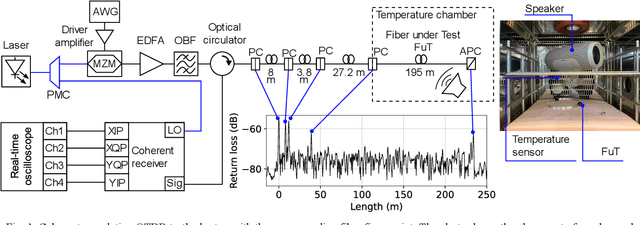
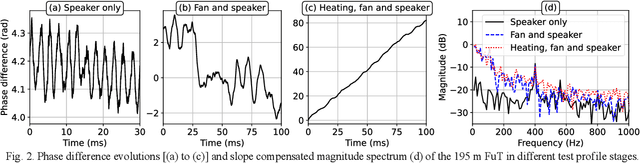
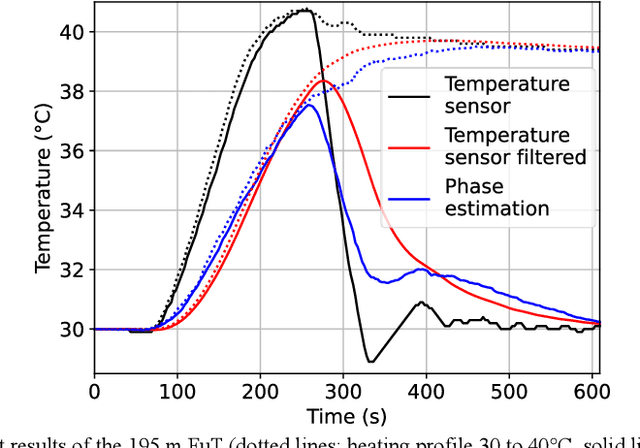
Superimposed temperature variations and dynamic strain applied through a 400 Hz acoustic signal on a 195 m single-mode fiber section are successfully measured using a coherent correlation optical time domain reflectometry as an interrogator.
* This work was partially funded by the German Federal Ministry of Education and Research in the framework of the RUBIN project Quantifisens (Project ID 03RU1U071D)