 Add to Chrome
 Add to Firefox
 Add to Edge
Nsl-kdd
Papers and Code
IntrusionX: A Hybrid Convolutional-LSTM Deep Learning Framework with Squirrel Search Optimization for Network Intrusion Detection
Oct 01, 2025
Intrusion Detection Systems (IDS) face persistent challenges due to evolving cyberattacks, high-dimensional traffic data, and severe class imbalance in benchmark datasets such as NSL-KDD. To address these issues, we propose IntrusionX, a hybrid deep learning framework that integrates Convolutional Neural Networks (CNNs) for local feature extraction and Long Short-Term Memory (LSTM) networks for temporal modeling. The architecture is further optimized using the Squirrel Search Algorithm (SSA), enabling effective hyperparameter tuning while maintaining computational efficiency. Our pipeline incorporates rigorous preprocessing, stratified data splitting, and dynamic class weighting to enhance the detection of rare classes. Experimental evaluation on NSL-KDD demonstrates that IntrusionX achieves 98% accuracy in binary classification and 87% in 5-class classification, with significant improvements in minority class recall (U2R: 71%, R2L: 93%). The novelty of IntrusionX lies in its reproducible, imbalance-aware design with metaheuristic optimization.

What Does Normal Even Mean? Evaluating Benign Traffic in Intrusion Detection Datasets
Sep 11, 2025Supervised machine learning techniques rely on labeled data to achieve high task performance, but this requires the labels to capture some meaningful differences in the underlying data structure. For training network intrusion detection algorithms, most datasets contain a series of attack classes and a single large benign class which captures all non-attack network traffic. A review of intrusion detection papers and guides that explicitly state their data preprocessing steps identified that the majority took the labeled categories of the dataset at face value when training their algorithms. The present paper evaluates the structure of benign traffic in several common intrusion detection datasets (NSL-KDD, UNSW-NB15, and CIC-IDS 2017) and determines whether there are meaningful sub-categories within this traffic which may improve overall multi-classification performance using common machine learning techniques. We present an overview of some unsupervised clustering techniques (e.g., HDBSCAN, Mean Shift Clustering) and show how they differentially cluster the benign traffic space.
CSAGC-IDS: A Dual-Module Deep Learning Network Intrusion Detection Model for Complex and Imbalanced Data
May 20, 2025As computer networks proliferate, the gravity of network intrusions has escalated, emphasizing the criticality of network intrusion detection systems for safeguarding security. While deep learning models have exhibited promising results in intrusion detection, they face challenges in managing high-dimensional, complex traffic patterns and imbalanced data categories. This paper presents CSAGC-IDS, a network intrusion detection model based on deep learning techniques. CSAGC-IDS integrates SC-CGAN, a self-attention-enhanced convolutional conditional generative adversarial network that generates high-quality data to mitigate class imbalance. Furthermore, CSAGC-IDS integrates CSCA-CNN, a convolutional neural network enhanced through cost sensitive learning and channel attention mechanism, to extract features from complex traffic data for precise detection. Experiments conducted on the NSL-KDD dataset. CSAGC-IDS achieves an accuracy of 84.55% and an F1-score of 84.52% in five-class classification task, and an accuracy of 91.09% and an F1 score of 92.04% in binary classification task.Furthermore, this paper provides an interpretability analysis of the proposed model, using SHAP and LIME to explain the decision-making mechanisms of the model.
Temporal-Spatial Attention Network (TSAN) for DoS Attack Detection in Network Traffic
Mar 21, 2025Denial-of-Service (DoS) attacks remain a critical threat to network security, disrupting services and causing significant economic losses. Traditional detection methods, including statistical and rule-based models, struggle to adapt to evolving attack patterns. To address this challenge, we propose a novel Temporal-Spatial Attention Network (TSAN) architecture for detecting Denial of Service (DoS) attacks in network traffic. By leveraging both temporal and spatial features of network traffic, our approach captures complex traffic patterns and anomalies that traditional methods might miss. The TSAN model incorporates transformer-based temporal encoding, convolutional spatial encoding, and a cross-attention mechanism to fuse these complementary feature spaces. Additionally, we employ multi-task learning with auxiliary tasks to enhance the model's robustness. Experimental results on the NSL-KDD dataset demonstrate that TSAN outperforms state-of-the-art models, achieving superior accuracy, precision, recall, and F1-score while maintaining computational efficiency for real-time deployment. The proposed architecture offers an optimal balance between detection accuracy and computational overhead, making it highly suitable for real-world network security applications.
Network Anomaly Detection for IoT Using Hyperdimensional Computing on NSL-KDD
Mar 04, 2025With the rapid growth of IoT devices, ensuring robust network security has become a critical challenge. Traditional intrusion detection systems (IDSs) often face limitations in detecting sophisticated attacks within high-dimensional and complex data environments. This paper presents a novel approach to network anomaly detection using hyperdimensional computing (HDC) techniques, specifically applied to the NSL-KDD dataset. The proposed method leverages the efficiency of HDC in processing large-scale data to identify both known and unknown attack patterns. The model achieved an accuracy of 91.55% on the KDDTrain+ subset, outperforming traditional approaches. These comparative evaluations underscore the model's superior performance, highlighting its potential in advancing anomaly detection for IoT networks and contributing to more secure and intelligent cybersecurity solutions.
Intrusion Detection in IoT Networks Using Hyperdimensional Computing: A Case Study on the NSL-KDD Dataset
Mar 04, 2025The rapid expansion of Internet of Things (IoT) networks has introduced new security challenges, necessitating efficient and reliable methods for intrusion detection. In this study, a detection framework based on hyperdimensional computing (HDC) is proposed to identify and classify network intrusions using the NSL-KDD dataset, a standard benchmark for intrusion detection systems. By leveraging the capabilities of HDC, including high-dimensional representation and efficient computation, the proposed approach effectively distinguishes various attack categories such as DoS, probe, R2L, and U2R, while accurately identifying normal traffic patterns. Comprehensive evaluations demonstrate that the proposed method achieves an accuracy of 99.54%, significantly outperforming conventional intrusion detection techniques, making it a promising solution for IoT network security. This work emphasizes the critical role of robust and precise intrusion detection in safeguarding IoT systems against evolving cyber threats.
CAGN-GAT Fusion: A Hybrid Contrastive Attentive Graph Neural Network for Network Intrusion Detection
Mar 02, 2025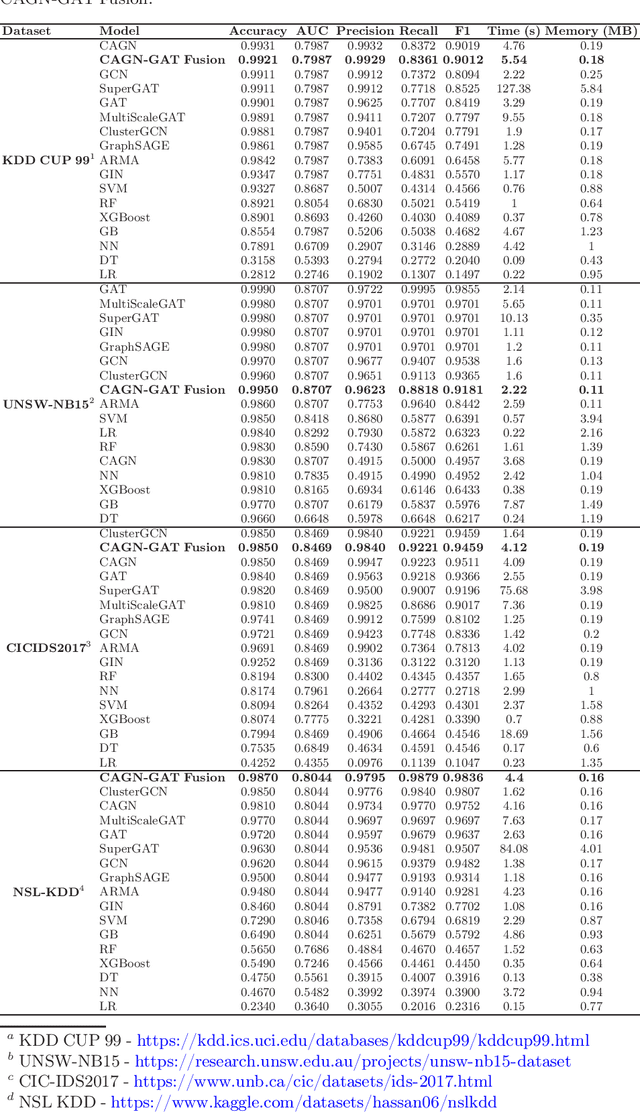
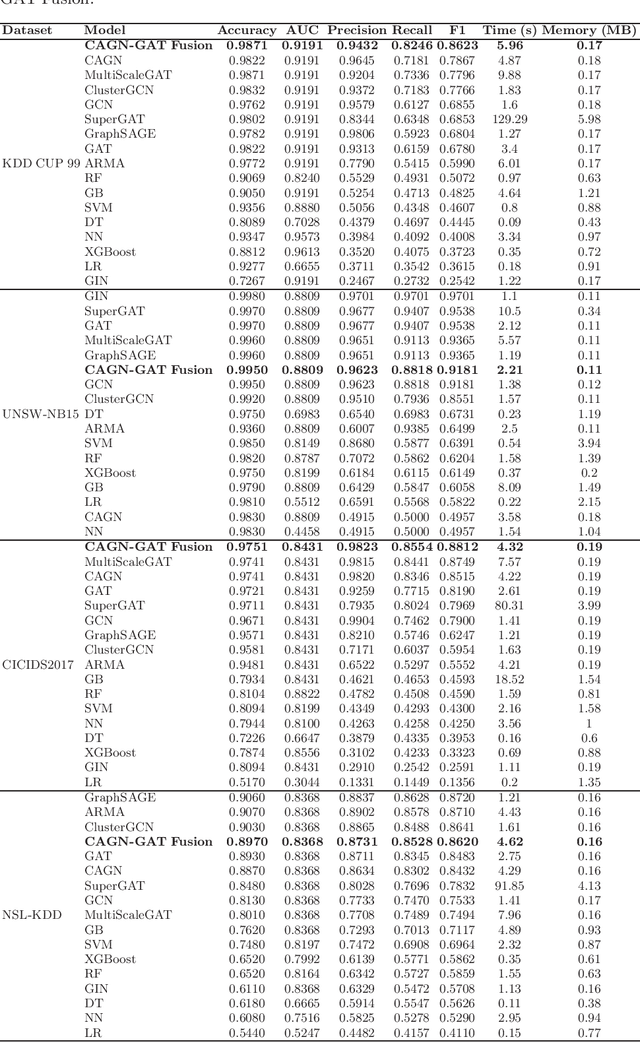
Cybersecurity threats are growing, making network intrusion detection essential. Traditional machine learning models remain effective in resource-limited environments due to their efficiency, requiring fewer parameters and less computational time. However, handling short and highly imbalanced datasets remains challenging. In this study, we propose the fusion of a Contrastive Attentive Graph Network and Graph Attention Network (CAGN-GAT Fusion) and benchmark it against 15 other models, including both Graph Neural Networks (GNNs) and traditional ML models. Our evaluation is conducted on four benchmark datasets (KDD-CUP-1999, NSL-KDD, UNSW-NB15, and CICIDS2017) using a short and proportionally imbalanced dataset with a constant size of 5000 samples to ensure fairness in comparison. Results show that CAGN-GAT Fusion demonstrates stable and competitive accuracy, recall, and F1-score, even though it does not achieve the highest performance in every dataset. Our analysis also highlights the impact of adaptive graph construction techniques, including small changes in connections (edge perturbation) and selective hiding of features (feature masking), improving detection performance. The findings confirm that GNNs, particularly CAGN-GAT Fusion, are robust and computationally efficient, making them well-suited for resource-constrained environments. Future work will explore GraphSAGE layers and multiview graph construction techniques to further enhance adaptability and detection accuracy.
A Defensive Framework Against Adversarial Attacks on Machine Learning-Based Network Intrusion Detection Systems
Feb 21, 2025As cyberattacks become increasingly sophisticated, advanced Network Intrusion Detection Systems (NIDS) are critical for modern network security. Traditional signature-based NIDS are inadequate against zero-day and evolving attacks. In response, machine learning (ML)-based NIDS have emerged as promising solutions; however, they are vulnerable to adversarial evasion attacks that subtly manipulate network traffic to bypass detection. To address this vulnerability, we propose a novel defensive framework that enhances the robustness of ML-based NIDS by simultaneously integrating adversarial training, dataset balancing techniques, advanced feature engineering, ensemble learning, and extensive model fine-tuning. We validate our framework using the NSL-KDD and UNSW-NB15 datasets. Experimental results show, on average, a 35% increase in detection accuracy and a 12.5% reduction in false positives compared to baseline models, particularly under adversarial conditions. The proposed defense against adversarial attacks significantly advances the practical deployment of robust ML-based NIDS in real-world networks.
Optimized detection of cyber-attacks on IoT networks via hybrid deep learning models
Feb 17, 2025The rapid expansion of Internet of Things (IoT) devices has increased the risk of cyber-attacks, making effective detection essential for securing IoT networks. This work introduces a novel approach combining Self-Organizing Maps (SOMs), Deep Belief Networks (DBNs), and Autoencoders to detect known and previously unseen attack patterns. A comprehensive evaluation using simulated and real-world traffic data is conducted, with models optimized via Particle Swarm Optimization (PSO). The system achieves an accuracy of up to 99.99% and Matthews Correlation Coefficient (MCC) values exceeding 99.50%. Experiments on NSL-KDD, UNSW-NB15, and CICIoT2023 confirm the model's strong performance across diverse attack types. These findings suggest that the proposed method enhances IoT security by identifying emerging threats and adapting to evolving attack strategies.
A Comparative Analysis of DNN-based White-Box Explainable AI Methods in Network Security
Jan 14, 2025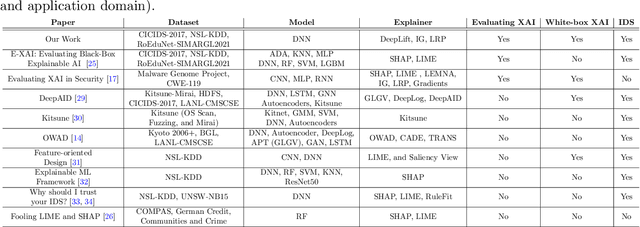
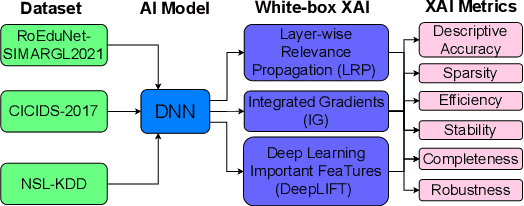
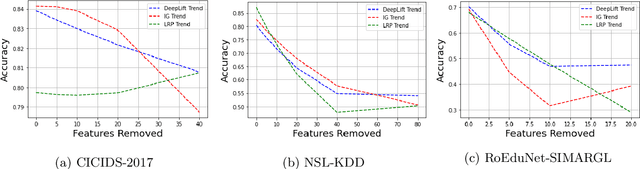
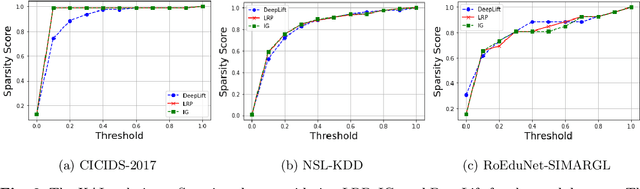
New research focuses on creating artificial intelligence (AI) solutions for network intrusion detection systems (NIDS), drawing its inspiration from the ever-growing number of intrusions on networked systems, increasing its complexity and intelligibility. Hence, the use of explainable AI (XAI) techniques in real-world intrusion detection systems comes from the requirement to comprehend and elucidate black-box AI models to security analysts. In an effort to meet such requirements, this paper focuses on applying and evaluating White-Box XAI techniques (particularly LRP, IG, and DeepLift) for NIDS via an end-to-end framework for neural network models, using three widely used network intrusion datasets (NSL-KDD, CICIDS-2017, and RoEduNet-SIMARGL2021), assessing its global and local scopes, and examining six distinct assessment measures (descriptive accuracy, sparsity, stability, robustness, efficiency, and completeness). We also compare the performance of white-box XAI methods with black-box XAI methods. The results show that using White-box XAI techniques scores high in robustness and completeness, which are crucial metrics for IDS. Moreover, the source codes for the programs developed for our XAI evaluation framework are available to be improved and used by the research community.