 Add to Chrome
 Add to Firefox
 Add to Edge
Matrixnet
Papers and Code
MatrixNet: Learning over symmetry groups using learned group representations
Jan 16, 2025
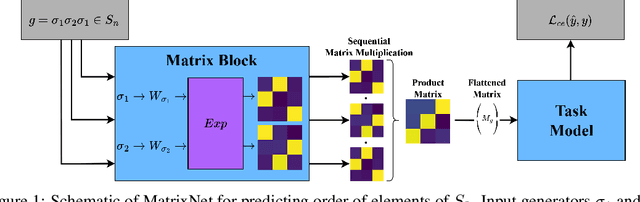
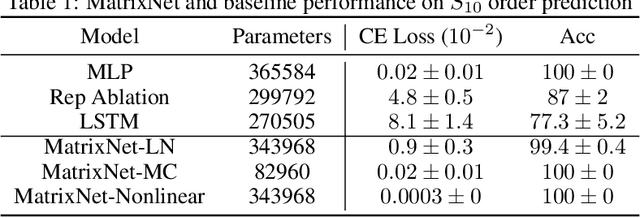
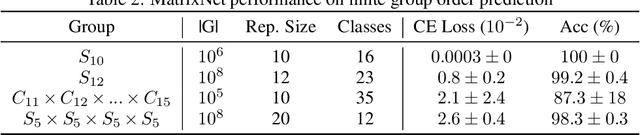
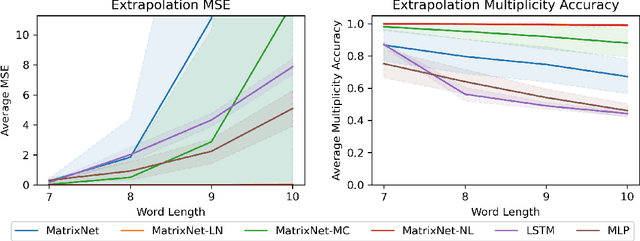
Group theory has been used in machine learning to provide a theoretically grounded approach for incorporating known symmetry transformations in tasks from robotics to protein modeling. In these applications, equivariant neural networks use known symmetry groups with predefined representations to learn over geometric input data. We propose MatrixNet, a neural network architecture that learns matrix representations of group element inputs instead of using predefined representations. MatrixNet achieves higher sample efficiency and generalization over several standard baselines in prediction tasks over the several finite groups and the Artin braid group. We also show that MatrixNet respects group relations allowing generalization to group elements of greater word length than in the training set.

Optimization of Decision Tree Evaluation Using SIMD Instructions
May 15, 2022Decision forest (decision tree ensemble) is one of the most popular machine learning algorithms. To use large models on big data, like document scoring with learning-to-rank models, we need to evaluate these models efficiently. In this paper, we explore MatrixNet, the ancestor of the popular CatBoost library. Both libraries use the SSE instruction set for scoring on CPU. This paper investigates the opportunities given by the AVX instruction set to evaluate models more efficiently. We achieved 35% speedup on the binarization stage (nodes conditions comparison), and 20% speedup on the trees apply stage on the ranking model.
MatrixNets: A New Scale and Aspect Ratio Aware Architecture for Object Detection
Jan 09, 2020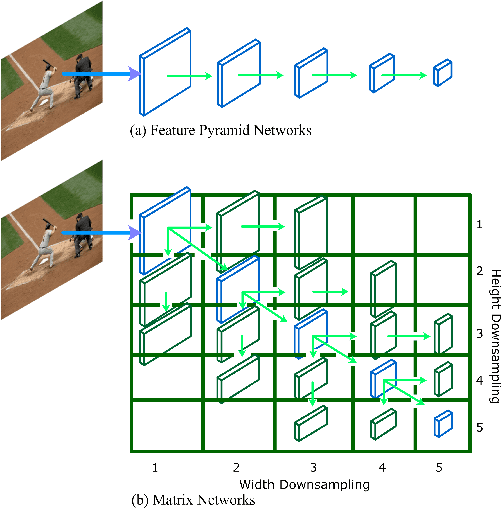
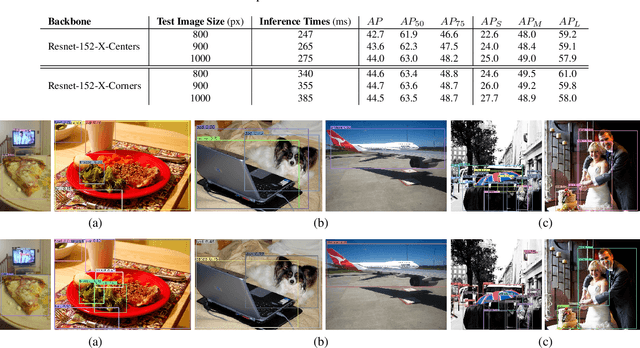
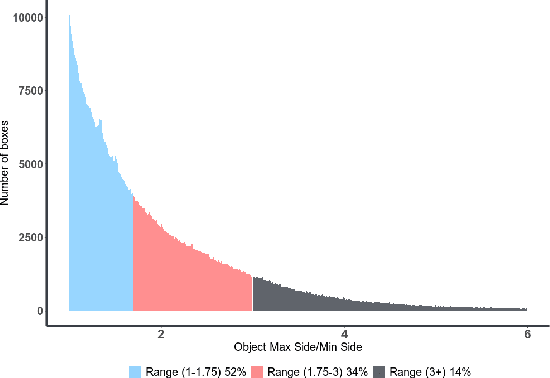
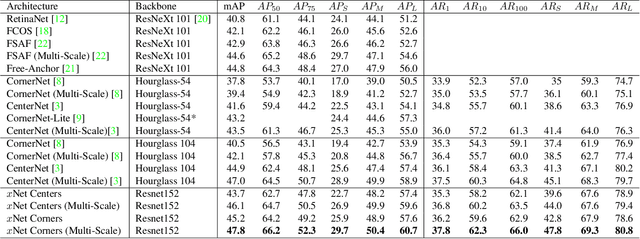
We present MatrixNets (xNets), a new deep architecture for object detection. xNets map objects with similar sizes and aspect ratios into many specialized layers, allowing xNets to provide a scale and aspect ratio aware architecture. We leverage xNets to enhance single-stage object detection frameworks. First, we apply xNets on anchor-based object detection, for which we predict object centers and regress the top-left and bottom-right corners. Second, we use MatrixNets for corner-based object detection by predicting top-left and bottom-right corners. Each corner predicts the center location of the object. We also enhance corner-based detection by replacing the embedding layer with center regression. Our final architecture achieves mAP of 47.8 on MS COCO, which is higher than its CornerNet counterpart by +5.6 mAP while also closing the gap between single-stage and two-stage detectors. The code is available at https://github.com/arashwan/matrixnet.
BoostJet: Towards Combining Statistical Aggregates with Neural Embeddings for Recommendations
Dec 07, 2017
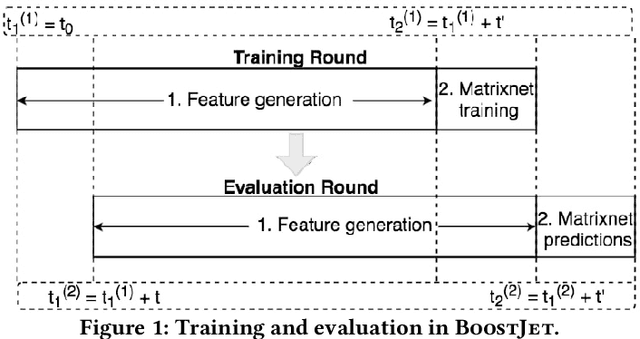

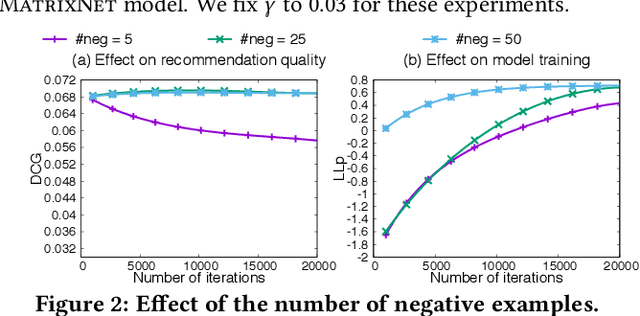
Recommenders have become widely popular in recent years because of their broader applicability in many e-commerce applications. These applications rely on recommenders for generating advertisements for various offers or providing content recommendations. However, the quality of the generated recommendations depends on user features (like demography, temporality), offer features (like popularity, price), and user-offer features (like implicit or explicit feedback). Current state-of-the-art recommenders do not explore such diverse features concurrently while generating the recommendations. In this paper, we first introduce the notion of Trackers which enables us to capture the above-mentioned features and thus incorporate users' online behaviour through statistical aggregates of different features (demography, temporality, popularity, price). We also show how to capture offer-to-offer relations, based on their consumption sequence, leveraging neural embeddings for offers in our Offer2Vec algorithm. We then introduce BoostJet, a novel recommender which integrates the Trackers along with the neural embeddings using MatrixNet, an efficient distributed implementation of gradient boosted decision tree, to improve the recommendation quality significantly. We provide an in-depth evaluation of BoostJet on Yandex's dataset, collecting online behaviour from tens of millions of online users, to demonstrate the practicality of BoostJet in terms of recommendation quality as well as scalability.
Using Neural Networks for Click Prediction of Sponsored Search
Sep 19, 2015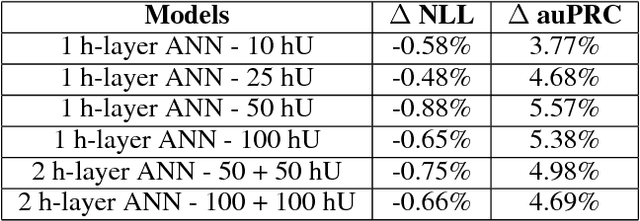
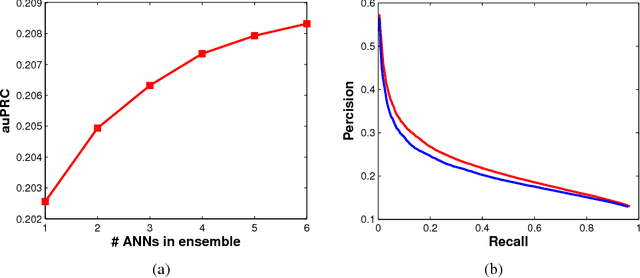
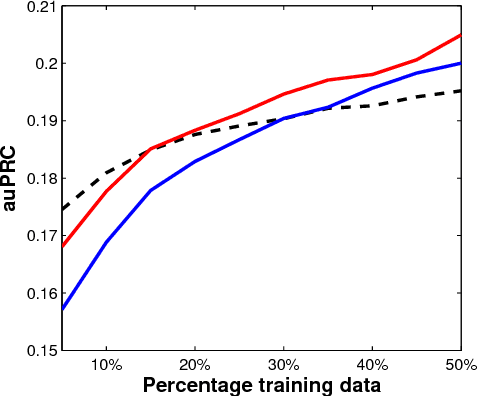

Sponsored search is a multi-billion dollar industry and makes up a major source of revenue for search engines (SE). click-through-rate (CTR) estimation plays a crucial role for ads selection, and greatly affects the SE revenue, advertiser traffic and user experience. We propose a novel architecture for solving CTR prediction problem by combining artificial neural networks (ANN) with decision trees. First we compare ANN with respect to other popular machine learning models being used for this task. Then we go on to combine ANN with MatrixNet (proprietary implementation of boosted trees) and evaluate the performance of the system as a whole. The results show that our approach provides significant improvement over existing models.