 Add to Chrome
 Add to Firefox
 Add to Edge
Nonlinear Sufficient Dimension Reduction for Distribution-on-Distribution Regression
Paper and Code

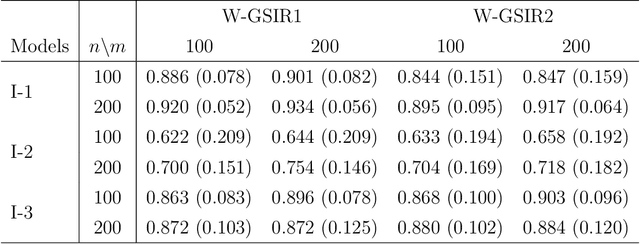
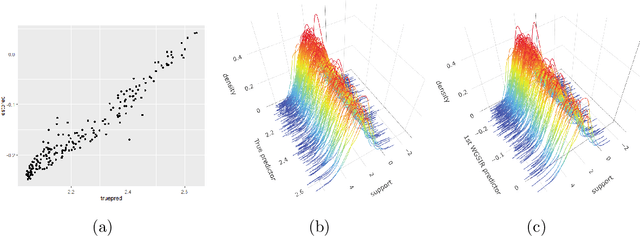
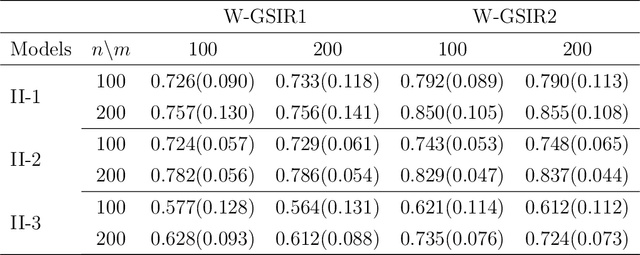
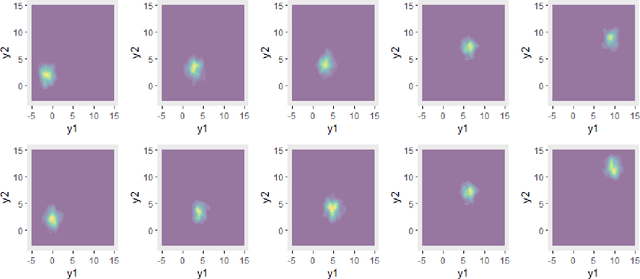
We introduce a novel framework for nonlinear sufficient dimension reduction where both the predictor and the response are distributional data, which are modeled as members of a metric space. Our key step to achieving the nonlinear sufficient dimension reduction is to build universal kernels on the metric spaces, which results in reproducing kernel Hilbert spaces for the predictor and response that are rich enough to characterize the conditional independence that determines sufficient dimension reduction. For univariate distributions, we use the well-known quantile representation of the Wasserstein distance to construct the universal kernel; for multivariate distributions, we resort to the recently developed sliced Wasserstein distance to achieve this purpose. Since the sliced Wasserstein distance can be computed by aggregation of quantile representation of the univariate Wasserstein distance, the computation of multivariate Wasserstein distance is kept at a manageable level. The method is applied to several data sets, including fertility and mortality distribution data and Calgary temperature data.
