 Add to Chrome
 Add to Firefox
 Add to Edge
Neural QAOA$^{2}$: Differentiable Joint Graph Partitioning and Parameter Initialization for Quantum Combinatorial Optimization
May 13, 2026
The quantum approximate optimization algorithm (QAOA) holds promise for combinatorial optimization but is constrained by limited qubits. While divide-and-conquer frameworks like QAOA$^{2}$ address scalability by partitioning graphs into subgraphs, existing methods suffer from two fundamental limitations: i) misalignment between heuristic partitioning metrics and quantum optimization goals, and ii) topology-blind parameter initialization that leads to optimization cold starts. To bridge these gaps, we propose Neural QAOA$^{2}$, an end-to-end differentiable framework that jointly generates graph partitions and initial parameters. By integrating a generative evaluative network (GEN), our method utilizes a differentiable quantum evaluator as a high-fidelity performance surrogate to provide direct gradient guidance, enabling the joint generator to learn the intrinsic mapping from graph topology to high-quality partition and parameter configurations. Extensive experiments on 183 QUBO, Ising, and MaxCut instances (21 to 1000 variables) demonstrate that our gradient-driven approach broadly outperforms heuristic baselines, ranking first on 101 instances. It exhibits zero-shot generalization across out-of-distribution graph topologies and scales.

Hybrid Memetic Search for Electric Vehicle Routing with Time Windows, Simultaneous Pickup-Delivery, and Partial Recharges
Oct 25, 2024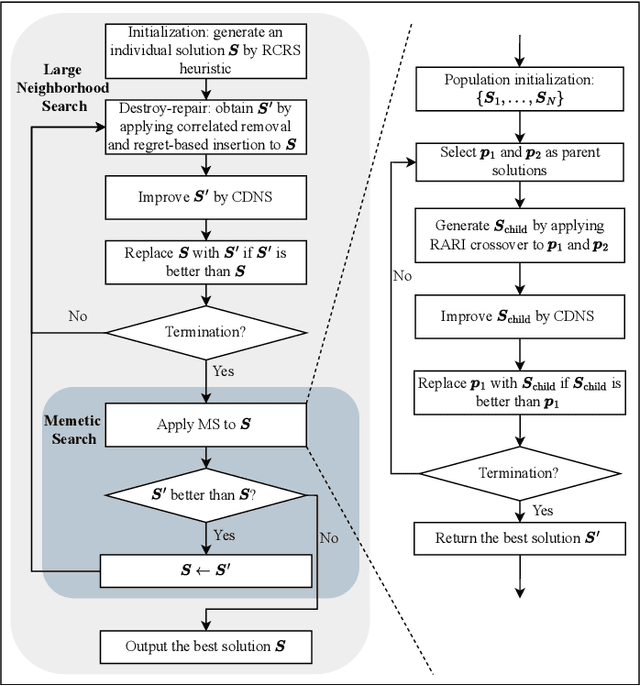
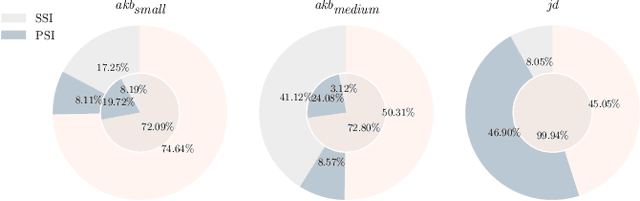
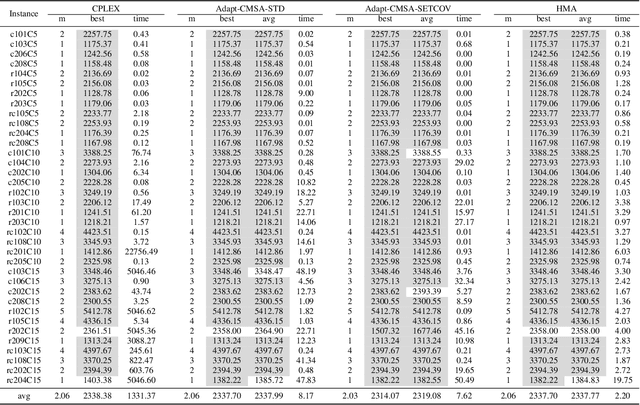
With growing environmental concerns, electric vehicles for logistics have gained significant attention within the computational intelligence community in recent years. This work addresses an emerging and significant extension of the electric vehicle routing problem (EVRP), namely EVRP with time windows, simultaneous pickup-delivery, and partial recharges (EVRP-TW-SPD), which has wide real-world applications. We propose a hybrid memetic algorithm (HMA) for solving EVRP-TW-SPD. HMA incorporates two novel components: a parallel-sequential station insertion procedure for handling partial recharges that can better avoid local optima compared to purely sequential insertion, and a cross-domain neighborhood search that explores solution spaces of both electric and non-electric problem domains simultaneously. These components can also be easily applied to various EVRP variants. To bridge the gap between existing benchmarks and real-world scenarios, we introduce a new, large-scale EVRP-TW-SPD benchmark set derived from real-world applications, containing instances with many more customers and charging stations than existing benchmark instances. Extensive experiments demonstrate the significant performance advantages of HMA over existing algorithms across a wide range of problem instances. Both the benchmark set and HMA will be open-sourced to facilitate further research in this area.