 Add to Chrome
 Add to Firefox
 Add to Edge
Praxium: Diagnosing Cloud Anomalies with AI-based Telemetry and Dependency Analysis
Mar 25, 2026
As the modern microservice architecture for cloud applications grows in popularity, cloud services are becoming increasingly complex and more vulnerable to misconfiguration and software bugs. Traditional approaches rely on expert input to diagnose and fix microservice anomalies, which lacks scalability in the face of the continuous integration and continuous deployment (CI/CD) paradigm. Microservice rollouts, containing new software installations, have complex interactions with the components of an application. Consequently, this added difficulty in attributing anomalous behavior to any specific installation or rollout results in potentially slower resolution times. To address the gaps in current diagnostic methods, this paper introduces Praxium, a framework for anomaly detection and root cause inference. Praxium aids administrators in evaluating target metric performance in the context of dependency installation information provided by a software discovery tool, PraxiPaaS. Praxium continuously monitors telemetry data to identify anomalies, then conducts root cause analysis via causal impact on recent software installations, in order to provide site reliability engineers (SRE) relevant information about an observed anomaly. In this paper, we demonstrate that Praxium is capable of effective anomaly detection and root cause inference, and we provide an analysis on effective anomaly detection hyperparameter tuning as needed in a practical setting. Across 75 total trials using four synthetic anomalies, anomaly detection consistently performs at >0.97 macro-F1. In addition, we show that causal impact analysis reliably infers the correct root cause of anomalies, even as package installations occur at increasingly shorter intervals.

GenLie: A Global-Enhanced Lie Detection Network under Sparsity and Semantic Interference
Mar 14, 2026Video-based lie detection aims to identify deceptive behaviors from visual cues. Despite recent progress, its core challenge lies in learning sparse yet discriminative representations. Deceptive signals are typically subtle and short-lived, easily overwhelmed by redundant information, while individual and contextual variations introduce strong identity-related noise. To address this issue, we propose GenLie, a Global-Enhanced Lie Detection Network that performs local feature modeling under global supervision. Specifically, sparse and subtle deceptive cues are captured at the local level, while global supervision and optimization ensure robust and discriminative representations by suppressing identity-related noise. Experiments on three public datasets, covering both high- and low-stakes scenarios, show that GenLie consistently outperforms state-of-the-art methods. Source code is available at https://github.com/AliasDictusZ1/GenLie.
SERFLOW: A Cross-Service Cost Optimization Framework for SLO-Aware Dynamic ML Inference
Oct 31, 2025Dynamic offloading of Machine Learning (ML) model partitions across different resource orchestration services, such as Function-as-a-Service (FaaS) and Infrastructure-as-a-Service (IaaS), can balance processing and transmission delays while minimizing costs of adaptive inference applications. However, prior work often overlooks real-world factors, such as Virtual Machine (VM) cold starts, requests under long-tail service time distributions, etc. To tackle these limitations, we model each ML query (request) as traversing an acyclic sequence of stages, wherein each stage constitutes a contiguous block of sparse model parameters ending in an internal or final classifier where requests may exit. Since input-dependent exit rates vary, no single resource configuration suits all query distributions. IaaS-based VMs become underutilized when many requests exit early, yet rapidly scaling to handle request bursts reaching deep layers is impractical. SERFLOW addresses this challenge by leveraging FaaS-based serverless functions (containers) and using stage-specific resource provisioning that accounts for the fraction of requests exiting at each stage. By integrating this provisioning with adaptive load balancing across VMs and serverless functions based on request ingestion, SERFLOW reduces cloud costs by over $23\%$ while efficiently adapting to dynamic workloads.
Rethinking Inference Placement for Deep Learning across Edge and Cloud Platforms: A Multi-Objective Optimization Perspective and Future Directions
Oct 27, 2025Edge intelligent applications like VR/AR and language model based chatbots have become widespread with the rapid expansion of IoT and mobile devices. However, constrained edge devices often cannot serve the increasingly large and complex deep learning (DL) models. To mitigate these challenges, researchers have proposed optimizing and offloading partitions of DL models among user devices, edge servers, and the cloud. In this setting, users can take advantage of different services to support their intelligent applications. For example, edge resources offer low response latency. In contrast, cloud platforms provide low monetary cost computation resources for computation-intensive workloads. However, communication between DL model partitions can introduce transmission bottlenecks and pose risks of data leakage. Recent research aims to balance accuracy, computation delay, transmission delay, and privacy concerns. They address these issues with model compression, model distillation, transmission compression, and model architecture adaptations, including internal classifiers. This survey contextualizes the state-of-the-art model offloading methods and model adaptation techniques by studying their implication to a multi-objective optimization comprising inference latency, data privacy, and resource monetary cost.
Privacy and Efficiency of Communications in Federated Split Learning
Jan 07, 2023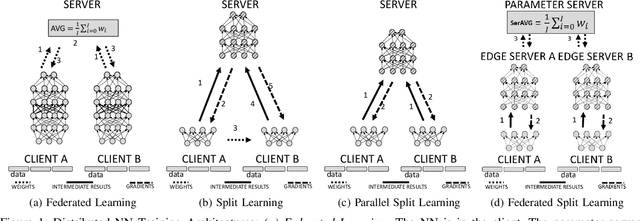
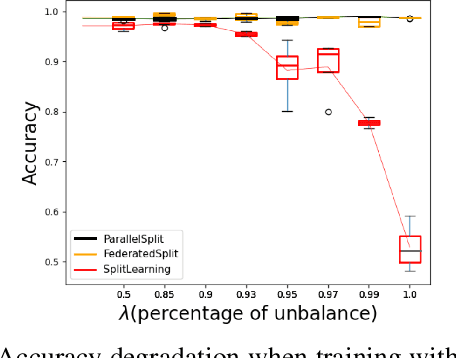
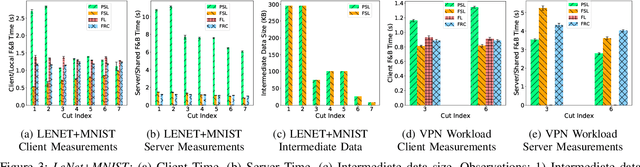
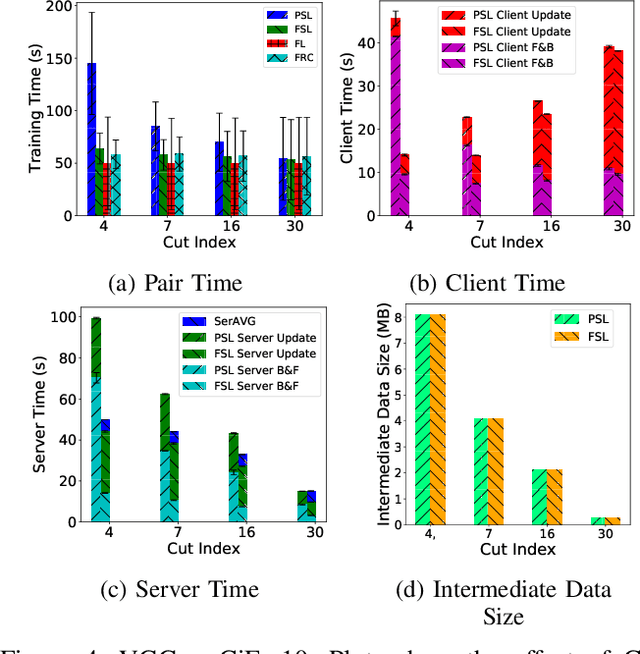
Everyday, large amounts of sensitive data is distributed across mobile phones, wearable devices, and other sensors. Traditionally, these enormous datasets have been processed on a single system, with complex models being trained to make valuable predictions. Distributed machine learning techniques such as Federated and Split Learning have recently been developed to protect user data and privacy better while ensuring high performance. Both of these distributed learning architectures have advantages and disadvantages. In this paper, we examine these tradeoffs and suggest a new hybrid Federated Split Learning architecture that combines the efficiency and privacy benefits of both. Our evaluation demonstrates how our hybrid Federated Split Learning approach can lower the amount of processing power required by each client running a distributed learning system, reduce training and inference time while keeping a similar accuracy. We also discuss the resiliency of our approach to deep learning privacy inference attacks and compare our solution to other recently proposed benchmarks.