 Add to Chrome
 Add to Firefox
 Add to Edge
A foundation model of numerical intelligence with cross-disciplinary generalization
Jul 30, 2026
Intelligence is commonly understood as the ability to acquire and apply knowledge, adapt to unfamiliar situations and solve new problems. Large language models exhibit this capacity by inferring task-relevant knowledge from textual context and applying it to new tasks. Yet intelligence need not be confined to language. For scientific and social systems, we need models that acquire and apply knowledge from numerical context-an ability we call numerical intelligence. Here we introduce UNified In-Context Operator Networks (UNICON), a foundation model that exhibits numerical intelligence across disciplines. Using graph-based examples from a system as context, UNICON infers the predictive relation shared across them and applies it to queries from the same system. Across scientific and social systems, including those from disciplines absent from training, the same model approaches specialist performance without retraining. Combining UNICON with language-model agents yields further gains, enabling it to surpass state-of-the-art specialists in a discipline unseen in training. We further show that training-corpus diversity improves generalization to unseen disciplines. Together, these results establish UNICON as a foundation model of numerical intelligence and position it as a building block for a broader ecosystem of artificial intelligence.

Agentic Symbolic Search: Characterizing PDEs Beyond Hand-crafted Expressions, Meshes, and Neural Networks
Jun 18, 2026Mathematicians understand a PDE solution through mathematical structures rather than tables of computed values. Historically, this has been the product of mathematical analysis, carried out by hand for each problem individually. Neither numerical simulation nor neural networks produce those structures directly. We propose Agentic Symbolic Search (ASYS), a prior-guided framework in which an agent translates PDE theory, public problem constraints, and accumulated search experience into testable differentiable symbolic programs. The mathematical forms are refined under evolutionary search, while their continuous parameters are fit by gradient-based optimization. This makes the search an automated form of inductive-bias injection rather than blind symbolic regression. For problems with known analytical forms, ASYS recovers these forms naturally; for other problems, ASYS constructs analytical approximations which can guide mathematicians toward further analysis. In our experiments, across five problems spanning bounded dynamics, finite-time blow-up, and free-boundary focusing, ASYS produces interpretable representations, including a geometric interface formula for Allen-Cahn 2D dynamics and a nine-parameter contraction law for Keller-Segel chemotactic blow-up, in settings where no closed-form description was previously available. ASYS shows the possibility of a new paradigm for characterizing PDE solutions, beyond handcrafted analytical solutions, mesh-based numerical solutions, and neural network approximations.
Self-Evolving Scientific Agent Discovers Generalizable Physically-Reasoned Fluid Control
Jun 07, 2026While data-intensive deep reinforcement learning can optimize complex control policies, scientific discovery in physical systems fundamentally requires an interpretable chain of reasoning that connects physical evidence to structured control architectures. Here, we present a self-evolving scientific-agent workflow, driven by large language models and iterative code generation, that automates controller construction while preserving strict interpretability and rigorous physical reasoning. Instead of adjusting weights, the agent deploys candidate strategies into physical simulations, actively diagnoses dynamic behaviors from multimodal evidence, and translates these observations into progressive source-code refinements. We demonstrate this framework on a highly non-linear fluid-structure interaction problem: an underactuated, two-joint dogfish swimmer tasked with spatial target reaching using only joint angular accelerations. Starting from a propulsive seed policy that exhibits a one-sided steering bias, the agent autonomously discovers and refines a unified controller that robustly captures all canonical targets. Remarkably, without any retraining or target-specific branching, the synthesized control policy generalizes to unseen static targets and dynamically curved pursuit trajectories. The auditable evolve log reveals an emergent control architecture built upon traveling-wave propulsion, body-frame target guidance, yaw-rate feedback, signed mean-tail curvature, and adaptive cadence relief. Our results show that an autonomous scientific agent can successfully transform accumulated physical evidence into robust, mathematically readable control policy, while maintaining a fully traceable process of scientific discovery.
Graph In-Context Operator Networks for Generalizable Spatiotemporal Prediction
Mar 13, 2026In-context operator learning enables neural networks to infer solution operators from contextual examples without weight updates. While prior work has demonstrated the effectiveness of this paradigm in leveraging vast datasets, a systematic comparison against single-operator learning using identical training data has been absent. We address this gap through controlled experiments comparing in-context operator learning against classical operator learning (single-operator models trained without contextual examples), under the same training steps and dataset. To enable this investigation on real-world spatiotemporal systems, we propose GICON (Graph In-Context Operator Network), combining graph message passing for geometric generalization with example-aware positional encoding for cardinality generalization. Experiments on air quality prediction across two Chinese regions show that in-context operator learning outperforms classical operator learning on complex tasks, generalizing across spatial domains and scaling robustly from few training examples to 100 at inference.
Localized Zeroth-Order Prompt Optimization
Mar 05, 2024
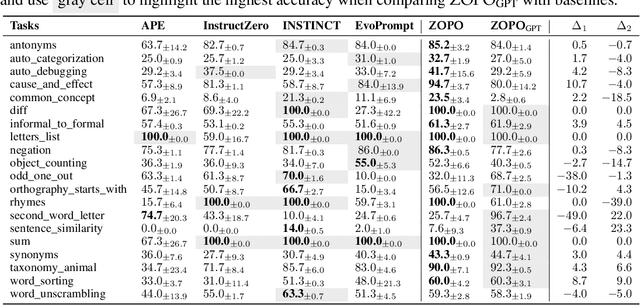
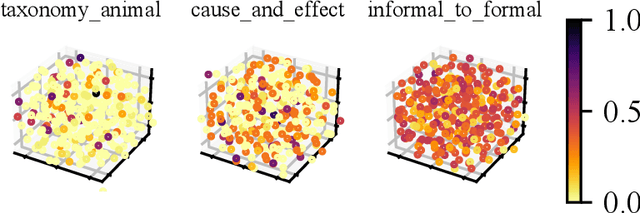
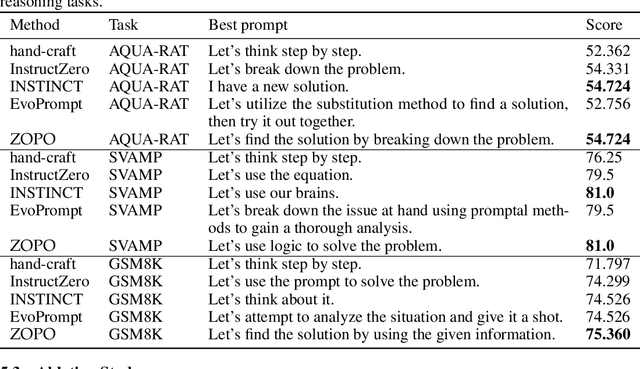
The efficacy of large language models (LLMs) in understanding and generating natural language has aroused a wide interest in developing prompt-based methods to harness the power of black-box LLMs. Existing methodologies usually prioritize a global optimization for finding the global optimum, which however will perform poorly in certain tasks. This thus motivates us to re-think the necessity of finding a global optimum in prompt optimization. To answer this, we conduct a thorough empirical study on prompt optimization and draw two major insights. Contrasting with the rarity of global optimum, local optima are usually prevalent and well-performed, which can be more worthwhile for efficient prompt optimization (Insight I). The choice of the input domain, covering both the generation and the representation of prompts, affects the identification of well-performing local optima (Insight II). Inspired by these insights, we propose a novel algorithm, namely localized zeroth-order prompt optimization (ZOPO), which incorporates a Neural Tangent Kernel-based derived Gaussian process into standard zeroth-order optimization for an efficient search of well-performing local optima in prompt optimization. Remarkably, ZOPO outperforms existing baselines in terms of both the optimization performance and the query efficiency, which we demonstrate through extensive experiments.