 Add to Chrome
 Add to Firefox
 Add to Edge
State over Tokens: Characterizing the Role of Reasoning Tokens
Dec 14, 2025
Large Language Models (LLMs) can generate reasoning tokens before their final answer to boost performance on complex tasks. While these sequences seem like human thought processes, empirical evidence reveals that they are not a faithful explanation of the model's actual reasoning process. To address this gap between appearance and function, we introduce the State over Tokens (SoT) conceptual framework. SoT reframes reasoning tokens not as a linguistic narrative, but as an externalized computational state -- the sole persistent information carrier across the model's stateless generation cycles. This explains how the tokens can drive correct reasoning without being a faithful explanation when read as text and surfaces previously overlooked research questions on these tokens. We argue that to truly understand the process that LLMs do, research must move beyond reading the reasoning tokens as text and focus on decoding them as state.

Do AI Voices Learn Social Nuances? A Case of Politeness and Speech Rate
Nov 12, 2025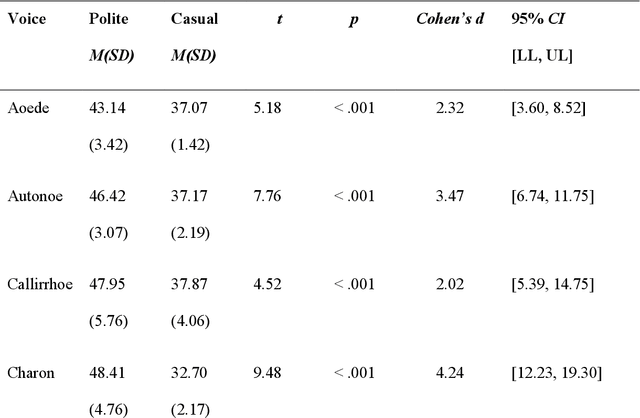
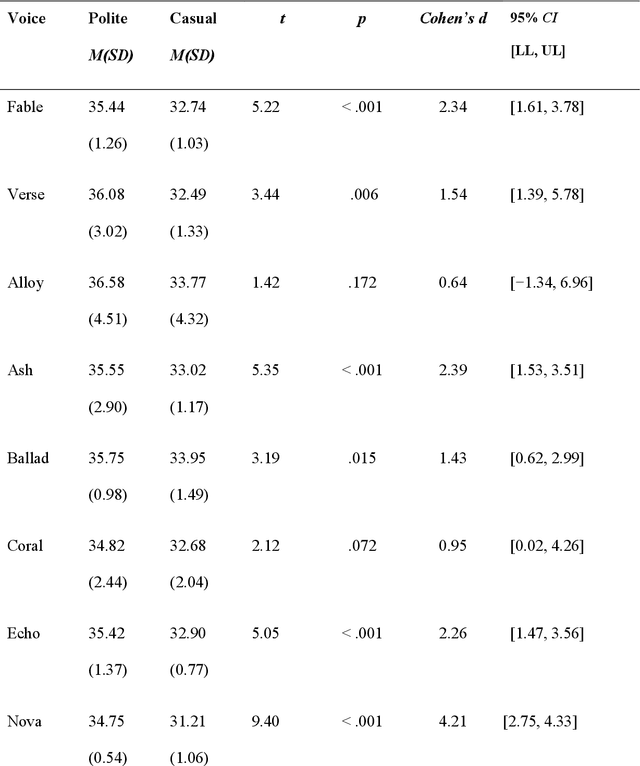
Voice-based artificial intelligence is increasingly expected to adhere to human social conventions, but can it learn implicit cues that are not explicitly programmed? This study investigates whether state-of-the-art text-to-speech systems have internalized the human tendency to reduce speech rate to convey politeness - a non-obvious prosodic marker. We prompted 22 synthetic voices from two leading AI platforms (AI Studio and OpenAI) to read a fixed script under both "polite and formal" and "casual and informal" conditions and measured the resulting speech duration. Across both AI platforms, the polite prompt produced slower speech than the casual prompt with very large effect sizes, an effect that was statistically significant for all of AI Studio's voices and for a large majority of OpenAI's voices. These results demonstrate that AI can implicitly learn and replicate psychological nuances of human communication, highlighting its emerging role as a social actor capable of reinforcing human social norms.