 Add to Chrome
 Add to Firefox
 Add to Edge
Hierarchical Muon: Tiled Newton-Schulz Updates for Efficient Muon Optimization
Jun 25, 2026
Muon-type optimizers construct update directions for dense neural-network weights by applying a finite Newton-Schulz map to momentum-gradient matrices. For an $H \times W$ matrix, with $r=\min\{H,W\}$ and $s=\max\{H,W\}$, $K$ steps of the full-matrix Newton-Schulz update require $O(r^2 s K)$ work and couple all rows and columns through repeated Gram matrix products. We introduce Hierarchical Muon (HiMuon), a tiled Newton-Schulz scheme for Muon-type optimization. HiMuon partitions each momentum-gradient matrix into $T \times T$ tiles, applies the same finite Newton-Schulz map independently to each tile, and reassembles the results. For finite $T$ below the matrix dimensions, HiMuon defines a local matrix-function map rather than a convergent approximation to the full-matrix update: spectral interactions are preserved within tiles and discarded across tile boundaries. For fixed finite $T$, the leading Newton-Schulz work decreases to $O(H W T K)$, and the computation decomposes into independent small dense matrix operations. This structure enables tile-size-dependent GPU kernels, cross-layer batching, memory-bounded chunking, and runtime tile-size schedules. Experiments on transformer training and controlled matrix-function diagnostics show that HiMuon improves optimizer-step efficiency while keeping training behavior close to full-matrix Muon in the tested regimes.

CoLI: A Reproducible Platform for Continuum Robot Learning via Monolithic 3D Printing and Isomorphic Teleoperation
Jun 18, 2026Continuum robots offer strong potential for manipulation tasks due to their high degrees of freedom, compliant structures, and operational safety. However, their adoption in both research and practical applications has been hindered by reproducibility issues arising from complex fabrication and assembly processes, challenging kinematic modeling, and a lack of intuitive control interfaces. To address these challenges, we present a novel open-source continuum robot design. The platform features a simplified fabrication pipeline enabled by multi-material 3D printing, allowing the arm to be fabricated as a monolithic compliant structure with minimal assembly. Control is achieved through an isomorphic teleoperation interface that establishes a direct actuator-level mapping, eliminating the need for explicit kinematic modeling and providing a singularity-free mapping. Building on this hardware design, the platform further supports imitation-learning-based autonomous control. The proposed system is evaluated through hardware characterization and a set of manipulation tasks. Experimental results demonstrate that the platform provides a reproducible, learning-ready continuum robot system, accelerating algorithmic development and systematic benchmarking for the continuum robotics community.
MFE: A Multimodal Hand Exoskeleton with Interactive Force, Pressure and Thermo-haptic Feedback
Apr 03, 2026Recent advancements in virtual reality and robotic teleoperation have greatly increased the variety of haptic information that must be conveyed to users. While existing haptic devices typically provide unimodal feedback to enhance situational awareness, a gap remains in their ability to deliver rich, multimodal sensory feedback encompassing force, pressure, and thermal sensations. To address this limitation, we present the Multimodal Feedback Exoskeleton (MFE), a hand exoskeleton designed to deliver hybrid haptic feedback. The MFE features 20 degrees of freedom for capturing hand pose. For force feedback, it employs an active mechanism capable of generating 3.5-8.1 N of pushing and pulling forces at the fingers' resting pose, enabling realistic interaction with deformable objects. The fingertips are equipped with flat actuators based on the electro-osmotic principle, providing pressure and vibration stimuli and achieving up to 2.47 kPa of contact pressure to render tactile sensations. For thermal feedback, the MFE integrates thermoelectric heat pumps capable of rendering temperatures from 10 to 55 degrees Celsius. We validated the MFE by integrating it into a robotic teleoperation system using the X-Arm 6 and Inspire Hand manipulator. In user studies, participants successfully recognized and manipulated deformable objects and differentiated remote objects with varying temperatures. These results demonstrate that the MFE enhances situational awareness, as well as the usability and transparency of robotic teleoperation systems.
* 8 pages, 7 figures, 2 tables
Toward a Graph Foundation Model: Pre-Training Transformers With Random Walks
Jun 17, 2025A foundation model like GPT elicits many emergent abilities, owing to the pre-training with broad inclusion of data and the use of the powerful Transformer architecture. While foundation models in natural languages are prevalent, can we build similar models for graphs? This paper describes an approach toward a graph foundation model that is pre-trained with diverse graph datasets by adapting the Transformer backbone. A central challenge toward this end is how a sequence model encodes graphs of varying sizes and from different domains. We propose representing a node as multiple random walks, such that the Transformer can extract node representations from sequences, which in turn form edge and graph representations. We develop a novel context prediction loss for these random walks and theoretically analyze their expressive power in distinguishing neighborhoods and graphs. We also demonstrate the pre-training of our model and its adaptation to downstream tasks, showcasing its potential as a foundation for processing and reasoning with graph-structured data.
An Efficient Nonlinear Acceleration method that Exploits Symmetry of the Hessian
Oct 22, 2022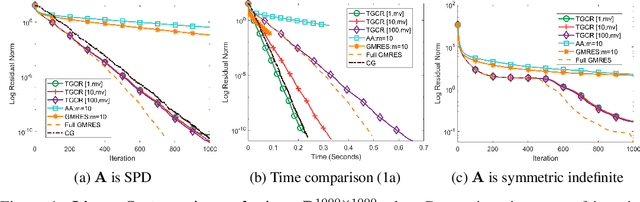
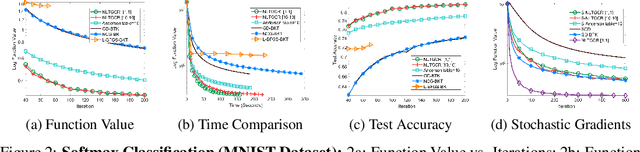
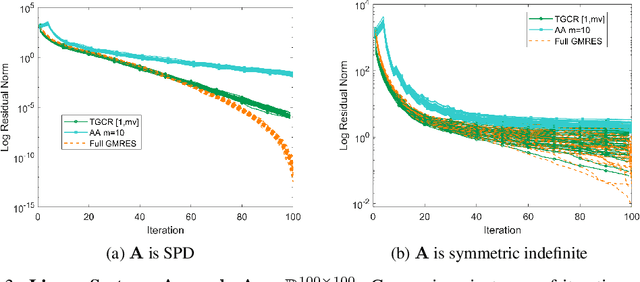
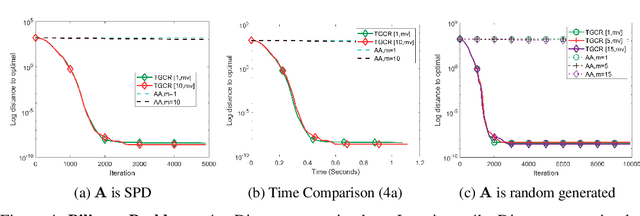
Nonlinear acceleration methods are powerful techniques to speed up fixed-point iterations. However, many acceleration methods require storing a large number of previous iterates and this can become impractical if computational resources are limited. In this paper, we propose a nonlinear Truncated Generalized Conjugate Residual method (nlTGCR) whose goal is to exploit the symmetry of the Hessian to reduce memory usage. The proposed method can be interpreted as either an inexact Newton or a quasi-Newton method. We show that, with the help of global strategies like residual check techniques, nlTGCR can converge globally for general nonlinear problems and that under mild conditions, nlTGCR is able to achieve superlinear convergence. We further analyze the convergence of nlTGCR in a stochastic setting. Numerical results demonstrate the superiority of nlTGCR when compared with several other competitive baseline approaches on a few problems. Our code will be available in the future.