 Add to Chrome
 Add to Firefox
 Add to Edge
Artificial-Intelligence-Assisted Multi-Modal Terahertz Sensing and Environment Reconstruction
May 31, 2026
Multi-modal sensing is an important enabler for future environment-aware wireless systems, since a single sensing modality is generally insufficient to provide accurate metric geometry, material awareness, and semantic interpretability in complex environments. This paper presents a measurement-based multi-modal THz sensing and vision framework for indoor environment reconstruction. A three-dimensional monostatic THz channel sounding system operating at 290-310 GHz is integrated with an omnidirectional fisheye camera to acquire radio-frequency and visual observations from a common sensing viewpoint. From the measured THz data, a signal processing pipeline extracts multipath components and infers geometryand material-consistent structural primitives through trajectory tracking-assisted parameter estimation, graph-based structure discovery, planar reconstruction, and reflection-loss analysis. In parallel, AI-based visual perception modules extract object-level semantic masks and depth priors from panoramic images. To associate these heterogeneous representations, an agentic-AI-based task-driven THz-agent module is developed to select appropriate integration tools according to the attributes of the modality-specific outputs. Through angular alignment and consistency analysis, THz-derived metric geometry and material information are associated with vision-derived semantic regions and depth priors, enabling geometry-consistent and semantically interpretable environment reconstruction directly from measurements. Experimental validation in the indoor L-shaped hallway demonstrates that the proposed framework reconstructs dominant structural elements with centimeter-level accuracy while identifying semantic categories and material attributes of representative indoor objects.

Environment Reconstruction in Terahertz Monostatic Sensing: Joint Millimeter-level Geometry Mapping and Material Identification
Aug 14, 2025Terahertz (THz) integrated sensing and communication (ISAC) offers high-speed communication alongside precise environmental sensing. This paper presents a computationally efficient framework for THz-based environment reconstruction by integrating connected component analysis (CCA)-assisted multipath component (MPC) estimation with a sliding-window refinement strategy. To start with, a monostatic sensing experiment is conducted in an indoor scenario using a vector network analyzer (VNA)-based sounder operating from 290 to 310 GHz. On one hand, as for geometry mapping, a CCA-based region search is employed to accelerate parameter extraction, significantly reducing the search space for space-alternating generalized expectation-maximization (SAGE)-based estimation and achieving an 8.4 times acceleration, while preserving resolution. Further analysis of the connected component structure enables the identification of indoor features such as flat walls and corners. A sliding-window refinement applied to the identified regions improves geometric mapping, achieving the mean distance error of 4.9 mm, which is one order of magnitude better than the literature. On the other hand, the deterministic and stochastic components of the monostatic channel are classified through reflection loss analysis. Then, material identification is performed by looking up the reflection loss in a THz time-domain spectroscopy (THz-TDS) database, which comprises over 200 materials across a 0-6 THz range. Experimental results validate millimeter-level accuracy in geometry mapping and reliable material classification, enhancing the environmental awareness capabilities of THz ISAC systems.
Centimeter-level Geometry Reconstruction and Material Identification in 300 GHz Monostatic Sensing
Oct 30, 2024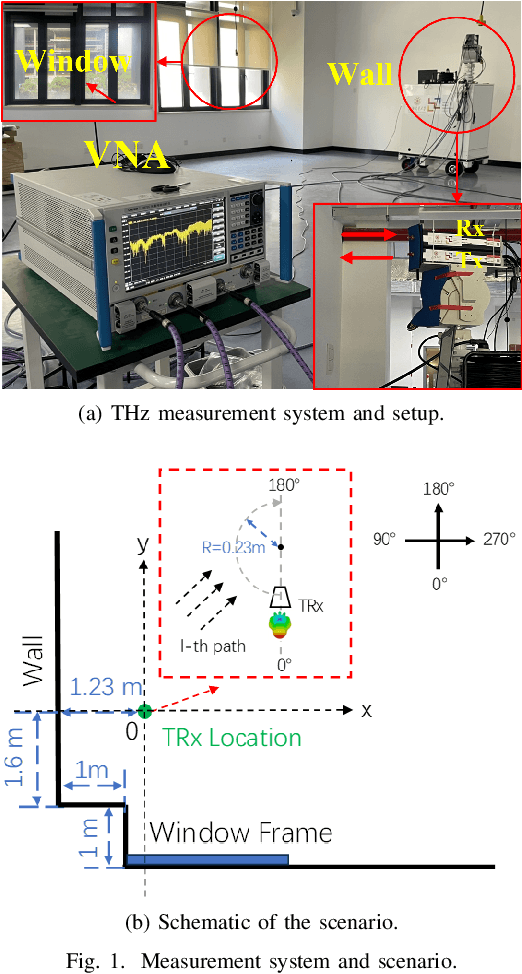
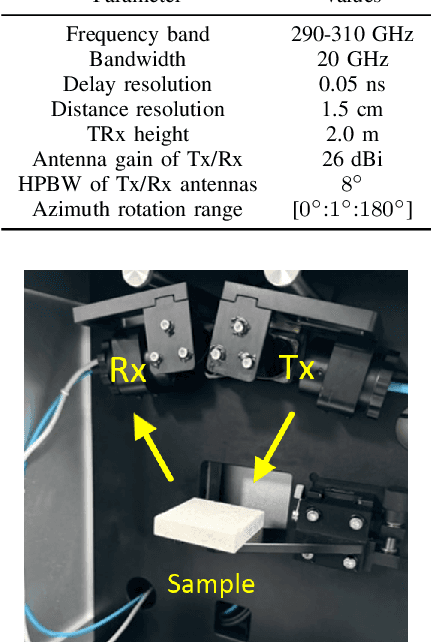
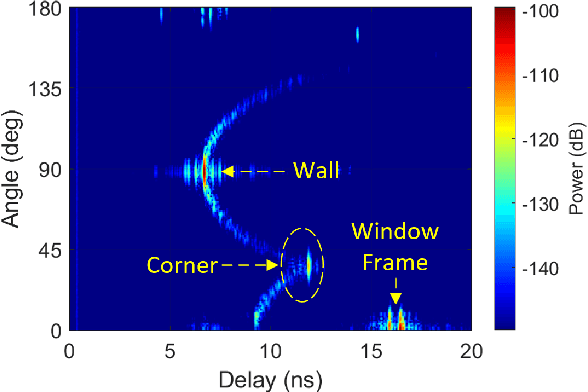
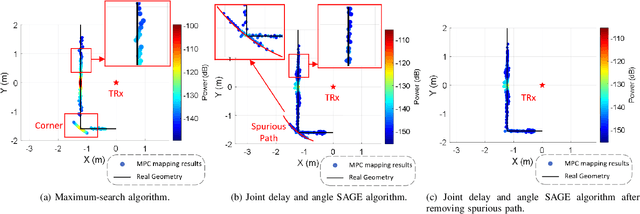
Terahertz (THz) integrated sensing and communication (ISAC) technology is envisioned to achieve high communication performance alongside advanced sensing abilities. For various applications of ISAC, accurate environment reconstruction including geometry reconstruction and material identification is critical. This paper presents a highly precise geometry reconstruction algorithm and material identification scheme for a monostatic sensing case in a typical indoor scenario. Experiments are conducted in the frequency range from 290 GHz to 310 GHz using a vector network analyzer (VNA)-based channel sounder by co-locating the transmitter and receiver. A joint delay and angle space-alternating generalized expectation-maximization (SAGE)-based algorithm is implemented to estimate multipath component (MPC) parameters and the indoor geometry is reconstructed based on the extracted parameters. Furthermore, a geometry-based method is employed to model and remove the spurious path of the corner, reaching an accuracy of 1.75 cm. Additionally, a material database using THz time-domain spectroscopy (THz-TDS) is established, capturing reflection losses of over 200 common material samples. Applying this database to our monostatic sensing, the measured reflection losses of wall and window frame are accurately identified as cement and steel, respectively. Our results demonstrate the centimeter-level geometry reconstruction and accurate material identification for practical THz ISAC scenarios, which unleash unprecedented sensing potential compared to microwave and millimeter-wave bands.