 Add to Chrome
 Add to Firefox
 Add to Edge
Extractive summarization on a CMOS Ising machine
Jan 16, 2026
Extractive summarization (ES) aims to generate a concise summary by selecting a subset of sentences from a document while maximizing relevance and minimizing redundancy. Although modern ES systems achieve high accuracy using powerful neural models, their deployment typically relies on CPU or GPU infrastructures that are energy-intensive and poorly suited for real-time inference in resource-constrained environments. In this work, we explore the feasibility of implementing McDonald-style extractive summarization on a low-power CMOS coupled oscillator-based Ising machine (COBI) that supports integer-valued, all-to-all spin couplings. We first propose a hardware-aware Ising formulation that reduces the scale imbalance between local fields and coupling terms, thereby improving robustness to coefficient quantization: this method can be applied to any problem formulation that requires k of n variables to be chosen. We then develop a complete ES pipeline including (i) stochastic rounding and iterative refinement to compensate for precision loss, and (ii) a decomposition strategy that partitions a large ES problem into smaller Ising subproblems that can be efficiently solved on COBI and later combined. Experimental results on the CNN/DailyMail dataset show that our pipeline can produce high-quality summaries using only integer-coupled Ising hardware with limited precision. COBI achieves 3-4.5x runtime speedups compared to a brute-force method, which is comparable to software Tabu search, and two to three orders of magnitude reductions in energy, while maintaining competitive summary quality. These results highlight the potential of deploying CMOS Ising solvers for real-time, low-energy text summarization on edge devices.

An Open-Source ML-Based Full-Stack Optimization Framework for Machine Learning Accelerators
Aug 23, 2023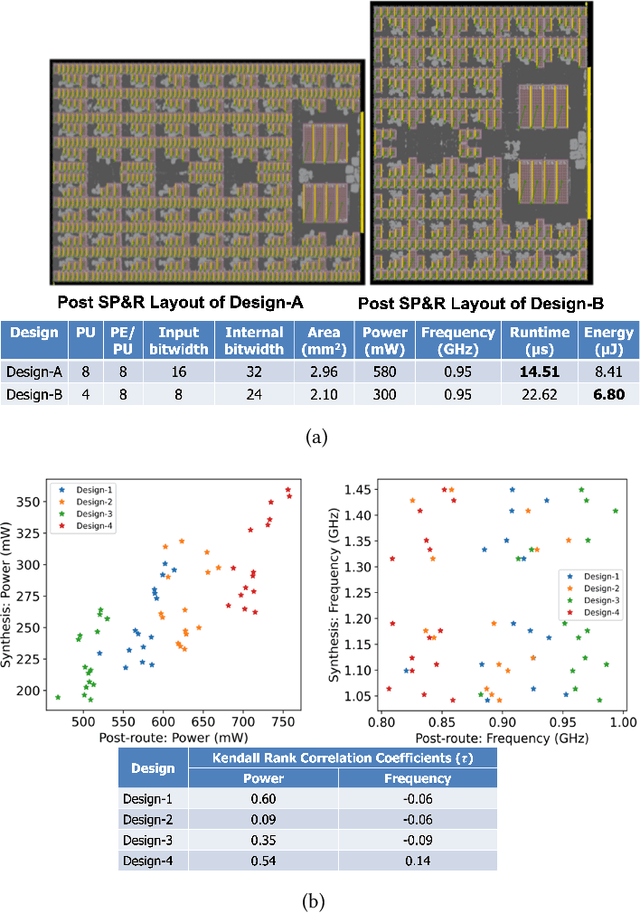
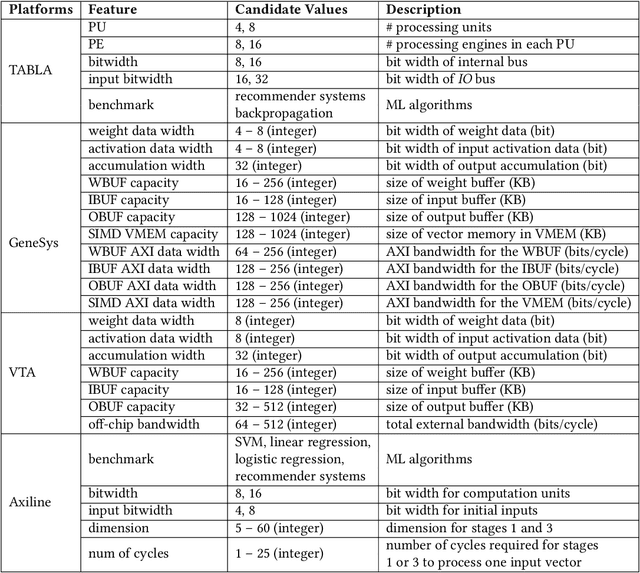
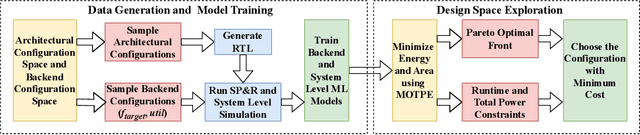
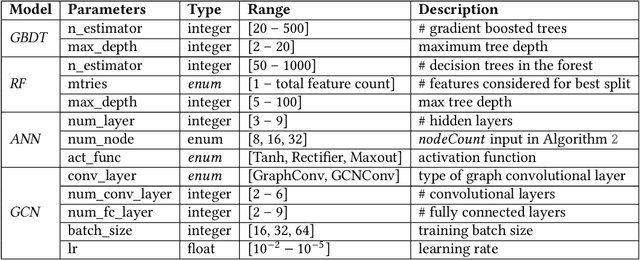
Parameterizable machine learning (ML) accelerators are the product of recent breakthroughs in ML. To fully enable their design space exploration (DSE), we propose a physical-design-driven, learning-based prediction framework for hardware-accelerated deep neural network (DNN) and non-DNN ML algorithms. It adopts a unified approach that combines backend power, performance, and area (PPA) analysis with frontend performance simulation, thereby achieving a realistic estimation of both backend PPA and system metrics such as runtime and energy. In addition, our framework includes a fully automated DSE technique, which optimizes backend and system metrics through an automated search of architectural and backend parameters. Experimental studies show that our approach consistently predicts backend PPA and system metrics with an average 7% or less prediction error for the ASIC implementation of two deep learning accelerator platforms, VTA and VeriGOOD-ML, in both a commercial 12 nm process and a research-oriented 45 nm process.