 Add to Chrome
 Add to Firefox
 Add to Edge
FGFRFT: Fast Graph Fractional FourierTransform via Fourier Series Approximation
Feb 24, 2026
The graph fractional Fourier transform (GFRFT) generalizes the graph Fourier transform (GFT) but suffers from a significant computational bottleneck: determining the optimal transform order requires expensive eigendecomposition and matrix multiplication, leading to $O(N^3)$ complexity. To address this issue, we propose a fast GFRFT (FGFRFT) algorithm for unitary GFT matrices based on Fourier series approximation and an efficient caching strategy. FGFRFT reduces the complexity of generating transform matrices to $O(2LN^2)$ while preserving differentiability, thereby enabling adaptive order learning. We validate the algorithm through theoretical analysis, approximation accuracy tests, and order learning experiments. Furthermore, we demonstrate its practical efficacy for image and point cloud denoising and present the fractional specformer, which integrates the FGFRFT into the specformer architecture. This integration enables the model to overcome the limitations of a fixed GFT basis and learn optimal fractional orders for complex data. Experimental results confirm that the proposed algorithm significantly accelerates computation and achieves superior performance compared with the GFRFT.

JFRFFNet: A Data-Model Co-Driven Graph Signal Denoising Model with Partial Prior Information
Sep 11, 2025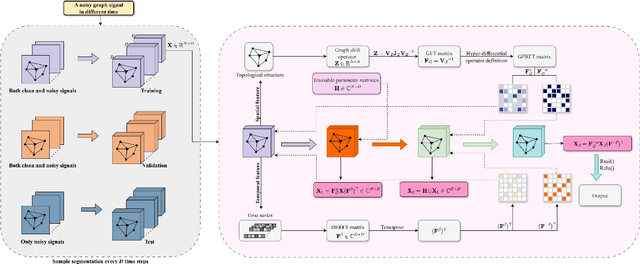
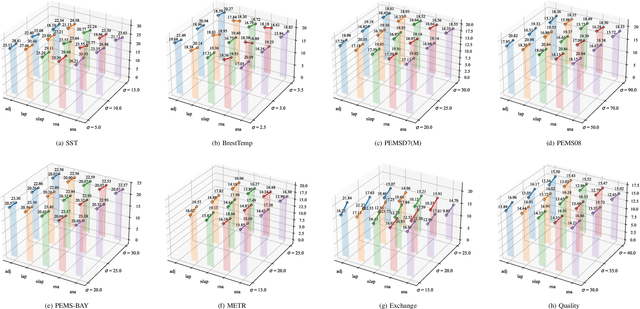
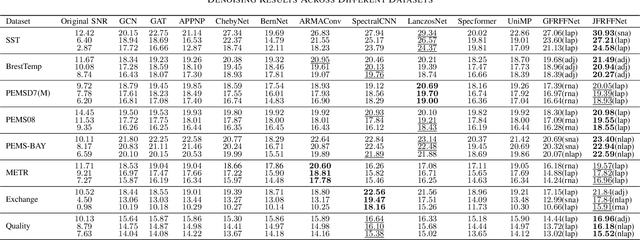
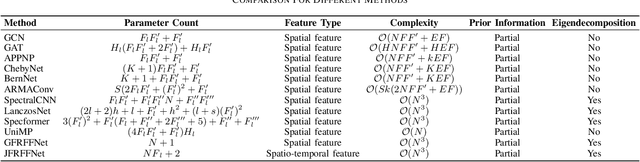
Wiener filtering in the joint time-vertex fractional Fourier transform (JFRFT) domain has shown high effectiveness in denoising time-varying graph signals. Traditional filtering models use grid search to determine the transform-order pair and compute filter coefficients, while learnable ones employ gradient-descent strategies to optimize them; both require complete prior information of graph signals. To overcome this shortcoming, this letter proposes a data-model co-driven denoising approach, termed neural-network-aided joint time-vertex fractional Fourier filtering (JFRFFNet), which embeds the JFRFT-domain Wiener filter model into a neural network and updates the transform-order pair and filter coefficients through a data-driven approach. This design enables effective denoising using only partial prior information. Experiments demonstrate that JFRFFNet achieves significant improvements in output signal-to-noise ratio compared with some state-of-the-art methods.