 Add to Chrome
 Add to Firefox
 Add to Edge
Large-Language-Model Discovery of Quantum LDPC Codes through Structured Concept Evolution
Jun 23, 2026
Quantum computers could outperform classical machines on important problems, but only if the errors that pervade quantum hardware can be corrected at scale. Quantum low-density parity-check (qLDPC) codes offer a promising route to this goal by combining sparse parity checks with finite encoding rate and growing distance, but their construction remains a challenging discrete design problem. Here we introduce structured concept evolution (SCE), a search framework that pairs a large language model with a structured algebraic mutation grammar to discover lifted-product code families, a class of CSS qLDPC codes. Instead of asking the LLM to design codes from first principles, SCE evolves structured concepts consisting of algebraic specifications paired with executable programs that realize them, using hierarchical mutations that modify the group algebra, protograph geometry, or base space. Running SCE, we discover a diverse set of competitive code families, ranging from abelian constructions to families over non-abelian groups beyond those underlying standard designs such as bivariate-bicycle codes, and characterize them under code-capacity depolarizing noise with BP+OSD decoding. These results are obtained with lightweight models (GPT-5.4-mini and GPT-5.4-nano).

Quantum Capsule Networks
Jan 05, 2022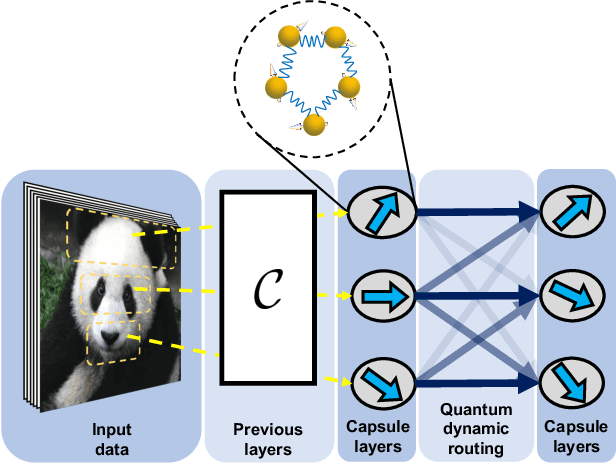
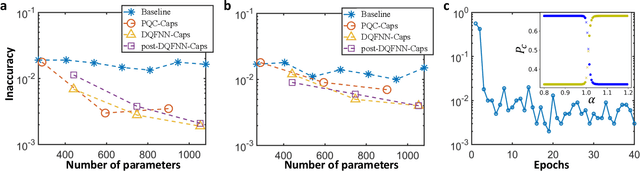
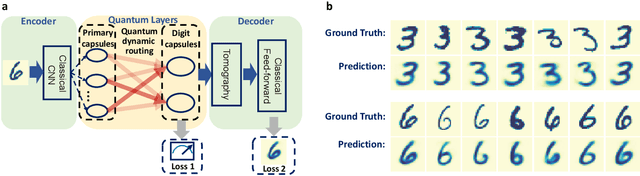
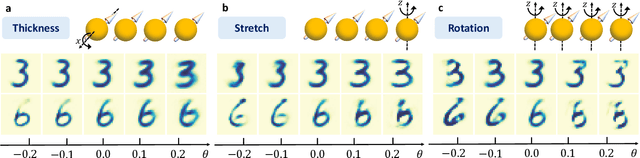
Capsule networks, which incorporate the paradigms of connectionism and symbolism, have brought fresh insights into artificial intelligence. The capsule, as the building block of capsule networks, is a group of neurons represented by a vector to encode different features of an entity. The information is extracted hierarchically through capsule layers via routing algorithms. Here, we introduce a quantum capsule network (dubbed QCapsNet) together with a quantum dynamic routing algorithm. Our model enjoys an exponential speedup in the dynamic routing process and exhibits an enhanced representation power. To benchmark the performance of the QCapsNet, we carry out extensive numerical simulations on the classification of handwritten digits and symmetry-protected topological phases, and show that the QCapsNet can achieve the state-of-the-art accuracy and outperforms conventional quantum classifiers evidently. We further unpack the output capsule state and find that a particular subspace may correspond to a human-understandable feature of the input data, which indicates the potential explainability of such networks. Our work reveals an intriguing prospect of quantum capsule networks in quantum machine learning, which may provide a valuable guide towards explainable quantum artificial intelligence.