 Add to Chrome
 Add to Firefox
 Add to Edge
Beyond Benchmarks of IUGC: Rethinking Requirements of Deep Learning Methods for Intrapartum Ultrasound Biometry from Fetal Ultrasound Videos
Feb 13, 2026
A substantial proportion (45\%) of maternal deaths, neonatal deaths, and stillbirths occur during the intrapartum phase, with a particularly high burden in low- and middle-income countries. Intrapartum biometry plays a critical role in monitoring labor progression; however, the routine use of ultrasound in resource-limited settings is hindered by a shortage of trained sonographers. To address this challenge, the Intrapartum Ultrasound Grand Challenge (IUGC), co-hosted with MICCAI 2024, was launched. The IUGC introduces a clinically oriented multi-task automatic measurement framework that integrates standard plane classification, fetal head-pubic symphysis segmentation, and biometry, enabling algorithms to exploit complementary task information for more accurate estimation. Furthermore, the challenge releases the largest multi-center intrapartum ultrasound video dataset to date, comprising 774 videos (68,106 frames) collected from three hospitals, providing a robust foundation for model training and evaluation. In this study, we present a comprehensive overview of the challenge design, review the submissions from eight participating teams, and analyze their methods from five perspectives: preprocessing, data augmentation, learning strategy, model architecture, and post-processing. In addition, we perform a systematic analysis of the benchmark results to identify key bottlenecks, explore potential solutions, and highlight open challenges for future research. Although encouraging performance has been achieved, our findings indicate that the field remains at an early stage, and further in-depth investigation is required before large-scale clinical deployment. All benchmark solutions and the complete dataset have been publicly released to facilitate reproducible research and promote continued advances in automatic intrapartum ultrasound biometry.

Robust Decentralized Multi-armed Bandits: From Corruption-Resilience to Byzantine-Resilience
Nov 13, 2025Decentralized cooperative multi-agent multi-armed bandits (DeCMA2B) considers how multiple agents collaborate in a decentralized multi-armed bandit setting. Though this problem has been extensively studied in previous work, most existing methods remain susceptible to various adversarial attacks. In this paper, we first study DeCMA2B with adversarial corruption, where an adversary can corrupt reward observations of all agents with a limited corruption budget. We propose a robust algorithm, called DeMABAR, which ensures that each agent's individual regret suffers only an additive term proportional to the corruption budget. Then we consider a more realistic scenario where the adversary can only attack a small number of agents. Our theoretical analysis shows that the DeMABAR algorithm can also almost completely eliminate the influence of adversarial attacks and is inherently robust in the Byzantine setting, where an unknown fraction of the agents can be Byzantine, i.e., may arbitrarily select arms and communicate wrong information. We also conduct numerical experiments to illustrate the robustness and effectiveness of the proposed method.
A Near-optimal, Scalable and Corruption-tolerant Framework for Stochastic Bandits: From Single-Agent to Multi-Agent and Beyond
Feb 11, 2025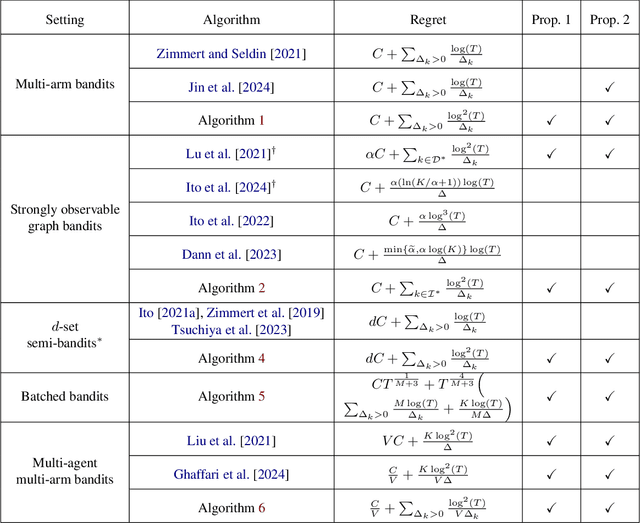
We investigate various stochastic bandit problems in the presence of adversarial corruption. A seminal contribution to this area is the BARBAR~\citep{gupta2019better} algorithm, which is both simple and efficient, tolerating significant levels of corruption with nearly no degradation in performance. However, its regret upper bound exhibits a complexity of $O(KC)$, while the lower bound is $\Omega(C)$. In this paper, we enhance the BARBAR algorithm by proposing a novel framework called BARBAT, which eliminates the factor of $K$ and achieves an optimal regret bound up to a logarithmic factor. We also demonstrate how BARBAT can be extended to various settings, including graph bandits, combinatorial semi-bandits, batched bandits and multi-agent bandits. In comparison to the Follow-The-Regularized-Leader (FTRL) family of methods, which provide a best-of-both-worlds guarantee, our approach is more efficient and parallelizable. Notably, FTRL-based methods face challenges in scaling to batched and multi-agent settings.