 Add to Chrome
 Add to Firefox
 Add to Edge
Linking Modality Isolation in Heterogeneous Collaborative Perception
Feb 28, 2026
Collaborative perception leverages data exchange among multiple agents to enhance overall perception capabilities. However, heterogeneity across agents introduces domain gaps that hinder collaboration, and this is further exacerbated by an underexplored issue: modality isolation. It arises when multiple agents with different modalities never co-occur in any training data frame, enlarging cross-modal domain gaps. Existing alignment methods rely on supervision from spatially overlapping observations, thus fail to handle modality isolation. To address this challenge, we propose CodeAlign, the first efficient, co-occurrence-free alignment framework that smoothly aligns modalities via cross-modal feature-code-feature(FCF) translation. The key idea is to explicitly identify the representation consistency through codebook, and directly learn mappings between modality-specific feature spaces, thereby eliminating the need for spatial correspondence. Codebooks regularize feature spaces into code spaces, providing compact yet expressive representations. With a prepared code space for each modality, CodeAlign learns FCF translations that map features to the corresponding codes of other modalities, which are then decoded back into features in the target code space, enabling effective alignment. Experiments show that, when integrating three modalities, CodeAlign requires only 8% of the training parameters of prior alignment methods, reduces communication load by 1024x, and achieves state-of-the-art perception performance on both OPV2V and DAIR-V2X dataset. Code will be released on https://github.com/cxliu0314/CodeAlign.

RoCo-Sim: Enhancing Roadside Collaborative Perception through Foreground Simulation
Mar 13, 2025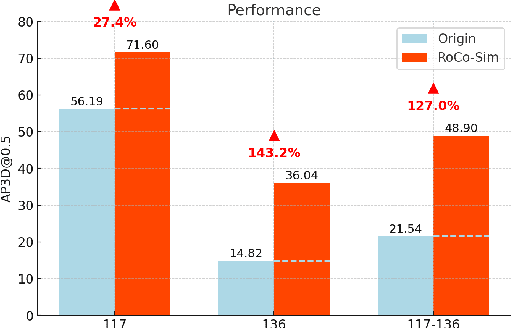
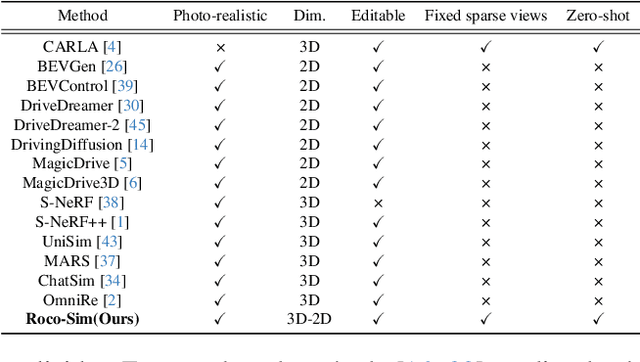
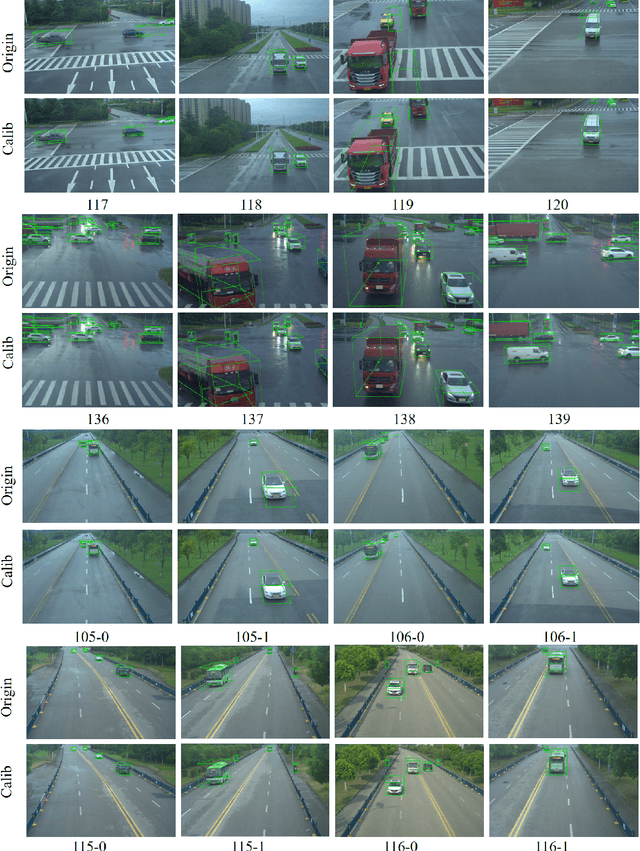
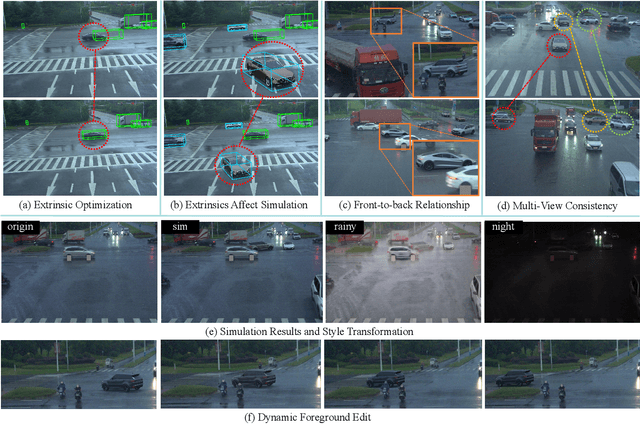
Roadside Collaborative Perception refers to a system where multiple roadside units collaborate to pool their perceptual data, assisting vehicles in enhancing their environmental awareness. Existing roadside perception methods concentrate on model design but overlook data issues like calibration errors, sparse information, and multi-view consistency, leading to poor performance on recent published datasets. To significantly enhance roadside collaborative perception and address critical data issues, we present the first simulation framework RoCo-Sim for road-side collaborative perception. RoCo-Sim is capable of generating diverse, multi-view consistent simulated roadside data through dynamic foreground editing and full-scene style transfer of a single image. RoCo-Sim consists of four components: (1) Camera Extrinsic Optimization ensures accurate 3D to 2D projection for roadside cameras; (2) A novel Multi-View Occlusion-Aware Sampler (MOAS) determines the placement of diverse digital assets within 3D space; (3) DepthSAM innovatively models foreground-background relationships from single-frame fixed-view images, ensuring multi-view consistency of foreground; and (4) Scalable Post-Processing Toolkit generates more realistic and enriched scenes through style transfer and other enhancements. RoCo-Sim significantly improves roadside 3D object detection, outperforming SOTA methods by 83.74 on Rcooper-Intersection and 83.12 on TUMTraf-V2X for AP70. RoCo-Sim fills a critical gap in roadside perception simulation. Code and pre-trained models will be released soon: https://github.com/duyuwen-duen/RoCo-Sim