 Add to Chrome
 Add to Firefox
 Add to Edge
Neural Voxel Dynamics: Learning Implicit 3D Physics via Volumetric Feature Advection
Jun 24, 2026
We present a self-supervised framework for learning implicit 3D physical dynamics directly from video-derived supervisory signals. While current generative video models achieve high visual fidelity, they lack a 3D geometric foundation, often resulting in physical inconsistencies and a failure to maintain object permanence. We address this by shifting the predictive bottleneck from 2D image space to a `lifted' 3D Volumetric Latent Space. Our method unprojects semantic features from a Video Joint-Embedding Predictive Architecture (V-JEPA) into a voxelized grid, grounded by monocular depth priors. This lifting enables a Volumetric Feature Advection to learn an action-conditioned transition operator that treats physics as a spatio-temporal state advection problem, i.e., learn implicit 3D physics. Unlike state-of-the-art hybrid models that rely on explicit classical simulators for training and/or inference, our architecture tracks material states implicitly within high-dimensional V-JEPA features. This allows for the emergent simulation of heterogeneous phenomena (e.g., rigid body motion in fluid flow) within a single, unified pipeline. Supervised solely via end-to-end video-derived signal plus action conditions, without access to physics engine internal states, labels, or surrogate models, our model demonstrates good long-term structural stability and physical plausibility on multiple benchmarks (CLEVERER, PhysInOne, PhysGaia). We believe that this work opens a scalable pathway toward general-purpose dynamic world models that internalize the 3D invariants of the physical world solely through passive observation of monocular videos.

Learning to Solve PDEs on Neural Shape Representations
Dec 24, 2025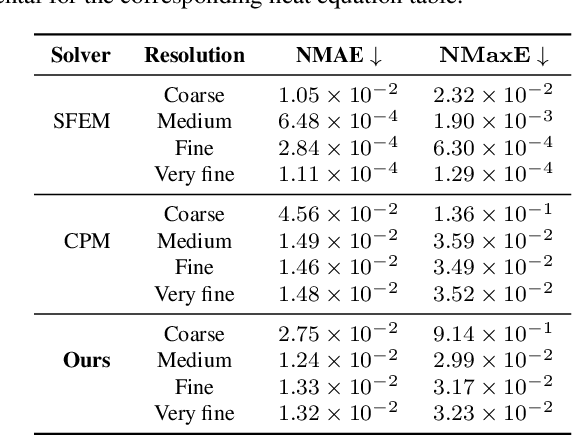
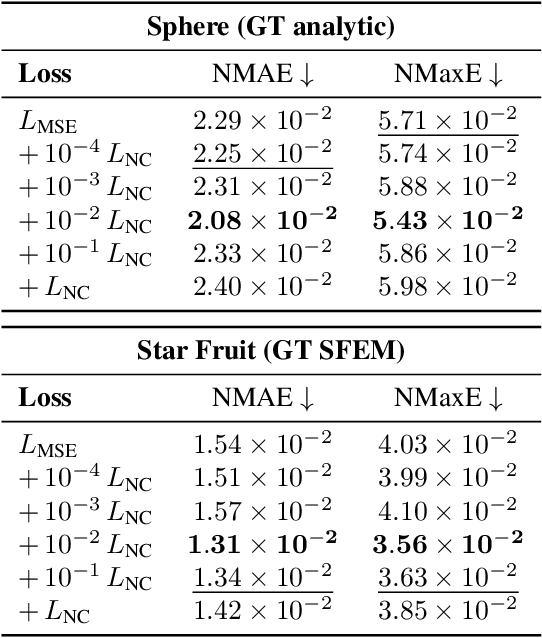
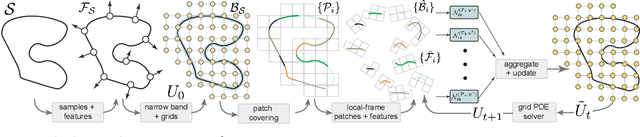
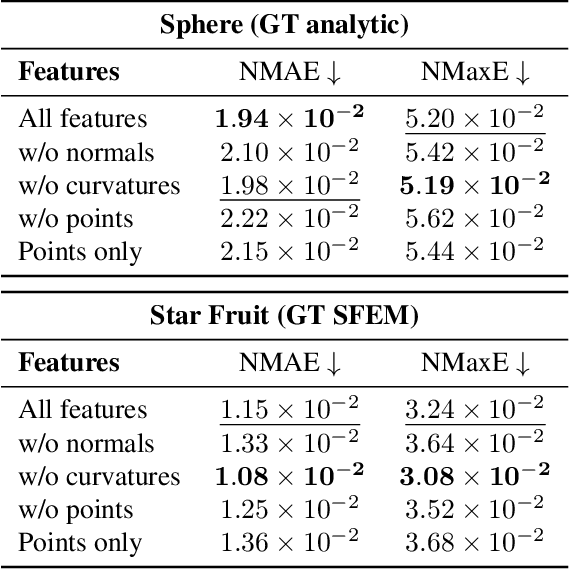
Solving partial differential equations (PDEs) on shapes underpins many shape analysis and engineering tasks; yet, prevailing PDE solvers operate on polygonal/triangle meshes while modern 3D assets increasingly live as neural representations. This mismatch leaves no suitable method to solve surface PDEs directly within the neural domain, forcing explicit mesh extraction or per-instance residual training, preventing end-to-end workflows. We present a novel, mesh-free formulation that learns a local update operator conditioned on neural (local) shape attributes, enabling surface PDEs to be solved directly where the (neural) data lives. The operator integrates naturally with prevalent neural surface representations, is trained once on a single representative shape, and generalizes across shape and topology variations, enabling accurate, fast inference without explicit meshing or per-instance optimization while preserving differentiability. Across analytic benchmarks (heat equation and Poisson solve on sphere) and real neural assets across different representations, our method slightly outperforms CPM while remaining reasonably close to FEM, and, to our knowledge, delivers the first end-to-end pipeline that solves surface PDEs on both neural and classical surface representations. Code will be released on acceptance.
SCREENER: A general framework for task-specific experiment design in quantitative MRI
Aug 06, 2024Quantitative magnetic resonance imaging (qMRI) is increasingly investigated for use in a variety of clinical tasks from diagnosis, through staging, to treatment monitoring. However, experiment design in qMRI, the identification of the optimal acquisition protocols, has been focused on obtaining the most precise parameter estimations, with no regard for the specific requirements of downstream tasks. Here we propose SCREENER: A general framework for task-specific experiment design in quantitative MRI. SCREENER incorporates a task-specific objective and seeks the optimal protocol with a deep-reinforcement-learning (DRL) based optimization strategy. To illustrate this framework, we employ a task of classifying the inflammation status of bone marrow using diffusion MRI data with intravoxel incoherent motion (IVIM) modelling. Results demonstrate SCREENER outperforms previous ad hoc and optimized protocols under clinical signal-to-noise ratio (SNR) conditions, achieving significant improvement, both in binary classification tasks, e.g. from 67% to 89%, and in a multi-class classification task, from 46% to 59%. Additionally, we show this improvement is robust to the SNR. Lastly, we demonstrate the advantage of DRL-based optimization strategy, enabling zero-shot discovery of near-optimal protocols for a range of SNRs not used in training. In conclusion, SCREENER has the potential to enable wider uptake of qMRI in the clinic.